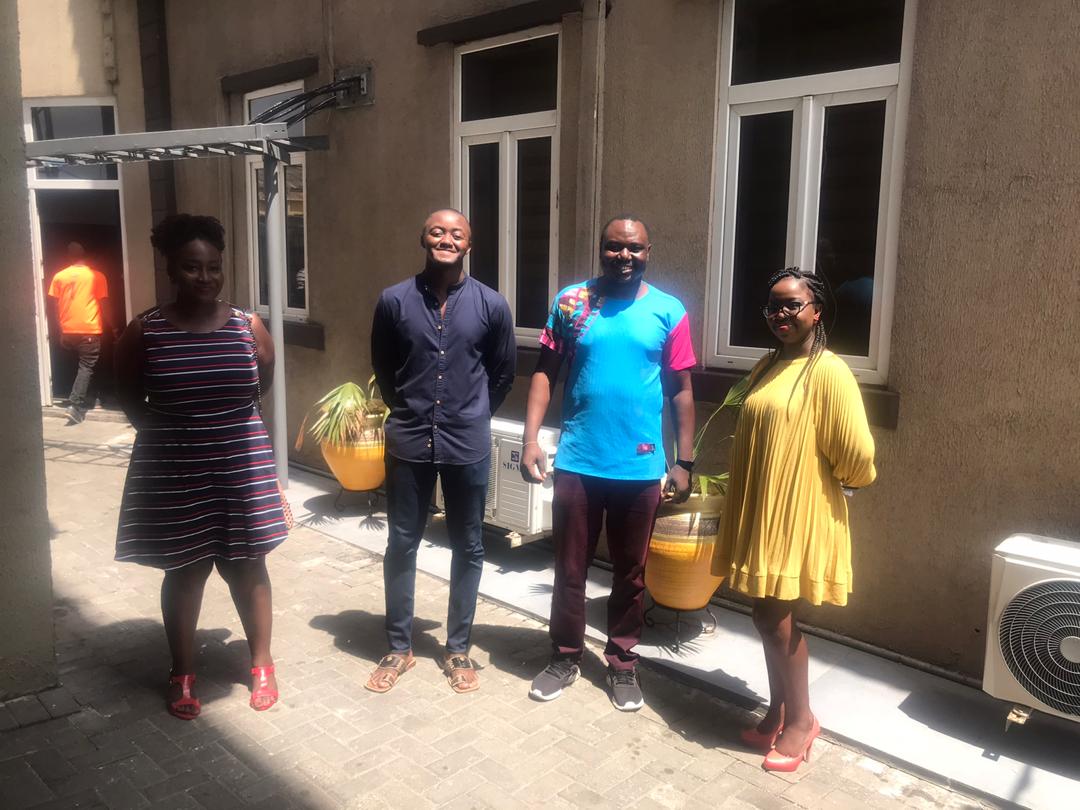
OccupyGhana® Expresses Regret At Special Prosecutor’s Resignation.

17th NOVEMBER 2020

OCCUPYGHANA® PRESS STATEMENT

OCCUPYGHANA® EXPRESSES REGRET AT SPECIAL PROSECUTOR’S RESIGNATION.

OccupyGhana®️ has read with considerable disquiet the letter from Mr Martin Amidu dated 16th November 2020, resigning from office as the Special Prosecutor, the Chief of Staff’s letter dated 17th November 2020 which accepted the resignation, and the letter from the President’s Executive Secretary responding to facts in the said resignation letter.

OccupyGhana®️ and several Ghanaians were excited about the decision of the government to appoint a Special Prosecutor essentially to prosecute corruption and corruption-related offences in Ghana. Parliament had our full support when it passed the OFFICE OF THE SPECIAL PROSECUTOR ACT, 2017 (ACT 959). We were happy when Mr Martin Amidu, based on his impeccable credentials, was nominated, vetted and appointed to the position, and we have keenly followed developments relating to the office after he was appointed.

OccupyGhana®️ has always believed that of all the provisions in the OSP Act, probably the most important is section 4(1) which guarantees the independence of the office in the following words:

“Except as otherwise provided in the Constitution, THE OFFICE IS NOT SUBJECT TO THE DIRECTION OR CONTROL OF A PERSON OR AN AUTHORITY in the performance of the functions of the Office” [emphasis ours.]

We believe that the grant and assertion of this independence is at the foundation of the entire Special Prosecutor experiment. It is in similar words that the Constitution guarantees the independence of the Judiciary and other Constitutionally-Established Independent Bodies such as the Auditor-General and Electoral Commission. It is our firm belief that those words vest in those relevant bodies political, financial and administrative independence from government and any other person or authority. This is what led us to successfully apply to be allowed to file an Amicus Brief in the pending case of ISAAC WILBERFORCE MENSAH V AUDITOR-GENERAL & 2 OTHERS (SUIT NO J1/2/2019). We await the final judgment of the Supreme Court on that matter.

Outside the Constitution, we note that Parliament has recognised that such independence is a critical attribute for certain national institutions. It has therefore deployed the same words in several statutes to grant independence to critical institutions and entities such as Commissions of Inquiry, Bank of Ghana, Public Utilities Regulatory Commission, National Petroleum Authority, National Peace Council, Legal Aid Commission, Witness Protection Commission, and the recently established Right to Information Commission. The OSP is part of this list of entities.

And the meaning of those words are not in doubt. In October 1992, which was even before this Constitution came into force, the High Court held in BILSON V RAWLINGS [1993-94] 2 GLR 413 that those words “explicitly give complete independence from government.”

However, while the Constitution or statute may “give complete independence from government,” we expect that the persons appointed to those offices would also assert that independence whenever it is challenged. Without that, the legal provisions that grant independence would be meaningless, the offices would be surrendered to government control, and Ghana would be the ultimate loser for it.

Having perused Mr Martin Amidu’s letter, we believe that the main challenge had to do with his interaction with the Executive on his most recent corruption risk assessment report. Without commenting on the merits or otherwise of the matters in disagreement, we believe that Executive push back is to be expected in the work on all constitutional or statutory independent bodies. When it becomes an attempt to creep on turf, we believe the best option is to call the bluff of the Executive, assert the independence, stick to one’s guns and proceed with one’s mandate. If we do not do this then we have surrendered that precious independence, back to the Executive.

OccupyGhana®️ restates its support for the OSP and its independence from every other person or authority. The purpose behind all of these independent institutions under the law is to preclude the exercise of arbitrary power. We expect there to be friction. Inherent in that inevitable friction is the expectation that each office holder would hold their ground so that in the healthy equilibrium of tension, Ghanaians would be protected from undue governmental authority.

That is why we are disappointed in both the resignation and its subsequent acceptance, which make it impossible for the decisions to be rescinded.

In the Service of God & Country

OccupyGhana®

Why We Filed An Amicus Brief In Mensah V Auditor-General & Others

Why We Filed An Amicus Brief In Mensah V Auditor-General & Others

28th OCTOBER 2020

OCCUPYGHANA® PRESS STATEMENT

WHY WE FILED AN AMICUS BRIEF IN MENSAH V AUDITOR-GENERAL & OTHERS

On 25 September 2020, OccupyGhana® applied to the Supreme Court for leave to file an Amicus Curiae Brief in the pending case MENSAH V AUDITOR-GENERAL & OTHERS. On 20 October 2020, the Court heard the application and granted it; and on 26 October 2020, we duly filed the Brief.

Having studied that case, we believe that we can contribute and hopefully assist the Court in resolving the issue surrounding the interpretation of article 187(7)(a) of the Constitution. Specifically: is the plaintiff right when he asserts that words ‘in the performance of his functions under this Constitution or any other law the Auditor-General… shall not be subject to the direction or control of any other person or authority,’ are ‘circumscribed…and restricted to the actual exercise or execution of his auditing work and activities necessarily incidental to the performance of that function’?

Thus, we respectfully urged the Court to seize the opportunity presented by the case, and finally pronounce on the meaning and extent of those words as they are used throughout the Constitution, not only with respect to the Auditor-General, but to the Judiciary itself (article 127), the Electoral Commission (article 46), the National Media Commission (article 172), the Public Services Commission (article 198), the Commission on Human Rights and Administrative Justice (article 225), the National Commission on Civil Education (article 234) and the Lands Commission (article 265).

We traced the constitutional evolution of the independence of the Judiciary and the Auditor-General from the 1954 Gold Coast Constitution, through the 1957 Independence Constitution, 1960 First Republican Constitution, the 1969 Second Republican Constitution, the 1972 National Redemption Council Establishment Proclamation, the 1979 Third Republican Constitution, to the 1992 Fourth Republican Constitution. We also reviewed the relevant and revealing proposals on the Auditor-General in the Reports of the 1956, 1968, 1978 and 1992 Constitutional Commissions and relevant judicial decisions.

On these bases, the Brief canvassed 3 main points as follows:

  1. That in BROWN V ATTORNEY-GENERAL, the Supreme Court affirmed that constitutionally, the Auditor-General has political and administrative independence and is ‘insulate[d]… against all forms of external pressures,’ and in OCCUPYGHANA V ATTORNEY-GENERAL, that the Auditor-General’s Disallowance and Surcharge Powers ‘have to be on a higher pedestal and given pride of place,’ emphasising the need to respect the Auditor-General’s Independence. Without upholding this Independence (under article 187(7)(a)), the Auditor-General’s Disallowance and Surcharge Powers (under article 187(7)(b)) would be rendered meaningless. In sharp focus is the fact that Ghana is now touted as a worldwide beacon and exemplar in the World Bank’s October 2020 GLOBAL REPORT, titled ‘Enhancing Government Effectiveness and Transparency: The Fight Against Corruption.’ This Report cited with ringing endorsement, (i) the Auditor-General’s Independence, (ii) the Court’s decision in OCCUPYGHANA V ATTORNEY-GENERAL, and (iii) the Judiciary’s designation of courts to hear Disallowance and Surcharge appeals, adding that ‘this achievement inspired other African [countries] to pass similar legislation on disallowances and surcharges.’
  2. That any arrangement that now seeks to make the Auditor-General or any of his functions and powers (auditing or administrative) subject to the Audit Service Board or any other ‘person or authority’ (including the Executive and the Legislature), would completely defeat the letter and spirit of the Constitution, and the expressed basic purpose for which the Audit Service Board was created under the 1969 Constitution and maintained in all subsequent Constitutions. It would send us back to the pre-1969 era, where, as was said in paragraph 592 of the 1968 Constitutional Commission Report, the Auditor-General’s Independence had been ‘only in theory…, usurped through political interference and official control,’ but this time exercised by or through the Audit Service Board, whose members are appointees of the Executive, the primary auditee of the Auditor-General.
  3. That where the Auditor-General (or any other Constitutionally-Established Independent Body) is alleged to have breached the Constitution or constitutionally-compliant law, the Constitution provides that only judicial action can reverse, correct or remedy it. Any attempt by any other ‘person or authority’ to do so would unconstitutionally usurp of the judicial power of state.

As we also stated in the Brief, when judgment in OCCUPYGHANA V ATTORNEY GENERAL was delivered on 14 June 2017, the total loss to Ghana from irregularities detected by the Auditor-General in his report to Parliament on Ministries, Departments and Other Agencies (MDAs) for 2016 was GH¢2,165,542,368.14. That judgment appeared to have had an immediate effect because the total loss to Ghana from irregularities in MDAs dropped to GH¢892,396,375.19 for 2017. Regrettably and alarmingly, this figure has started to climb up. In 2018, total losses from irregularities in MDAs rose to a record GH¢5,196,043,399.94 and dropped to a still unacceptable GH¢3,008,187,888.15 in 2019. It is anyone’s guess where this figure will land in 2020 while the Auditor-General battles to assert the constitutionally donated independence from all other persons or authorities.

We believe that Ghana needs a sufficiently empowered and independent Auditor-General to perform the functions of the office, particularly to issue, enforce and defend required Disallowances and Surcharges, described in OCCUPYGHANA V ATTORNEY-GENERAL as ‘the way forward.’ In filing the Brief, we do not take a position in favour of any of the parties to the action but simply hope to provide a broad view of the potential ramifications of these issues, as a friend of this Court. We also hope that through this Brief, we have contributed what we can in the search and fight for a truly independent Auditor-General who can exercise all his powers and perform his functions (especially Disallowance and Surcharge) without fear or favour, or interference from any quarter.

We anxiously await the Court’s decision. Ghana anxiously awaits the Court’s decision.

In the Service of God & Country

OccupyGhana®

THE ISSUE OF THE LYNCHING OF WITCHES

3rd AUGUST 2020

OCCUPYGHANA® PRESS STATEMENT

THE ISSUE OF THE LYNCHING OF WITCHES

Like most Ghanaians OccupyGhana®’s attention has been drawn to a very disturbing video making the rounds on social media. It shows an elderly woman being assaulted by two women while a crowd watches.

The incident is supposed to have occurred in Kafaba in the East Gonja Municipality of the Savannah region. The victim is alleged to be a 90-year-old woman called Madam Akua Denteh, was accused by a local fetish priestess called Hajia Filina, of being a witch. It appears the prietess was hired by one Sanjo to make this ‘diagnosis.’ The others involved in this crime were persons named Aliu, Bumaye, Ashley and Manafo. The poor victim succumbed to her injuries and her dead body was later found where she was lynched.

This rather heart-breaking and barbaric act is but one of many such lynching incidents that plague the Ghanaian society. Victims of lynchings are not only suspected criminals but also often elderly women accused of being witches.

Mob justice in itself is terrible. Unfortunately, it is a rather dark side of our country’s history and does not seem to want to go away. It is unconstitutional, barbaric, unjust, unfair and criminal, and often has fatal consequences.

The fact that in this day and age, there are Ghanaians who still believe in the superstion that witches exert an enormous deleterious influence on life and the punishment for this alleged pernicious activity which should be death by lynching, is unbelievable. It hints at how deep the belief in erroneous, dangerous and arcane customs are and how much these beliefs influence life in the country.

That a crowd watched as a helpless 90-year-old woman was lynched shows the degree of acceptance of this inhuman practice in the society.

That this occurrence is not uncommon is rather sad. If one does a Google search with the words ‘witch’ and ‘Ghana,’ the stories and reports that pop up should make each Ghanaian hang their head in collective shame. It is not a coincidence that about 235 km due northwest from Kafaba is a ‘Witch Camp.’ In the town of Gushegu, the Missionary Sisters of the Poorest of the Poor run a camp for poor women who were accused of witchcraft, beaten, and cast out. These are the lucky ones who did not succumb to the assaults and this camp is their haven now.

Not only elderly women get accused but younger women and even children fall victim to this practice. According to a 2018 Human Rights Report by the US States Department, there are more than six witch camps spread throughout the northern regions of Ghana. These camps are said to hold about 2,000-2,500 adult women and 1,000-1,200 children and the numbers could be larger.

Article 15 of the Constitution demands respect for the dignity of all persons, and clearly states:

‘1.      The dignity of all persons shall be inviolable.

  1. No person shall, whether or not he is arrested, restricted or retained, be subjected to
  2. torture or other cruel, inhuman or degrading treatment or punishment;
  3. any other condition that detracts or is likely to detract from his dignity and worth as a human being.’

In spite of these constitutional rights, any fetish priest or priestess can get women and children assaulted and even killed with the simple yet dangerous designation of ‘Witch.’

This video has incited the usual uproar and the Police has even publicized a letter about the investigation. The President has spoken about it. We understand that some arrests have been made. We commend the police on being on the case. However, soon we will forget about this incident and another poor woman will be accused of being a witch and assaulted, even killed.

Unless there is a move to change this deeply-held belief systems and do away with these superstitions that witches dwell among us and are responsible for most misfortunes, these assaults and lynching of poor women will not stop.

It is our view that what occurred at Kafaba, before the murder happened, was a trial by ordeal, which is a second-degree felony under section 315 or our Criminal Offences Act, 1960 (Act 29). Indeed, each of the persons captured on the video as being present are guilty of the misdemeanour of being present when the crime was taking place, under section 316 of the Act. For not taking any step to prevent the crime, all those persons are guilty of a second misdemeanour under section 22 of the Act.

We therefore call for the arrest everyone who is identified as being present. Faced with the prospect of jail, they are very likely to help identify and track all the perpetrators in the murder.

We further ask that the National Commission for Civic Education (NCCE) step up its efforts to educate the population about superstitions and arcane customs and practices. A program reminding Ghanaians about the need to respect each other’s’ civil and human rights is also direly needed.

We also ask the Gender and Social Protection Ministry to enforce the closure of these so-called ‘Witch Camps’ and allow these poor women and children to re-join society with adequate protections. The Ministry has an obligation to offer vocational training to the occupants of those camps to aid their reintegration.  The Ministry should also embark on an education program aimed at teaching people in at-risk areas that witchcraft is a superstition for which no one should die.

We ask all TV and radio stations to dedicate time each day to exhorting against mob justice and the assaulting and lynching of women accused of being witches.

With these actions, we hope we can take a step closer to a Ghana, where civil and human rights are respected, and the lynching of witches becomes a thing of the past

In the Service of God & Country

OccupyGhana®

OCUPYGHANA TO ATTORNEY GENERAL: REQUEST FOR BILL TO CRIMINALISE VOTE-BUYING AT INTERNAL PARTY ELECTIONS AND PRIMARIES

27th July 2020

The Attorney-General & Minister of Justice
Attorney-General’s Department
Accra

Dear Madam:

REQUEST FOR BILL TO CRIMINALISE VOTE-BUYING AT INTERNAL PARTY ELECTIONS AND PRIMARIES

OccupyGhana® is convinced that it is time to bring to an end, the pervasive phenomenon of vote-buying at internal party elections to elect party officers and party primaries to elect candidates for general elections. To this end, we write to respectfully invite you to consider preparing and then sending a bill to Parliament that criminalises such vote-buying in the manner that is provided under Part IV, Chapter 5 of the Criminal Offences Act, 1960 (Act 29), Part II of the Referendum Act, 1977 (SMCD 143) and Part V of the Representation of the People Act, 1992 (PNDCL 284).

OccupyGhana® has taken note of the several reports of vote buying at internal political party elections and primaries since the inception of the Fourth Republican Constitution. The phenomenon seems to be getting worse with every election cycle when politicians raise funds simply to distribute to party delegates either in cash or in kind, in exchange for their votes. It has gotten to a stage where it is the highest bidder who wins internal elections and primaries, which have become the ‘cocoa season’ for those fortunate to be selected as delegates.

We are concerned that this is prevalent probably because there appears to be no law that specifically criminalises vote-buying at internal elections and primaries. The provisions against vote-buying and related offences in Act 29, SMCD 143 and PNDCL 284 are specifically targeted at public elections and referenda, and by definition do not extend to internal elections and primaries. For instance, section 3(5) of Act 29 says ‘the expression “public election” shall be construed by reference to article 49 of the Constitution, and includes an election the qualification for voting at which, or the mode of voting at which, is determined or regulated by an enactment.’ Section 50 of PNDCL 284 simply says ‘“election” means any public election.’ Even section 11 of the more recent Vigilantism and Related Offences Act, 2019 (Act 999) defines ‘public election’ by reference to ‘general, presidential and district level elections and referenda conducted or supervised by the Electoral Commission.’

Although it is arguable that the definition in Act 999 may apply to internal elections and primaries because they are supervised by the Electoral Commission, it does not go far enough. This is because under article 19(11) of the Constitution, an act is not a crime until it is specifically provided as such in written law with a specifically prescribed punishment.

The current lacuna in the law cannot continue. For starters, article 55(5) of the Constitution demands that political parties must be run along democratic lines. Specifically, it says ‘the internal organisation of a political party shall conform to democratic principles and its actions and purposes shall not contravene or be inconsistent with this Constitution or any other law.’ OccupyGhana® believes that there is nothing that is more blatantly undemocratic than the sheer bastardisation of democracy that is the naked buying of votes. It is time for Ghana to make it clear that this will not be tolerated any more in our democratic dispensation.

While we do not think that simply criminalising vote-buying will make people stop doing it, we think that the specific criminalisation will send a clear message to current and future perpetrators that, at the very least, Ghana frowns on those acts and is willing to punish those who engage in them. It will also serve as a clear message that if they are caught, the law will deal with them.

We do not think that Ghana requires any massive legislative amendments to achieve this. We could achieve this by extending the current definition of ‘public elections’ to cover internal elections and primaries, so that the criminalising provisions under Part IV, Chapter 5 of Act 29 and Part V of PNDCL 284 would apply. Alternatively, we may consider a standalone legislation that regulates such internal elections and primaries and criminalises vote-buying among others.

It is on the bases of all the foregoing that we write to respectfully request that you consider preparing the relevant bill on this matter and submit it to Parliament for passage into law.

Yours in the service of God and Country

OccupyGhana®

OCCUPYGHANA® CONDEMNS SHOOTING INCIDENT AT AWUTU SENYA EAST AND CALLS FOR URGENT AND QUICK POLICE INVESTIGATION

21st JULY 2020

OCCUPYGHANA® PRESS STATEMENT

OCCUPYGHANA® CONDEMNS SHOOTING INCIDENT AT AWUTU SENYA EAST AND CALLS FOR URGENT AND QUICK POLICE INVESTIGATION

OccupyGhana® has noted with grave concern, the news reports that the Special Development Initiatives Minister and Awutu Senya East MP, Mrs. Hawa Koomson, allegedly fired a gun at a registration centre in her constituency. We note that the Minister has admitted to this.

OccupyGhana® has had occasion, especially in the wake of the Ayawaso West Wuogon by-election, to condemn the use of violence in our electoral politics, whether by government agents or private persons. The use of force or violence is a crime under our laws, unless there is reasonable justification, and within the strict bounds provided by law. Specifically, it is a crime to fire a weapon ‘in a town without lawful and necessary occasion.’ Possession of a firearm ‘without lawful excuse’ is a first-degree felony. And it is also a crime to have an offensive weapon while in a public place, public meeting, or at a public assembly of people, ‘without lawful authority.

We condemn all election-related violence. We also condemn the inexplicable circumstances under which the Minister took a loaded weapon to the registration centre in the first place, when the Minister has police guard, paid for by the state and whose job is to protect her.

Further, the law that regulates the registration of voters also provides a process for challenging ineligible people who register or attempt to do so. That is what should be followed, if people are breaking the law. No individual has the mandate or power to seek to prevent others from registering simply because that individual believes that the law is being flouted.

In a country governed by the Rule of Law, you do not prevent an alleged breach of the law, by breaching the law yourself. What the Minister did endangered the lives of not only the political actors, but innocent people whose only interest in being at the registration centre, was ostensibly to exercise their constitutional right to be registered and to vote in the coming elections.

We cannot have a registration exercise and then an election where people would feel so threatened that they would either stay at home and not vote at all, or go to the registration or polling stations armed. Ghanaians are already battling the spread of the dreadful coronavirus. This should not be combined with needless threats to our lives and safety.

We call on the police to quickly investigate the circumstances under which this incident occurred. If it is found that the Minister breached the law, she should be prosecuted to the fullest extent possible under the law.

In the Service of God & Country

OccupyGhana®

OCCUPYGHANA® CALLS FOR THE IMMEDIATE RECALL OF THE AUDITOR-GENERAL FROM LEAVE

OCCUPYGHANA® CALLS FOR THE IMMEDIATE RECALL OF THE AUDITOR-GENERAL FROM LEAVE

10TH JULY 2020
OCCUPYGHANA® PRESS STATEMENT
OCCUPYGHANA® CALLS FOR THE IMMEDIATE RECALL OF THE AUDITOR-GENERAL FROM LEAVE

1. OccupyGhana® has observed with great disquiet the circumstances leading to and following the President’s directive to the Auditor-General to proceed on an ‘accumulated leave.’ We find it difficult reconciling that directive with the constitutional injunction under which in the performance of his functions, which necessarily includes the mundane matter of whether, when and how he takes his leave, the Auditor-General is insulated from the ‘direction and control of any person or authority.’

2. While it may be best industrial, governance and management practice for every worker, including the Auditor-General, to take an annual leave, we think the constitutional insulation of that office is clear and leaves no room for any penumbra within which the presidential directive may operate. Even if there was, which we dispute, the circumstances of this matter should have given the Executive a great opportunity for exercising restraint of power and the development of the constitutional check and balances inherent in the creation and protection of independent constitutional bodies. Ours is still a nascent democracy that requires all of us to assist in upholding the independence of constitutionally protected bodies such as the Auditor-General, the Electoral Commission, CHRAJ and the Judiciary. Ghana would be the ultimate loser if presidential power is deployed to micromanage any of these independent constitutional bodies, contrary to the express terms of the Constitution.

3. We also believe that this matter ought to be resolved by the Council of State in a manner that upholds restraint of power and errs on the side of the development of the constitutional check and balances inherent in the creation and protection of the independent constitutional bodies.

Leave Is a Constitutional Right

4. First, leave is a constitutional right, and not a statutory obligation. With respect to the Auditor-General, article 187(12) of the Constitution specifically mentions, recognises and protects ‘his rights in respect of leave of absence.’ These words are repeated verbatim in section 10(7) of the Audit Service Act.

5. The leave entitlement of the Auditor-General is part of the terms and conditions of his office, expected to be provided under article 71 of the Constitution. Under that article, the ‘facilities and privileges’ of the Auditor-General (which definitely includes ‘his rights in respect of leave of absence’) is first recommended by the relevant Article 71 Committee and then determined by the President, acting in accordance with the Council of State’s advice.

6. From our checks, the relevant and applicable Article 71 Committee Report is the Edu-Boandoh Report of August 2016, which was to apply for 2013 to 2017 but has continued in operation because there is no other, current Report. Our review of that document shows that it contains no provision on the Auditor-Generals’ leave entitlement.

7. To compound matters, the whopping 40-day leave provided under the Conditions Of Service For Management Staff of the Audit Service dated 30 July 2008 (extended by the reported practice that adds 4 days of ‘travel time’ to annual leave periods for some public officers) does not apply to the Auditor-General. That document, prepared by the Board of the Audit Service under article 189(3) of the Constitution states expressly as follows:

‘These Conditions of Service…shall apply to the Management Staff of the Audit Service (Deputy Auditors-General, Assistant Auditors-General and Directors) other than the Auditor-General.’

8. In this situation, all that an Auditor-General is assured of, is the minimum 15 days entitlement provided for under section 20 of the Labour Act.

9. Further, and with respect to leave being a right and not an obligation, article 24(2) of the Constitution assures all workers of ‘rest, leisure and reasonable limitation of working hours and periods of holidays with pay, as well as remuneration for public holidays.’ These are assurances, not obligations. Thus, if a worker may voluntarily opt to work beyond the normal ‘limitation of working hours,’ then that worker does nothing wrong in deciding to take less or even no ‘periods of holidays with pay,’ however personally unhealthy that might be.

10. That is why section 31 of the Labour Act cannot be interpreted or applied to convert the constitutional right into its exact opposite, a statutory obligation. Such an interpretation or application is not only unconstitutional, but does violence to the internal harmony of the Labour Act itself, section 20 of which aligns with the position of the superior provisions of the Constitution, that leave is a right.

11. While we may debate the propriety or otherwise of not taking one’s leave entitlement, and also debate the meaning of the outlawing of an ‘agreement’ to relinquish or forgo leave under section 31 of the Labour Act, whichever meaning is applied cannot turn or flip the constitutional right on its head into a statutory obligation.

12. Thus, we respectfully think that the singling out of the Auditor-General and applying leave to him as an obligation is a grave error and a regrettable unconstitutional act.

13. Our worries got even exacerbated when the presidency purported to direct the Auditor-General to also proceed on his 2020, largely unearned leave when 2020 is only about halfway through. While that directive is also unconstitutional by itself, in our view, it also breaches section 20 of the same Labour Act that the presidency relies upon, which speaks of the right to leave being ‘in any calendar year of continuous service.’

14. 2020 is not over and every worker, subject to arrangements with the employer, technically has until the last 15 days of the year (the minimum statutory period of leave) to exercise that right. The presidency’s direction to the Auditor-General to take his 2020 leave literally in the middle of the year, could become a bad precedent that can only harm our constitutional development.

15. We are further alarmed at the purported reliance on some previous direction to another Auditor-General to proceed on accumulated leave. We are convinced that that alleged administrative precedent was illegal and unconstitutional, and that the quiet compliance with, and failure, refusal or neglect of the affected person then to challenge it (reminiscent of the period where successive Auditors-General were too scared to even exercise their constitutional disallowance and surcharge powers), does not convert that illegality and unconstitutionality into a much-desired precedent, worthy of being followed.

16. We are certainly not convinced by the purported reliance on the decision of the Court of Appeal in Adrah v ECG. That decision was simply that an employer could not provide for commuting leave into cash in its Staff Manual and then assert in court that that was illegal. Dzamefe JA characteristically did not mince his words. He said ‘ECG cannot play hot and cold at the same time… It is contradictory. The company’s negligence and mistakes cannot be visited on the innocent employee.’

17. In his detailed concurring opinion, Ofoe JA spent considerable time to analyse and interpret section 31 of the Labour Act and held that what that section did was to deny the worker the right to sell his leave and prevent the employer from buying that leave. However, based on the specific facts of the matter, he held that in equity, it would be unconscionable, grossly unfair, manifestly unjust and fraudulent to allow ECG to rely on this section of the Act. He would not allow ECG to use the law as an engine of fraud and therefore held that it is not every agreement to forgo leave that is void and for which accumulated leave yields no benefits for the worker.

18. Thus, throughout this unanimous decision, the Court was careful to uphold the fact that leave is an entitlement to the worker. For section 31 to apply, it held, there must be an agreement to sell the leave. That is what was outlawed. This case did not provide any general support to compelling any worker to go on so-called accumulated leave.

19. What the case rather establishes is that section 31, on which the entire presidential direction appears to be based, outlaws agreements to sell or purchase leave. Thus, where the worker fails or neglects to take or commence leave in the calendar year the worker loses the leave days and cannot be paid for it, unless the court finds grounds to the contrary.

20. We must also comment on the eye-popping leave entitlement of some public officials. 44 working days of leave, in addition to the 13 days of public holidays, means that for three months in each year, these public official enjoy leisure and rest, while being paid by the tax payer. It is time to begin a national debate on whether it is right at out stage of development when hard work is what is required, for public officials to work for just three-quarters of a year, and to enjoy paid rest for one-quarter of the year.

21. The reality, we know, is that several public officials never took the full leave entitlement. The simply sold it back to us and we paid for it. This is what section 31 seeks to prevent, according to the Court of Appeal in Adrah v ECG.

22. Thus, neither the purported administrative precedent nor purported judicial precedent is applicable or of any relevance to this matter.

23. We should also look beyond the immediate and be concerned about why at least two Auditors-General have been reluctant to take their full leave entitlements, and the role that the Board of the Audit Service plays in all of these matters.

Independence of the Auditor-General

24. The Constitution vests in the Ghanaian presidency, some of the most immense powers in any democracy on earth. The President is the repository and embodiment of executive power and authority, and gets to appoint almost every actor in the public service.

25. But having vested such immense powers in the President, the Constitution puts in place certain checks and balances that, hopefully, would restrain the exercise of those powers and not leave Ghana with the oxymoron or contradiction of a democratic, constitutional dictatorship to replace the dictatorship that we quietly rejected and overthrew when we voted to enact this Constitution at a national referendum held throughout Ghana on the 28 April 1992.

26. One way in which the Constitution checks presidential power is the creation of independent constitutional bodies or offices. Although the President appoints persons to those bodies or offices, the President has and exercises absolutely no power over them after they are appointed. As hard as that may be to accept, the President has no political, executive, administrative, financial or even disciplinary power over those offices.

27. Those bodies or offices are the Electoral Commission, CHRAJ, NCCE, National Media Commission, Public Services Commission, Lands Commission, and of course the Auditor-General. By the use of the radical and mandatory words ‘shall not be subject to the direction or control of any person or authority,’ the Constitution insulates these from being subjected to any other entity, including the Executive and Parliament. The only other body with similar insulation is the Judiciary.

28. Yet the Constitution did not seek to constitute those offices into demi-gods. It therefore subjects them and their operations to the Constitution and the law, by providing specific, limited instances for calling them to order, such as articles 23, 33, 295(8) and 296 of the Constitution.

29. That is why in the 25 June 2020 ruling of the Supreme Court in NDC v AG & EC (Consolidated), the Court felt constrained to refer to and reiterate its 2016 decision in Abu Ramadan & Gary Nimako v EC (No 2), that an independent body such as the EC in the exercise of its functions, ‘cannot be compelled to act in a particular manner unless there is clear evidence that they have acted unconstitutionally,’ and that it was ‘necessary to keep the Court itself within its proper limits in order to give effect to the supremacy of the law.’ We commend this exemplary exercise of restraint of power, to the Executive and Legislature in their dealings with these bodies.

30. This constitutional architecture that restrains even the highest court of the land from giving directions to or exercising control over these bodies, in the absence of any evidence of unconstitutionality, is deliberate. These bodies are expected to counter-balance and check the power of, and stand up to, all other persons or authorities, if need be. Thus our Constitution does recognises not just the traditional three branches of power, but carves out and ring fences another branch, composed by the independent constitutional bodies, essential watchdog bodies, and insulates them from any control. By this, the Constitution anticipates and expects ‘healthy tension’ between these bodies and other persons and authorities, and therefore protects the former from the whims and caprices of the latter, in the expectation that out of that ‘equilibrium of tension,’ (to borrow from Nixon v Sirica) Ghanaians would be protected from oppression.

31. Separation of powers is ‘not to promote efficiency but to preclude the exercise of arbitrary power. The purpose was not to avoid friction, but by means of the inevitable friction incident to the distribution of the governmental powers… to save the people from autocracy’ (Myers v United States.)

32. This is the state of the unique separation within even executive power, meant to hold the otherwise super-powerful executive presidency in check. Thus, although the occupants of the independent office are public officers appointed by the President, the latter shall not direct and control them in any manner whatsoever.

33. Therefore, the argument from the presidency, that article 297(a) subjects these bodies to the President’s disciplinary control simply on account of his having appointed them is implausible, is untenable and drives a fleet of Ayalolo buses through the carefully constructed constitutional architecture meant to prevent just that.

34. The fact that a past President breached that constitutional architecture and got away with it, sets a bad precedent. Bad precedents are not followed. Bad precedents are not justified. If this is not checked and rolled back immediately, we will be setting further bad precedents that will eventually erode the precious little constitutional checks on executive power that exist.

Concluding Comments

35. OccupyGhana® has from its formation been interested in the work of the Auditor-General and a great deal of our time, resources, advocacy and efforts have been directed toward making that office work to protect the national purse. When the occupant of that office and the powers-that-be at the time would not listen to us, we went to the Supreme Court. The victory that we won and the seminal decision in OccupyGhana v AG, marked a turning point in the work of that office in the history of this nation. Not only that, we drafted and submitted the bill, which together with changes made by the Rules of Court Committee, was enacted as High Court (Civil Procedure) (Amendment) (No 2) Rules, 2016 (CI 102), to regulate appeals from the Auditor-General’s disallowances and surcharges.

36. However, we can never discount the yeoman’s role that this Auditor-General has personally played in seizing the opportunity offered by judgment by the scruff of the neck and running with it.

37. In the State of the Nation Address delivered on 8 February 2018, the President endorsed the work of OccupyGhana® with the Auditor-General as follows:

‘The role of OccupyGhana in increasing awareness of the importance of the work of the Auditor-General should be recognised.’

38. The President made this statement after recounting the huge savings Ghana had made from a blatant attempt by some public officers to swindle the nation, but for the work of the Auditor-General. The President said:

‘a staggering amount of GH¢5.4 billion has been identified as constituting fictitious claims.’

39. It remains a source of surprise to us that no person involved in making those fictitious claims, which Auditor-General’s work exposed, has faced prosecution or even compelled to take a leave.

40. In a speech delivered by the Vice President at a town hall meeting held on 3 April 2019, he referred to this saving and said of the work of the Auditor-General:

‘In addition to this, 112 Certificates have been issued and a total amount of GH¢511,211,239.04 was levied against individuals, companies and institutions who committed financial infractions against the State. Also, GH¢67million had been recovered from disallowances and surcharges. This is protecting the public purse.’

41. We bring these up because we do not think that Auditor-General should be subjected to this treatment on account of him losing his leave. Although he has not taken the full complement of his leave, his office has been audited each year by the independent auditing firm appointed by Parliament for that purpose under article 187(15) of the Constitution.

42. The combination of the decision in OccupyGhana v AG and the Auditor-General’s sterling work has raised the stature and profile of Ghana in the world of auditors to the extent that some African countries, namely South Africa, Liberia and Sierra Leone (and Zambia, earlier in time), have adopted Ghana’s disallowance and surcharge provisions, so that their Auditors-General can do what has been done in Ghana.

43. When the history of the office of the Auditor-General is written, the appointment (and even the timing and circumstances of it), the work of the current Auditor-General and the phenomenal financial and other support that this government gave to his office, should be what are highlighted. That story should not end with a final paragraph that says in the twilight of his public service, the Auditor-General was subjected to an unconstitutional removal from office dressed up as an enforced accumulated leave.

44. The constitutional history of the Fourth Republic is replete with stories of the ‘little people’ who, with their lawyers, stood up to and stared down at authority, and helped shape our constitutional rule. Key examples are found in the ex parte Ampong and ex parte Adim Odoom cases where ‘ordinary’ civil servants and their lawyers refused to be cowed by the might of the presidency. They stood up to the then President, and with the support of the courts, established that the President had no disciplinary powers over civil servants and could not place them on interdiction. The principle that supported their efforts then, should be alive, respected and upheld today.

45. We call on the President to revoke the directive and allow the administrative system in the Auditor-General’s office to appropriately evolve, like every other institution, and perfect some of the very basic matters such as leave in order to safeguard the constitutional principles which justified guaranteeing the independence of office. We should do all in our power as a nation not to sour and soil one of the few highlights in the generally and historically stuttering fight against corruption in Ghana.

46. Considering the seriousness of this matter, we also call on the Council of State to intervene, in the exercise of its advisory mandate under article 91(3) of the Constitution to ‘upon request or on its own initiative, consider and make recommendations on any matter being considered or dealt with by the President.’

47. We identify with and endorse the unified position of fellow Civil Society Organisations to demand a reversal of this directive.

48. We also commend to all the wisdom and foresight in the enduring and near-prophetic words of Dotse JSC in his powerful and insightful dissent in Appiah-Ofori v AG:

‘It should be noted that in view of the very important watchdog role that the Auditor-General plays or is supposed to superintend in the transparent use and accountability of the public purse, any attempt to prejudice and/or compromise his position by linking it to the pleasure of a sitting President, is untenable. This is because the President is the head of the Executive Branch of Government whose use of monies entrusted to them, the Auditor-General is mandated to audit… Once appointed to that office, the Auditor-General must have his continued stay in office subject only to this Constitution, and no more.’

49. The presidency does not deserve this. The Auditor-General does not deserve this. More importantly, Ghana does not deserve this.

Yours in the service of God and Country
OccupyGhana®
OCCUPYGHANA® DEMANDS THE DISMISSAL, PROSECUTION AND WITHDRAWAL OF CANDIDATURE OF CARLOS AHENKORAH

3RD JULY 2020

OCCUPYGHANA® PRESS STATEMENT

OCCUPYGHANA® DEMANDS THE DISMISSAL, PROSECUTION AND WITHDRAWAL OF CANDIDATURE OF CARLOS AHENKORAH

OccupyGhana® joins countless Ghanaians in registering our chagrin and disappointment with the behaviour and actions of Deputy Trade and Industry Minister, Mr Carlos Ahenkorah, MP. He has admitted that after testing positive for COVID-19, and before obtaining a subsequent negative test, he recklessly and callously put himself in the public space, visiting registration centres in the Tema West Constituency. By this, he put his fellow citizens at such high risk of contracting the coronavirus disease. As a minister of state of a government that is battling hard against this pandemic, he has shown a remarkable lack of good sense on the social and physical distancing that is required by law, on the pain of criminal prosecution.

His actions show gross disrespect to the pronouncements of the President concerning keeping the populace safe, and his behaviour makes a mockery of any enactments government has made in the fight against the coronavirus.

This is especially worrying in the wake of the political primaries, which in the main, also ignored the law and common sense of social and physical distancing, and the obvious struggle of the Electoral Commission to enforce these rules in the ongoing voter registration. We fear that the combination of these events, and the irresponsible conduct of government officials such as Mr Ahenkorah will lead to an increase in infections and possibly, deaths.

These are the reasons why we find the deputy Minister’s conduct despicable, outrageous and selfish. This conduct and his defensive nonchalance are not befitting of a person occupying the high offices of a Deputy Minister.

If no steps are taken against Mr Ahenkorah, it will cast the government as not just being hypocritical, but as being incapable of keeping the citizenry safe and incompetent to enforce laws it has made. Many have been taken to task for doing way less than Mr. Ahenkora has done, including not wearing a mask while driving alone.

We therefore respectfully call upon the President to remove him from office forthwith. We also call on the police to investigate his actions, and if found to have breached the law, to prosecute him. We also call on the New Patriotic Party to withdraw him as their candidate for the upcoming parliamentary elections.

We conclude by urging the government and the Electoral Commission to ensure that participants in the ongoing voters’ registration fully comply with the COVID19 security, health, safety, and personal hygiene protocols.

For God and Country

OccupyGhana®

Re: DEAR GHANA, HAVE WE DECIDED TO LIVE WITH THE VIRUS?

Re: DEAR GHANA, HAVE WE DECIDED TO LIVE WITH THE VIRUS?

21ST JUNE 2020

OCCUPYGHANA® PRESS STATEMENT

Re: DEAR GHANA, HAVE WE DECIDED TO LIVE WITH THE VIRUS?

OccupyGhana® has seen the Ghana Health Service (GHS) News Release dated 17 June 2020 in response to our PR dated 15 June 2020 on the above matter. As a sign of good faith, we held back from an immediate robust response, to abide a requested zoom meeting between our leadership and Medical Team on the one hand, and the entire leadership of the Government’s COVID-19 team on the other hand, in the evening of 19 June 2020. It was a very engaging meeting.

This PR is to state our position after the GHS News Release and the meeting.

Just to recap, these are the health-related issues we raised in our PR:

  1. Is it Government policy to head for ‘herd immunity’?
  2. Why are ambulances not responding to the several callers?
  3. Why is there so much delay in releasing test results?
  4. Why has contact tracing reduced?
  5. Sanctity of the data.
  6. Why is there a shortage of PPE?
  7. The holding and treatment centres in the Greater Accra and Ashanti Regions (the two epicentres) are full.


  1. ‘HERD IMMUNITY’?

The GHS’ News Release did not address this question. But at the meeting we were assured that this was not the Government’s intention. Noted.

  1. AMBULANCE RESPONSE

The GHS’ News Release did not address this because, as they confirmed at the meeting, they did not consider this to be within their remit.

But we were concerned that the delays could be due to not enough ambulances having been assigned for COVID-19 related use. However, at the meeting we were assured that our concerns would be addressed. Noted. We will continue to monitor the situation.


  1. TEST RESULT DELAYS

In the GHS response, it was claimed that it took 48 hours for most results to be released. That is inaccurate. As was shown at the meeting, currently, some results take as much as seven days. Sometimes it takes much longer to receive results.

We therefore raised further questions on whether the testing centres are optimised to perform? Are all the testing centres running, and if not, why? Do the testing centres have data entry issues?  Do the sample collection facilities adequately fill the case forms that accompany all the samples? Is there a high number of mislabelling?

Ultimately, the meeting conceded that there are indeed delays and assured us that a lot was being done to address that. For instance, a barcode labelling system with electronic transmission of test results through the SORMAS app has been introduced.

We will continue to watch this space since reducing the delay in getting test results will reduce anxiety among those who have tested and then dovetail into the discharge strategy so that patients are discharged in good time to make room for others.

  1. REDUCED CONTACT TRACING

We were informed that Ghana is no longer doing the enhanced contact tracing that characterised the lockdown, and that the mass contact tracing team has been disbanded.

We disagree, strongly. At the end of the lockdown on 19 April 2020, Ghana had 1,042 positive cases. Currently we have a total of 13,717 positive cases of which 3,558 are active.

We find this new policy bizarre and counterintuitive. We know enhanced tracing has financial implications, but it beggars belief that that would be discontinued when the daily number of new positive cases is increasing. Early detection and treatment are critical to preventing severe and critical cases. We forcefully expressed these concerns and have been assured that they will be addressed. We will continue to advocate for and demand a return to enhanced tracing.

  1. DATA SANCTITY

This was the elephant in the room. Our exact words in our 15 June 2020 PR were:

“There is cause to suspect that the death numbers are being massaged.” We then gave one cause of the suspicion.

Both the GHS News Release and the Government COVID-19 team denied that the data was being massaged, claiming that rather, there had been a delay due to a verification process.

We vehemently disagreed, and we still question the science behind the GHS’ claim they it is verifying the ‘epidemiological condition’ of dead COVID-19 cases. We pointed out that this terminology served nothing but confusion, since the verification team in Accra was not doing any retesting or post mortem. Simply there is nothing to verify, outside a simple phone call to the people on the ground.

As we also pointed out, and as the Government COVID-19 team admitted, several of the deaths then not included in the national total, had occurred some two to three weeks before the President recently further eased restrictions. To us, that meant that as at the time the President was taking that decision and announcing it, both he and Ghanaians had been denied the full complement of the data and the true picture. It is entirely possible that had the full information been made available, the President’s decision and public reaction would have been different. We still consider the excuse of a delay due to a so-called verification, unacceptable and untenable, giving grounds to our expressed suspicion. These delays erode public confidence in the GHS’ data.

The meeting agreed that it should not take two weeks to verify the data. We were assured that the problem had been resolved and there would be more real-time updates. We will continue to monitor this.

  1. PPE AND SAFETY OF HEALTH WORKERS

We informed the meeting that Facilities that we contacted since our PR have indeed been supplied with some items this week. Although there are inadequate stocks of PPE in almost all facilities, we acknowledge efforts being made to improve the situation. We raised further questions on whether the front-liners are receiving their allowances and on time. We were assured that these would be looked into. Noted.

  1. HOLDING AND TREATMENT CENTRES AND BED SPACES

There was general acknowledgment, and it was indisputable that the Greater Accra and Ashanti Regions’ holding and treatment centres had run out of spaces, and we expressed our surprise there was an effort to deny that. While it may be true that some 21 centres are lying idle in other areas, we asked if there was a plan to move patients from the epicentres to the idle centres. We were assured that that would be looked into. Noted.

IN CONCLUSION:

We appreciate that the situation with COVID-19 is fluid and changing all the time. We appreciate the hard work that those in charge and in the frontline are doing. We are all concerned about the welfare of our fellow citizens. We appreciate the challenges. But those challenges and the full, unvarnished story must be told plainly and bluntly to the authorities. Those in authority will not and should not be offended by being shown the true picture. We believe that those in authority seek the best for the rest of us, and that showing them exactly what is on the ground, will only make them better.

Once again, although we could not agree on the answers provided and explanations made to all the issues raised, we acknowledge the good faith shown by the GHS and the government team, especially for opening the door for future engagement between them and us.

There surely will be further engagement.

For God and Country

OccupyGhana®

DEAR GHANA, HAVE WE DECIDED TO LIVE WITH THE VIRUS?

DEAR GHANA, HAVE WE DECIDED TO LIVE WITH THE VIRUS?

15th June 2020

OCCUPYGHANA® PRESS STATEMENT

DEAR GHANA, HAVE WE DECIDED TO LIVE WITH THE VIRUS?

The outbreak of COVID-19 surprised many leaders around the world. Several had to institute lockdowns in major parts of their countries to stem the spread of the virus. However, this led to massive economic downturns in their countries. To deal with this reality, several leaders have opened their countries up again and are countenancing an express or implied policy of ‘Living with the Virus.’

THE HEALTH REALITY IN GHANA

We acknowledge the initial successes that the government has had with containing the spread of COVID-19 within Ghana, which has even attracted the favourable attention of some international commentators. However, we should not be lulled into a false sense of security.

Ambulances are not showing up when people call 112. Tests are delayed on account of suspected depletion in reagents, short staffing etc. There’s a complete lack of candour from officialdom on infections. A good case in point is the real possibility that there is an outbreak of COVID-19 among parliamentarians and yet that fact is being hidden and all we get are conflicting statements and behaviour that is not in line with how to deal with this disease.

The case count is growing steadily by the day – about 200 to 300 new cases per day. At the last count, we had 7652 confirmed active cases even though that number could be higher (the total number of confirmed cases is 11,964.)

There is cause to suspect that the death numbers are being massaged. The reported 54 deaths so far cannot be right. For instance, even though 38 deaths have been reported from the Ashanti Region alone, less than 20 of those deaths are included in the national count!

If the public suspects under reporting etc, there will be a loss of trust in the reporting system and that will have consequences that will influence public behavioural responses.

Several healthcare workers have been infected and some have died, sadly. This points to the sad fact that our doctors and nurses and frontline health workers do not have adequate PPE. Our holding and treatment facilities are running out of space and just a few days ago, the Special Advisor on Health at the Presidency lamented the fact that we do not have enough critical care staff. We also do not have enough critical care beds.

Hospitals are getting overwhelmed with spill overs of designated areas for suspected and confirmed cases into emergency rooms and wards otherwise not assigned. The result of this, with delays in getting test results, is a desperate attempt to shorten hospital stay and increase availability of bed space by discharging patients before the post-treatment test results. The unfortunate occurrence, which has led to some being discharged with their repeat tests coming back positive after their discharge. This is disheartening and should not be allowed as we seek to fight this pandemic with professionalism and integrity.

Contact tracing is not being done at the levels needed anymore. The government must answer allegations that because contact tracers were paid GHS70 instead of the promised GHS150 per day, they have walked out. The result is that there isn’t much contact tracing going on at the moment.

And yet we, Ghanaians, are not doing the things that have been shown to reduce the spread of the disease – no physical or social distancing and an unwillingness to wear face masks. Even elected and other high-ranking government officials are guilty of this. The country’s success in suppressing the spread of this disease was due in part to the early and aggressive lockdown strategy, minimising the opportunity for transmission of the disease in strategic areas. If the lockdown is not economically feasible, should we not be pursuing other measures that reduce transmission and do not affect the economy as much?

REOPENING PUBLIC SCHOOLS

Following that line of thought, is it a wise decision to reopen schools even if it is just for Forms 2 and 3 SHS, Form 3 JHS and final-year students in our tertiary institutions?

We acknowledge that to ensure social distancing, the President directed that JHS 3 classes are to comprise of a maximum of 30 students and SHS classes a maximum of 25 students. Prior to the students arriving, the schools are supposed to be fumigated and disinfected. Once the students arrive, each student, teacher and non-teaching staff are to be provided with re-usable face masks by the Ministry of Education.

Yet we worry about the wisdom and safety of this measure, looking at how fast the disease is spreading now. The belief that the virus does not affect children is false. Children and teenagers do get the disease and then spread it to adults who are more vulnerable. Also, the virus induces an inflammatory condition in children and teenagers that can be deadly.

Looking at the behaviour of the general Ghanaian population, how sure are we that the JHS and SHS students are going to wear their masks and social-distance not only in the classrooms but also when they leave the classrooms and in the dormitories? How good is personal hygiene going to be at a time when it is of utmost importance? For instance, are all schools going to be assured of the running water needed for the basic hand-washing protocol?

If we are not careful, these schools could turn into hotspots for disease transmission and the students could become super-spreaders.

Of course, students have been impacted by lockdown. Their learning has been affected, even where there are robust online and at-home lessons underway. But at this point in the school year, is it really worth the risk of reopening schools? If the whole aim is for them to finish their exams, can we put resources into getting students to take these exams online? How about students being given time-bound extended essays and/or open book examinations to write at home? How about combining all of those with continuous assessment grades to arrive at a final exam score for all such students?

We are asking these questions because we do not think that the need to get the students to be physically present for exams is worth the risk of having the disease break out in our schools. We are not convinced that if students get sick in schools, there are adequate resources to test and treat them.

CONCLUDING COMMENTS

If the government has decided to pursue a policy of ‘living with the virus,’ then the healthcare system and the population should be prepped for this. Let’s just remember that Sweden tried the method and has one the highest levels of deaths per million in the world.

We acknowledge the renewed emphasis on enforcing social distancing and the wearing of masks. This should be across the board and must include all government officials. They have to lead by example.

Large social gatherings should be continued to be banned.

We should re-dedicate resources into testing and contact tracing.

Recent studies have shown that not all patients who get severely ill need ventilators. We should invest in cheaper non-invasive oxygen therapy solutions.

Also, the use of convalescent plasma has been shown to reduce mortality. The Ministry of Health should start an aggressive push to harvest and store plasma from recovered patients.

At the start of this outbreak, Ghana showed the world that we could do a lot with the little we had. This took resolve and great leadership. We should not lose that now when the stakes may be much higher.

For God and Country

OccupyGhana®

OCCUPYGHANA®, THREE OTHERS DONATE TOWARDS COVID-19 FIGHT

OCCUPYGHANA®, THREE OTHERS DONATE TOWARDS COVID-19 FIGHT

29th March 2020

OCCUPYGHANA® PRESS STATEMENT

OCCUPYGHANA®, THREE OTHERS DONATE TOWARDS COVID-19 FIGHT

Pressure group, OccupyGhana® and local company IT Consortium Ltd have teamed up with the Ghana Association of Doctors in Residency (GADOR) to raise funds to acquire Personal Protection Equipment (PPEs) to assist doctors and other health professionals across the country in the COVID-19 pandemic fight.

GADOR’s project seeks to assist in the protection of its members and other frontline HCWs by creating an avenue to complement government’s efforts and improve availability and accessibility of PPEs, which are currently in short supply at the facility level, but is required in the treatment of COVID-19 patients.

At a brief ceremony this morning, OccupyGhana® presented the sum of GHS 20,000 to GADOR as seed fund for the fund-raising effort and some boxes of PPE. IT Consortium Ltd, which is providing the electronic platform for cash contributions (through the short codes *887*2# and *887*10#) also donated the sum of GHS 10,000 as seed fund.

At the same ceremony, two other individuals Prof Nana Kofi Quakyi (on behalf of his family, the Milkani family, and SOS HGIC Class of 2008) and Vice President of Imani Ghana, Selorm Brantie also made separate presentations to GADOR. In all GADOR received GHS30,000, 700 disposable gowns, 85 overalls and 50 N95 masks.

Receiving the items on behalf of GADOR, Dr Priscilla Kpodoh and Dr Florence Akumiah explained that GADOR is a sub-group of the Ghana Medical Association (GMA), which represents doctors in residency training. They were grateful for the donations, which they said would greatly assist GMA’s efforts to address COVID-19 pandemic in Ghana.

Speaking at the presentation, Mr James Addo said that OccupyGhana® considers it a civic duty to throw its support behind the fight against COVID-19. “We are aware of the government’s efforts to fight the pandemic; it is however important that as citizens, we also contribute our bit to the fight. GADOR’s request for our support coincided with our own discussions with IT Consortium Ltd on launching the electronic platform for contributions, and so this was a super opportune time to jump in and give our full support to this global fight,” he said.

Mr. Addo appealed to Ghanaians to help combat the disease. “We are in this together. In addition to complying with all the rules on social distancing and self-quarantine etc, our donations to and support for our heroic doctors and other medical professional in the frontline of this fight will go a long way to get our lives back to normalcy, quickly. Please call the short codes *887*2# and *887*10#, and make a donation of any amount,” he added.

In the Service of God and Country

OccupyGhana®