OPEN LETTER TO PRESIDENT AKUFO-ADDO ON GALAMSEY

Accra, 28 September 2022

OPEN LETTER TO PRESIDENT AKUFO-ADDO ON GALAMSEY

Mr President:

The main problem with unlicensed mining in Ghana (‘Galamsey’) and the increasing scourge it has become, is the Government’s sheer inability, total unpreparedness and/or blatant unwillingness to enforce the law. We are befuddled and dumbstruck at the Government’s absolute impotence, in the face of the brazen destruction of our lands and wanton poisoning of our water bodies.

Every law required to regulate the mining industry exists. Every Government agency required to enforce the law (namely the Ministry of Lands and Natural Resources, Minerals Commission, the police, the courts and even the military) exists. Every district, municipality and metropolis in which Galamsey takes place has a fully-paid Chief Executive supported by an Authority and Assembly. There are chiefs in all of those towns and villages where the plunder happens. These people cannot feign ignorance and pretend to be innocent in this matter. What is going on defies reason and only gives support and credence to the popular rumour or belief that the very persons who should be fighting this crime, are rather those involved in and benefitting from it.

On 10 July 2017, the presidency.gov.gh website reported that you called the bluff of Galamsey operators and stated that you would put your presidency on the line for the Galamsey fight. You are reported to have added that ‘IT WILL BE A BETRAYAL OF THE TRUST IMPOSED ON ME IF I FAIL TO END THIS.’ Subsequently, you have repeated this pledge in various forms. However, your bold statements are ringing hollow and have petered out; you are failing and, in your own words, betraying the trust reposed in you. Sir, can you simply ensure that the law, namely the Minerals and Mining Act, 2006 (Act 703), as amended, is enforced without fear and favour and irrespective of whose ox is gored?

For our part, we will send a reminder to you every Monday, until we see firm action to stamp this crime out. If that fails, we will shame your Government by going to court to compel the Government to sit up and do its job! That is not a threat, sir; it is a promise.

Yours in the service of God and Country,

OccupyGhana

cc. All Media Houses

ATTORNEY-GENERAL’S ADMITS ‘INORDINATE DELAY’ AND ‘SIGNIFICANT TARDINESS’ ON DISALLOWANCE AND SURCHARGE ENFORCEMENT – OCCUPYGHANA’S RESPONSE

PRESS RELEASE

ATTORNEY-GENERAL’S ADMITS ‘INORDINATE DELAY’ AND ‘SIGNIFICANT TARDINESS’ ON DISALLOWANCE AND SURCHARGE ENFORCEMENT – OCCUPYGHANA’S RESPONSE

Accra, 29 August 2022: The Attorney-General has admitted, in his letter dated 19 July 2022 to OccupyGhana, that his office and the Auditor-General have failed to enforce disallowances and surcharges because of ‘INORDINATE DELAY’ and ‘SIGNIFICANT TARDINESS.’

This shows that both the Attorney-General and Auditor-General have breached the 2017 orders of the Supreme Court in OCCUPYGHANA v ATTORNEY-GENERAL, namely (i) the Auditor-General must disallow and surcharge whenever the circumstances listed in article 187(7) of the Constitution are triggered, and (iii) the Attorney-General must enforce disallowances and surcharges, including initiating criminal prosecution. Clearly, both offices have exhibited shocking nonchalance and contemptuous disinterestedness in the Supreme Court’s orders.

FORMER AUDITOR GENERAL’S ACTIONS
This is in contrast with the immediate aftermath of the Supreme Court decision, when the then Auditor-General enforced the Supreme Court decision and disallowed more than GHS5 Billion that the Government was falsely required to pay, and then recovered more than GHS67 Million through surcharges. Ghana thus became a worldwide beacon of the anti-corruption fight, with the World Bank acknowledging both the Supreme Court decision and these recoveries in the 2020 GLOBAL REPORT, titled Enhancing Government Effectiveness and Transparency: The Fight Against Corruption, and revealing that ‘this achievement [had] inspired other African [countries] to pass similar legislation on disallowances and surcharges.’

CURRENT AUDITOR-GENERAL’S ABJECT FAILURE
However, since the appointment of the current Auditor-General, we have noticed an inexplicable reluctance on his part to disallow and surcharge. Even when his annual reports point to the constitutional disallowance and surcharge triggers, the Auditor-General inexcusably and inexplicably refuses to issue them, contrary to the mandatory demands by the Constitution and the Supreme Court. OccupyGhana’s consistent reminders to the Auditor-General of his obligations under the Constitution, with potential consequences of him being held in contempt of court, and/or prosecution for a high crime under the Constitution, fell on deaf ears.

AUDITOR-GENERAL’S EXCUSE CREATES A LOOPHOLE FOR CULPRITS
It was well over a year of writing, and after a petition to the Right to Information Commission, that the Auditor-General responded to OccupyGhana’s queries, to shockingly admit that since he took office, he has only issued ONE disallowance and surcharge. He explains that he is now investigating the matters in his own annual reports, to gather evidence for disallowance and surcharge.

This excuse is not just ridiculous and farcical; it is false and contrived. Here is an Auditor-General who has published several reports in which he cites the constitutional triggers for disallowance and surcharge, names the possible culprits and states the amounts lost to Ghana. He has submitted those reports to Parliament. But his excuse for not exercising his constitutional duties is that he only investigates for evidence to disallow and surcharge, after he has submitted and published the reports. In effect, the reports notify potential culprits and give them the opportunity to cover their tracks up and possibly destroy evidence.


OCCUPYGHANA CHASES ATTORNEY-GENERAL FOR ENFORCEMENT
OccupyGhana also wrote to the Attorney-General, demanding what steps that his office had taken to enforce the Auditor-General’s disallowances and surcharges, when issued. Again, it took over a year and finally a petition to the Right to Information Commission to get the Attorney-General to respond.
When the Attorney-General finally responded, on 19 July 2022, his response catalogued and revealed a generally failed and unacceptable state of enforcement as follows:

(1) 2017 and 2018: no enforcement occurred because the Auditor-General failed to provide required follow-up information;
(2) 2019 and 2020: no record of enforcement; and
(3) 2021: the Attorney-General’s office received just ONE notice of surcharge; however, ‘there has been a rather inordinate delay in the institution of the action… [and we are] now ready to file the suit and will do so immediately.’

OCCUPYGHANA’S NEXT STEPS
We are concerned that the Auditor-General pays little to scant attention to the obligations placed upon him by law. For instance, although he is required by article 187(5) of the Constitution to submit his reports to Parliament ‘within six months after the end of the immediately preceding financial year,’ and by section 23 of the Audit Service Act to publish them ‘as soon as the reports have been presented to the Speaker,’ it was only a letter from OccupyGhana to him dated 24 August 2022 (our ref OG/2022/028), that compelled him to surreptitiously publish some of the 2021 reports on the Audit Service website.

In the coming weeks, we intend to escalate our engagement with both the Auditor-General and Attorney-General to ensure that the proper thing is done. If they fail to comply, we would have no other choice but to return to court. However, we invite Ghanaians to join us in this fight. We do not need to incur further legal expenses just to get public officers to do the work that both the Constitution and the Supreme Court have already ordered them to do.
-END-

GHANA’S CURRENT TRIP TO THE IMF IS A CRYING SHAME

Like almost all Ghanaians, it had been blindingly obvious to us for a while that the Government would have to return to the IMF. Yet, not even that foreknowledge could describe the disappointment when Government made the formal announcement. This return is spectacularly remarkable because it is after we boldly announced the ‘Ghana Without Aid’ aspiration.

FISCAL RESPONSIBILITY ACT

When the 2018 Fiscal Responsibility Act was passed, we were concerned whether that Act would indeed impose the kind of fiscal responsibility and discipline that Ghana needed. We therefore wrote a detailed letter to the Finance Minister on 29 January 2019, to inquire which steps were being taken to ensure that there was real control of excessive government expenditure. We received neither a response nor even a simple acknowledgement of receipt.

E-LEVY

It was clear to everyone that the E-Levy was not going to be the panacea to Ghana’s problem. We issued a press statement on 15 February 2022, in which we questioned the loftily utopian expectations, and stated that ‘the e-levy will be meaningless until it is linked with (1) the total implementation of our income tax laws, (2) absolute commitment to recovering our misused monies, and (3) complete fiscal transparency and accountability.’ Although we delivered copies of the statement to both the Executive and Parliament, that was also ignored.

WHY DO WE NEED IMF SUPPORT?

We have noted from the statement of the Information Minister, that Ghana would be seeking about $2B from the IMF. $2B is roughly ₡16B. Is that ALL we need to tide us over the mess that we find ourselves in? And do we have to go scurrying to the IMF to provide that, when from the Auditor-General’s Reports, calculated from 2016 to 2020, the amount of monies lost or stolen is ₡47,945,579,875? In dollar terms, that is almost three times the $2B we are going for.

Clearly, we would not need the IMF if the government was serious about recovering these lost and stolen monies, and then plugging the holes that allowed them to be lost or stolen in the first place.

DISALLOWANCE & SURCHARGE

Mercifully, the framers of our Constitution had sufficient foresight on these matters and therefore entrusted the Auditor-General to, beyond merely conducting audits and producing journalistic reports, disallow wrongful expenditure and surcharge people who either cause losses or steal our monies.

Also, the 2000 Audit Service Act specifically empowered the Attorney-General to take legal action to recover the monies, where the persons surcharged do not pay after 60 days.

Yet, for almost 25 years after the Constitution came into force, these fine laws simply adorned the pages of our statute books, and neither the government nor the Auditor-General took any step to enforce them.

What we were subjected to was the annual charade where the Auditor-General issued lame and tame Reports, did no disallowance or surcharge, and then passed the baton to Parliament’s inaptly named Public Accounts Committee to continue the charade with televised hearings that did not recover a pesewa of the lost or stolen funds.

SUPREME COURT JUDGMENT

It had to take OccupyGhana, formed only in 2014, to go to the Supreme Court to teach the Auditor-General how to read and understand the simple powers that the Constitution had vested in that office. Thankfully, the judiciary in June 2017, threw out all the defences that the government put up against our case, including the insultingly fatuous and risible objection that we did not have the capacity to take the government to court. The judiciary also ignored the blatantly false claim by the then Auditor-General that its Management Letters constituted the disallowances and surcharges that the Constitution demanded.

Ghana’s judiciary stood up for Ghana when it unanimously ordered both the Auditor-General and the Attorney-General to do what is mandatorily required of them by both the Constitution and the Audit Service Act.

RECOVERIES MADE

As if by divine providence, this development coincided with the appointment of a new Auditor-General who was prepared to act on the judgment. As the President acknowledged in his 2015 State of the Nation Address, the first act of disallowance by the Auditor-General stopped the potential theft of ₡5.4B (which at that date was roughly $1B) by public officials. And as the Vice President acknowledged in a speech during a Town Hall Meeting on 3 April 2019, the Auditor-General had by that date issued disallowance and surcharge certificates in excess of ₡500M and succeeded in recovering almost ₡70M in lost or stolen funds.

Although not a single public official or other person got prosecuted for any of these, the pleasing aspects of these developments in Ghana caught the eye of the World Bank. In its 2020 GLOBAL REPORT, titled ENHANCING GOVERNMENT EFFECTIVENESS AND TRANSPARENCY: THE FIGHT AGAINST CORRUPTION, the World Bank proudly mentioned the June 2017 OccupyGhana judgment and stated that these achievements in Ghana had inspired the enactment of ‘similar legislation on disallowances and surcharges’ elsewhere. We know that Uganda, Sierra Leone, Kenya, Zambia and South Africa, have passed laws that take inspiration from our disallowance and surcharge laws.

GOVERNMENT SHENANIGANS

However, Ghana’s role as the poster child in this matter was to suffer a severe jolt with the government’s shenanigans that forced the immediate past Auditor-General out of office. Two cases filed around the same time to determine the extent of the Auditor-General’s independence as provided under the Constitution, have simply stalled. They are not being listed for hearing, despite considerable pressure from civil society.

RETURN OF THE CHARADE

The result is that the charade has returned. The current Auditor-General is clearly scared to exercise the disallowance and surcharge powers. After months of pressure from OccupyGhana, the Auditor-General now claims that he has issued just ONE surcharge since the 2018 Reports were published.

His weak explanation is that after he issues his Reports listing the losses and thefts, he then investigates to gather evidence for surcharging. If the Auditor-General is now gathering evidence, then on what basis did he issue the Reports in the first place? It is only in Ghana that the cart can pull the horse and the tail can wag the dog in such a brazenly inexplicable manner.

The Attorney-General is not left out in this charade. Apart from being required by law and the Supreme Court to take steps to recover the lost and stolen monies, he is required by the 2016 Public Financial Management Act to submit reports on these steps.

However, he has ignored all our requests for information (spanning a full year) on whether he has prepared and submitted these reports, finally compelling us to file a petition against him with the Right to Information Commission on 30 June 2022. We await the Commission’s ruling.

IMF, THE BITTER TASTE…

That is why this return to the IMF for a ‘paltry’ $2B leaves a bitter taste in our mouths. We would not be submitting ourselves to this forced and humiliating ‘Ghana [is not yet] beyond aid’ position if we had prevented the losses and thefts in the first place. In the second place, we would not be here if we had taken the simple steps of recovering the monies lost and stolen.

How credible is this return to the IMF, when the monies we seek, sit comfortably in the bank accounts and pockets of those who caused us to lose the monies or who stole our monies?

DEMANDS

We strongly demand that the Auditor-General immediately resumes disallowances and surcharges.

We strongly demand that the Attorney-General enforces the disallowances and surcharges, including taking criminal action, as also demanded by the Supreme Court.

A nation that will not prevent or recover its lost and stolen monies, will keep making return trips to the IMF.

Yours in the service of God and Country,

OccupyGhana

OCCUPYGHANA®, THREE OTHERS DONATE TOWARDS COVID-19 FIGHT

OCCUPYGHANA®, THREE OTHERS DONATE TOWARDS COVID-19 FIGHT

29th March 2020

OCCUPYGHANA® PRESS STATEMENT

OCCUPYGHANA®, THREE OTHERS DONATE TOWARDS COVID-19 FIGHT

Pressure group, OccupyGhana® and local company IT Consortium Ltd have teamed up with the Ghana Association of Doctors in Residency (GADOR) to raise funds to acquire Personal Protection Equipment (PPEs) to assist doctors and other health professionals across the country in the COVID-19 pandemic fight.

GADOR’s project seeks to assist in the protection of its members and other frontline HCWs by creating an avenue to complement government’s efforts and improve availability and accessibility of PPEs, which are currently in short supply at the facility level, but is required in the treatment of COVID-19 patients.

At a brief ceremony this morning, OccupyGhana® presented the sum of GHS 20,000 to GADOR as seed fund for the fund-raising effort and some boxes of PPE. IT Consortium Ltd, which is providing the electronic platform for cash contributions (through the short codes *887*2# and *887*10#) also donated the sum of GHS 10,000 as seed fund.

At the same ceremony, two other individuals Prof Nana Kofi Quakyi (on behalf of his family, the Milkani family, and SOS HGIC Class of 2008) and Vice President of Imani Ghana, Selorm Brantie also made separate presentations to GADOR. In all GADOR received GHS30,000, 700 disposable gowns, 85 overalls and 50 N95 masks.

Receiving the items on behalf of GADOR, Dr Priscilla Kpodoh and Dr Florence Akumiah explained that GADOR is a sub-group of the Ghana Medical Association (GMA), which represents doctors in residency training. They were grateful for the donations, which they said would greatly assist GMA’s efforts to address COVID-19 pandemic in Ghana.

Speaking at the presentation, Mr James Addo said that OccupyGhana® considers it a civic duty to throw its support behind the fight against COVID-19. “We are aware of the government’s efforts to fight the pandemic; it is however important that as citizens, we also contribute our bit to the fight. GADOR’s request for our support coincided with our own discussions with IT Consortium Ltd on launching the electronic platform for contributions, and so this was a super opportune time to jump in and give our full support to this global fight,” he said.

Mr. Addo appealed to Ghanaians to help combat the disease. “We are in this together. In addition to complying with all the rules on social distancing and self-quarantine etc, our donations to and support for our heroic doctors and other medical professional in the frontline of this fight will go a long way to get our lives back to normalcy, quickly. Please call the short codes *887*2# and *887*10#, and make a donation of any amount,” he added.

In the Service of God and Country

OccupyGhana®


COVID-19 – ARE WE READY?

1st March 2020

OCCUPYGHANA® PRESS STATEMENT

COVID-19 – ARE WE READY?

Since the very first patient reported to a hospital in Wuhan China on 1 December 2019, the COVID-19 virus has led to 87,586 confirmed infections and 2989 reported deaths worldwide as at 1 March 2020.

Wuhan in the Hubei Province in China is the epicentre of this outbreak that is reaching pandemic status and even though cases have been reported from 57 countries so far, China remains the country with the most cases and deaths.

In the last week or two, Iran, Italy and South Korea have reported an increasing number of cases too.

Until last week, no cases had been reported from countries in sub-Saharan Africa. However, that changed when an Italian travelled to Nigeria from Milan, Italy (the epicentre of the outbreak there) and was found to be positive for a COVID-19 infection. This shows that it is only a matter of time until cases are seen in Ghana too. With the amount of travel between countries in the sub-region and also between the region and Europe, we in Ghana are bound, sooner or later, to see cases.

That is why the country needs to be prepared if an outbreak should occur.

The Ghana Health Service (GHS) recently released a paper detailing its degree of preparedness. The efforts to prepare for and deal with a possible outbreak of COVID-19 are being spearheaded by the Emergency Operations Centre (EOC) with help from units like a Rapid Response Team (RRT). We commend all involved in those efforts. However, we cannot escape the fact that the nation’s health sector is weak and not well-resourced. This means that our preparedness for epidemics and/or pandemics may not be the most optimal. The 2019 Global Health Security Index, published by Johns Hopkins and the Nuclear Threat Initiative ranked Ghana 105th out of 195 on preparedness for epidemics and pandemics.

Notwithstanding these odds, Ghana has been able to deal with outbreaks like H1N1 influenza and cholera; so the ability is there.

Thus, where a possible COVID-19 outbreak is concerned, thought must be given to what to do when our resources are stretched to the maximum. There must be a Plan B. With this Press Release OccupyGhana® seeks to explore that.

In planning for a possible COVID-19 outbreak, OccupyGhana® suggests that Ghana considers the following variables:

1 – Surveillance;

2 – Containment;

3 – Prevention;

4 – Testing;

5 – Treatment;

6 – Coordination; and

7 – Finance.


  1. SURVEILLANCE

Since COVID-19 started and is spreading outside Ghana, keeping an eye on travellers to Ghana from the countries with outbreaks of the virus is of utmost importance. The Ghana Health Service (GHS) in collaboration with the respective stakeholders is already monitoring travellers at our ports-of-entry. Since patients infected with the virus may not show symptoms in the first 14 days, the combination of temperature monitoring and the use of the health declaration form is a good idea. To ensure that surveillance at these ports-of-entry are done properly, the calibre of medical staff manning these health post must meet international standards.

In our places of work and worship, in our schools and universities, we should all be on the lookout for those who may appear ill and ask them to seek treatment or to self-quarantine.

Surveillance testing is another important yet expensive part of dealing with an outbreak. The Chinese surmised that COVID-19 could be circulating more broadly and undetected in the community, especially in patients with fever, flu-like or SARS-like symptoms. Thus, they tested broadly and widely, including all who showed these symptoms and those who presented to their fever clinics. In Guangdong Province, by 24 February 2020, 320,000 suspected cases had been tested. 420 patients tested positive, giving a yield of about 0.14%. Given our economic means, surveillance testing may not be feasible.

  1. CONTAINMENT

Quarantining those who are suspected of having the virus either because they travelled to a high-risk area and/or have had contact with a person with the virus is one of the best ways of preventing the spread of the disease. The only known quarantine centre we have is a 100-bed new hospital. Thought must be given to finding alternatives. Could finished but unused public housing be commandeered for this purpose? Other unused hospitals? What about tents or converted containers?

Another option is for patients to self-quarantine at home. This calls for a high level of discipline on the part of patients. Maybe law-enforcement could be used to ensure isolation is adhered to. The police and even the army may be necessary in those instances where whole communities or even towns may need to be isolated.

  1. PREVENTION

That can go a long way to reduce the contraction and spread of the virus. Enough cannot be said about personal hygiene including the washing of hands for at least 20 seconds and keeping a safe distance of at least 1 meter from persons with symptoms. The use of face masks by infected patients may reduce the spread of droplets when they cough or sneeze.

People who fall sick with symptoms that may be due to COVID-19 should consider not going to work, school or even church. They should avoid large gatherings.

In this, public education assumes a very important role. Constant education of the public through TV, radio and social media would be very helpful.

Events that call for large gatherings – funerals, church services, campaign rallies, sporting events – may need to be curtailed.

Ghana’s experience from the H1N1 epidemic in 2009 when the 1st confirmed case reported at a private clinic in Accra should teach us that the frontline primary care facilities could well be where the first case would be picked up. Private facilities are the first option for foreigners and this could be the route for community entry and transmission of COVID-19. Even preliminary checks by OccupyGhana®’s Medical Team suggest that preparedness at the front-line facilities is poor. Being prepared means making sure front-line clinics and polyclinics have the logistics and supplies needed to screen, catch and hold suspected cases until help is received from the Rapid Response Team. Currently, even though some training has been done, no additional support like Personal Protective Equipment has been made available at this level.

Several numbers have been made available for a hotline. Maybe there should be just one number made up of 3 easy-to-remember digits. Also, these numbers cannot be the personal phone numbers of medical personnel.

  1. TESTING

Testing is now being done at just two places – Noguchi Memorial Institute and the Kumasi Centre for Collaborative Research. The Emergency Operations Centre (EOC) should ensure that all frontline clinics know what to do when a patient shows up with symptoms suspicious of COVID-19 infection.

These clinics should have holding rooms for such cases. The personnel should also have protective gear that allows them take samples from the patient that the Rapid Response Team can then pick up. Having an easy-to-remember hotline number helps.

  1. TREATMENT

Tema General and Ridge hospitals have been designated as the two hospitals for isolating and treating these patients. Four other facilities (Ga East, Police, LEKMA and Korle-Bu Teaching Hospitals) have been identified as additional facilities to support case management.

However, are these isolation and treatment centres ready and able to accept and manage confirmed cases? Do they have adequate stocks of oxygen, ventilators and other vital equipment? We were surprised to learn that until a few days ago, Tema General Hospital had no running water. We were also shocked to learn about how Korle Bu Hospital, a designated support centre for COVID-19 buckled under when its lack of readiness was exposed by 2 suspected cases. How can we trust that these designated centres are up to the task?

COVID-19 can lead to severe pneumonia and even Acute Respiratory Distress Syndrome (ARDS). These complications call for intubation and ventilation in the intensive care setting. Ghana has very few ventilators nationally. The health system could get very overwhelmed quickly if there is an outbreak of COVID-19. Without an acute expansion of our intensive care capabilities in the next few days, we need to realise that not everyone who will need life support is going to get one. So, for the future we urge the government to expand our intensive care capabilities and also set up at least 1, preferably 2 specialised hospitals for Infectious Diseases management and research. These emergent viral diseases are here to stay.

Lastly, so as not to overload our already crowded medical facilities, those with mild symptoms should be advised to stay home. That will all depend on the level of education that is done.

  1. COORDINATION

The Emergency Operations Centre (EOC) which was set up during the Ebola epidemic was dismantled after that outbreak died out. That should never have happened. Ghana is constantly buffeted by infectious disease outbreaks and the ability to deal with them on a large scale should be maintained at all times. However, per the statement from the GHS recently, another EOC has been set up in the wake of COVID-19. Moreover, the Incident Commander of the EOC or a surrogate should maintain open lines of communication with the general public. It helps inform, diffuse anxiety and counter mis-information. There’s also the need to prepare a COVID-19 vaccine deployment plan now and explore access mechanisms as WHO has already deemed Ghana to be among the high-risk African countries.

  1. FINANCES

Government initially declared an emergency provision of GHS2.5m for COVID-19 preparation. Subsequently, the MOH/GHS EOC estimated a budget of about GHS35m. It is understood that an initial GHS2.5m is in the pipeline. The slow pace of MOH/GHS mobilisation is very worrying as COVID-19 is a global emergency.

In conclusion, although Ghana may not be as prepared as a lot of developed nations, OccupyGhana® believes that if we consider the above, use our resources well, think outside the box and figure out alternatives, we might just avert a disaster should there be a COVID-19 outbreak.

In the Service of God and Country

OccupyGhana®

CONSTITUTION DAY: IT IS TIME TO TAKE THE ASSETS AND LIABILITIES DECLARATION REGIME SERIOUSLY

7th January 2020

OCCUPYGHANA® PRESS STATEMENT

CONSTITUTION DAY: IT IS TIME TO TAKE THE ASSETS AND LIABILITIES DECLARATION REGIME SERIOUSLY

OccupyGhana® salutes Ghanaians on the 26th anniversary of the coming into force of the Fourth Republican Constitution. Marking 7th January as ‘Constitution Day’ is intended to acknowledge Ghana’s collective efforts at ensuring that the tenets of democracy, rule of law and principles of constitutionalism are upheld. This has been the longest spell of constitutional democracy since independence, and it is no mean achievement.

On this auspicious day we would want to highlight, once again, an aspect of our Constitution that has been largely ignored by successive governments, but which is currently being forced to the front burner of our national discourse by the Auditor-General: the declaration of assets and liabilities by public office holders.

Our position is summarised as follows:

(i) affected officers must file the declarations at the specific times prescribed by the Constitution (for which reason the six-month extension granted by statute is unconstitutional and must be repealed),

(ii) the over 40,000 public officers in default must be compelled to comply forthwith, and

(iii) the Auditor-General must end the unconstitutional system of secret, unverified declarations.

TIME FOR FILING

The Constitution expressly and mandatorily requires that prescribed office holders must declare their assets and liabilities to the Auditor-General (i) before taking office, (ii) on every fourth anniversary thereafter, and (iii) at the end of a person’s term of office. We demand strict compliance with these mandatory timelines.

That is why we remain convinced that the provision in section 1(4) of Public Office Holders (Declaration of Assets and Disqualification) Act, 1998 (Act 550), which gives a 6-month extension for making declarations, is unconstitutional and void.

We therefore repeat our invitation to the government to take immediate steps to repeal this offending provision, without us having to proceed to the Supreme Court to have it struck down as unconstitutional.

PRESCRIBED OFFICERS

The Constitution prescribed specific public office holders who were to declare, and allowed Parliament to extend the coverage to other public office holders. This is what Parliament did when it passed Act 550, Schedule 1 of which contains the extended list.

Unfortunately, the vast majority of public office holders have simply failed, refused or neglected to make the declarations. From our conservative estimates, more than 40,000 public officers are currently in breach of the law.

While we were contemplating legal action against every public office holder in breach, we became aware of the Auditor-General’s 31st December 2019 Circular that announced that henceforth the declarations would be considered part of audits and that offending officers shall be reported to the Commission on Human Rights and Administrative Justice for action as required by article 287 of the Constitution.

Since then we have become aware of some frantic and even desperate efforts by some heads of affected institutions to ensure compliance within those institutions. We commend this to every institution mentioned in the law. As the saying goes, “better late than never.”

We also welcome this bold move by the Auditor-General and we give it our full and unalloyed commendation and support.

END OF SECRET DECLARATIONS

The fact is that even in the relatively few circumstances where declarations have been made, they have been made in sealed envelopes to the Auditor-General and remain unopened, unaudited and unverified.

However an automatic audit or verification would ascertain whether (i) the assets and liabilities were declared in accordance with the law, (ii) the assets declared actually exist, so as to prevent ‘assumptive’ declarations (where the person declares non-existing assets now, based on the assumption that through corruption those assets may be acquired later), (iii) the declarations were submitted within the time provided by the Constitution, and (iv) any new assets were acquired or liabilities discharged while in office, so that an inquiry may be conducted into whether those assets or the means to settle the declared liabilities were genuinely acquired.

Sadly, successive Auditors-General have not considered it part of their obligations under the Constitution to open the sealed envelopes, let alone verify or audit their contents.

We reiterate our position that there is nothing in article 286 that supports the current “secret declaration,” which is a contradiction in terms. The concept of a “secret declaration” that remains uninspected in the hands of the Auditor-General is not just alien to the Constitution but an anathema, and is therefore unconstitutional.

Verification by the Auditor-General is the only way to give life to article 286(3) as follows:

“Any property or assets acquired by a public officer after the initial declaration required by clause (1) of this article and which is not reasonably attributable to income, gift, loan, inheritance or any other reasonable source shall be deemed to have been acquired in contravention of this Constitution.”

The current stance therefore flies in the face of the probity, accountability and transparency provisions in the Preamble to the Constitution, negates the mandatory obligation placed on the state under article 35(8) “to eradicate corrupt practices,” and claws back the duty placed on citizens by article 41 “to protect and preserve public property and expose and combat misuse and waste of public funds and property.”

CONCLUSION

This is the fifth time that OccupyGhana® is raising the issue of assets and liabilities declaration. We believe that the government must take the lead in this matter and simply ensure that affected officers comply with the law. Further, we do not think that the government wants to wait for years of litigation before simply repealing the six-month extension for the declarations.

While saluting and congratulating Ghanaians on the 26th anniversary of the Fourth Republican Constitution, we wish to remind ourselves that there is a lot more to do to safeguard the Constitution and make its provisions relevant.

We once again invite all Ghanaians to occupy our spaces because if each of us does a little, together we will do a lot.

Still in the service of God and Country

OccupyGhana®

OCCUPYGHANA® – 2019 IN REVIEW

23rd December 2019
OCCUPYGHANA® PRESS STATEMENT
OCCUPYGHANA® –  2019 IN REVIEW

As the year draws to a close, we at OccupyGhana® reflect on what we have done this year, what is left to be done and where we want to go next year in the service of God and our dear country Ghana, as follows:
1.    We started off the New Year by congratulating the Auditor-General on the first ever Special Audit Report on Disallowances and Surcharges. The news that he had saved the country the net total of GHS5,445,676,134.53 in disallowances and recovered GHS67,137,517.86 in surcharges was very good. We also urged the prosecution of all persons found culpable in the Auditor-General’s Reports. That is yet to happen, to the best of our knowledge.
2.    Later that month, we sent a letter to the Minister of Finance in which we raised concerns about the new Fiscal Responsibility Act. We are yet to get an answer to any of the 14 questions we posed.
3.    On 1st February, we issued a statement that condemned the violence during the bye-elections at Ayawaso West Wuogon. We also demanded a commission of inquiry be set up to investigate the events that occurred that day. In a subsequent letter a few days later, we also questioned the legality of the National Security Council deploying armed personnel during the violence that marred the elections, stating firmly that any armed force operating in Ghana without parliamentary approval was an unconstitutionality.
4.    We were glad when the President announced a commission to investigate the violence during the elections a few days later. We note that the Commission’s Report was aligned with our position on the unconstitutionality of having an armed force operating without parliamentary approval. We demand that the government should either disband the NSC force or obtain parliamentary approval for it. We also urge Ghanaians to continue following the Commission’s Report to ensure that we end partisan and electoral violence once and for all.
5.    On 31st March, after a rather horrific and fatal accident involving two passenger buses on the Tamale-Kitampo road a few days earlier, we asked for measures that would reduce the carnage on our roads in a statement that elucidated the possible steps that could be taken. We can only hope that the authorities are considering those suggestions seriously.
6.    April saw us issuing a statement that disagreed with comments the Senior Minister, Hon. Yaw Osafo Marfo, made about the deportation of the Galamseyer and Chinese National, Aisha Huang. We were shocked at the justification given for that, especially when she was only properly charged with substantive offences after our intervention with and petition to the Attorney-General. We still disagree with the government on this. And as things turned out, the government now disagrees with its own action in this matter.
7.    In May, we saluted the President and Parliament on the Right to Information bill.
8.    On 13th June, we announced the inaugural OccupyGhana v. Attorney-General Anniversary Lectures. The event celebrated our work towards the Supreme Court decision that ensured that the Auditor-General now fully exercises disallowance and surcharge powers.
9.    In July, we joined most Ghanaians to question Parliament over its plans to build a new 450-seat chamber in light of all the other problems the nation faced and also since it did not appear in the annual budget. Those plans were rightfully shelved.
10.    Later on in the month, we questioned the circumstances surrounding the flouting of Afoko’s bail orders. We felt rightfully that those actions encroached on his civil rights.
11.    On 23rd August, in response to revelations by the journalist Manasseh Awuni on the Public Procurement Authority, and the collapse of several financial institutions that seemed to have no end, we demanded that the government enforces the laws to bring order in the procurement and financial sectors.
12.    We followed that with a statement a few weeks later that highlighted the importance of public officials appreciating the importance of avoiding Conflicts of Interest in the course of their work. We are still demanding the passage of a comprehensive legislation on the conduct of public office holders.
13.    Also in September, after the President finally expressed regret about Aisha Huang not facing trial before her deportation, a position we had advocated, we strongly expressed, once again, our disappointment with the government over that turn of events. In our view, that deportation, its justification and then its condemnation, all by the same government, marks one of the lowest points this year.
14.    A month later, we issued a statement condemning the heavy-handedness of the police against demonstrating law students in Accra. We hope that such acts of senseless brutality against Ghanaians will become a thing of the past.
15.    We followed it later with a statement demanding assets and liabilities declaration by over 40,000 public officials, who have flouted the constitution by not declaring. We urged the government to assist the Auditor-General in developing a robust software for assets and liabilities declarations.
16.    In mid-November, we demanded the government make good on the promise to set up an effective emergency response service in Ghana. To that effect, we asked for the release of the ambulances parked in front of the State House into use and also for the set up of command centers. We received a not-wholly satisfactory answer and will continue to demand more information and action on this.
17.    On 1st December, in a letter to the Attorney-General, we stated our view on the unconstitutionality of the 6-month extension given to public officials for asset and liabilities declaration. We expect the government to effect the necessary amendment of the extension provision in the law to bring it in line with the Constitution, without us having to resort to a court action on the matter.
18.    A few days ago, we reiterated the issue of the constitutional independence of the Auditor-General, and the need for the continued exercise of his disallowance and surcharge powers. We raised again the question on why no one was being prosecuted.
We cannot end this release without making two specific demands of government, and in respect of which we require answers before the end of the year:
(i) the Attorney-General must present a full update to Ghanaians on the status of the high profile corruption cases that are being investigated or prosecuted, including the status of recovery and enforcement in the Woyome and the Assibit/Abuga Pele cases; and
(ii) a full investigation into the alleged unauthorised development of a property at the Airport Residential Area that attracted the public ire and intervention of the Minister of Road and Highways, and the much publicised arrest of the developers.
As one can see, we have been busy. From the formation of this organisation, we have emphasised on a fight for hearts and minds, and we have stuck to that with a lot of successes chalked. We believe that our strength lies in the fact that our efforts are based on using, primarily, the law to enhance governance. We believe that the victories won this way are longer-lasting and more effective.
We will continue to stay vigilant and fight for good governance for our dear country. We cannot take on every fight. That’s not what we seek to do, and we do not even have the capacity to do that. Within our means and abilities, we occupy our space and have combined as a group into something formidable.
As we wish every Ghanaian a Merry Christmas and Happy New Year, we urge each one to occupy his or her space and in so doing, help right the wrongs that plague our land and put this country on a true road to becoming greater and stronger.
For God and Country!
OccupyGhana®

OCCUPYGHANA® DEMANDS ASSETS AND LIABILITIES DECLARATION BY OVER 40,000 AFFECTED PUBLIC OFFICERS

16th OCTOBER, 2019

OCCUPYGHANA® PRESS STATEMENT

OCCUPYGHANA® DEMANDS ASSETS AND LIABILITIES DECLARATION BY OVER 40,000 AFFECTED PUBLIC OFFICERS

NON-COMPLIANCE
Article 286 of the Constitution demands the declaration of assets and liabilities by the occupants of certain public offices under three circumstances: (1) upon appointment, (2) every four years, and (3) at the end of the appointment. This provision has become notorious for the breach of it rather than compliance with it.

Often, the discourse has focused on the political offices that article 286(5) specifically mentions. Scant attention has been paid to the chairpersons, MDs and CEOs, General Managers and Departmental Heads in public corporations and companies “in which the State has a controlling interest,” who are also covered. Possibly no attention is paid to the category the Constitution specified as “such officers in the public service and any other public institution as Parliament may prescribe.”

In the Public Office Holders (Declaration of Assets and Disqualification) Act, 1998 (Act 550), Parliament prescribed several additional, covered officers including officers “in any other public office or public institution other than the Armed Forces, the salary attached to which is equivalent to or above the salary of a Director in the Civil Service.”

From preliminary and raw data to which we are privy, the number of public officers who fall within this ‘salary-based requirement’ but who do not comply with the mandatory declaration of assets and liabilities exceeds 40,000.

In the Ministry of Education alone, over 5,000 officers are covered. Others include the Ministries of Finance and Health, each of which has over 3,000 officers covered. Each of the Ministry of Interior, Ghana Health Service and Controller and Accountant General’s Department has over 1000 officers covered. The Audit Service has well over 600 officers affected.

When we apply the ‘salary-based requirement’ to officers of the various other Ministries, Departments, Agencies, Authorities, Commissions, Councils, Boards, Services, Institutes, Organisations, Secretariats, Colleges, Programs, Diplomatic Missions, and the Metropolitan, Municipal and District Assemblies, then our 40,000 estimate appears extremely conservative. The actual figure could exceed 10% of all public servants.

The effect is that all of these public officers are in breach of article 286 of the Constitution and should be facing sanctions under article 287.

ONLINE DECLARATIONS
The sheer volume of declarations required brings into sharp focus the capacity of the Auditor-General to receive the declarations and then verify them to ensure that the correct declarations are made. The statutory requirement for obtaining, completing and submitting hard copy forms is clearly obsolete and impractical, and a fetter to both compliance and the Auditor-General’s audit and verification responsibilities.

We therefore call upon the Government to, as a matter of extreme urgency, procure necessary, appropriate and robust software that will make it easy both for affected officers to comply by simply filling the forms online and for the Auditor-General to audit and verify the declarations made. We also call for the immediate amendment of Act 550 to provide statutory support for the online declaration regime, if deemed necessary.

CONCLUDING COMMENTS
In our press release on Assets and Liabilities Declaration issued on January 28, 2018, we stated that the Auditor-General’s post-declaration audit and verification function, which to the best of our knowledge have never happened, are critical to ascertain whether the assets and liabilities are declared in accordance with the law, upon the assumption the public officer assuming office. The audit and verification would investigate whether the assets declared actually exist, so as to prevent ‘assumptive’ declarations, where the person declares non-existing assets now, based on the assumption that through corruption those assets may be acquired later. The audit and verification would also determine whether the declarations were submitted within the time provided by the Constitution, and whether any new assets were acquired or liabilities discharged while in office, so that an inquiry may be conducted into whether those assets or the means to settle the declared liabilities were acquired genuinely.

We repeat that the only way to give voice and flesh to article 286 is to equip the Auditor-General to verify and audit declarations that are submitted, or at least a sample of them.

We once again call on the Auditor-General to outline a verification and audit procedure that reflects the true and proper interpretation of the Constitution, particularly article 286, in line with the above, and implement it forthwith.

Yours in the service of God and Country

OccupyGhana®

OCCUPYGHANA® CONDEMNS POLICE BRUTALITIES AGAINST DEMONSTRATING LAW STUDENTS AND DEMANDS REFORMS TO PROFESSIONAL LEGAL EDUCATION

OCCUPYGHANA® CONDEMNS POLICE BRUTALITIES AGAINST DEMONSTRATING LAW STUDENTS AND DEMANDS REFORMS TO PROFESSIONAL LEGAL EDUCATION

9th OCTOBER, 2019

OCCUPYGHANA® PRESS STATEMENT

OCCUPYGHANA® CONDEMNS POLICE BRUTALITIES AGAINST DEMONSTRATING LAW STUDENTS AND DEMANDS REFORMS TO PROFESSIONAL LEGAL EDUCATION

POLICE BRUTALITIES

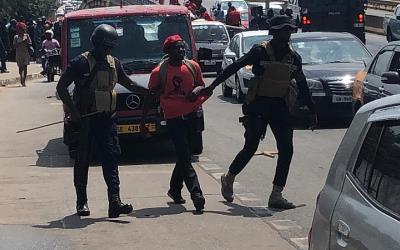
OccupyGhana® is appalled by the brutal assault that the Police meted out to unarmed and peacefully demonstrating law students and their sympathisers on Monday, October 7, 2019. We have seen footages and photographs that show several infractions against the rule of law and of humaneness on the part of the Police. This Police high-handedness and brutality against students exercising nothing more than their constitutional right to demonstrate and air out their grievances makes a mockery of the democracy we claim to respect, and we wish to unequivocally announce our disgust with that turn of events and to condemn same in no uncertain terms.

We have closely studied the Police Statement on the matter which, to all intents and purposes, is a poor attempt to throw dust in the faces of Ghanaians concerning a true and accurate account of the day. For instance, how does the Police Service explain how the protestors somehow procured arsenals of stones to hurl at Police officers on the Independence Road stretch between the Canadian Consulate to the Golden Jubilee House? How is it possible, in 2019, for the police to call an exercise of the constitutional right to assembly “illegal” when police permits are not required to stage a demonstration, and the notice requirement in the Public Order Act can never morph into an unconstitutional demand for some kind of police permission?

We could ask a dozen questions about the Police Statement, which we find as offensive as we find their unwarranted abuse of power and their impunity in a civilised society governed by respect for human rights, human dignity, the rule of law and justice. And we wonder how Government can bear the news that many of these harmless student protestors reportedly found shelter at a foreign consulate from the atrocities of their country’s own Police Service.

We repeat and remind the Police that the right to demonstrate is an inalienable right that requires absolutely no police approval or censure beyond notification. And no edifice, building or “zone” should exist which, having the benefit of public access roads, public traffic and public thoroughfare in whole or in part, cannot accept the presentation of petitions by unarmed and inoffensive demonstrators. No ground in this country is so sacred that it cannot tolerate the lawful exercise of unarmed students’ rights to demonstrate.

We demand, at the very least an apology from the recently-confirmed Inspector General of Police who bears ultimate responsibility for this egregious display of brutishness. We also demand that all Commanding Officers who directly supervised, sanctioned and called for these barbaric attacks on innocent protestors be punished in accordance with the law.

PROFESSIONAL LEGAL EDUCATION

We must also emphatically state that the time is ripe to address the root cause of this matter: the inability of the state to provide sufficient facilities to enable law students from the various law faculties and law schools gain access to professional legal education. We cannot, as a people, grant accreditation for several law faculties and law schools to be opened and run, and then maintain the current size of the School of Law for the professional law course, a completely unjustified bottleneck and another evidence of our lack of planning.

It is a fact that the introduction of the entrance examinations and the erstwhile interviews remain a formalised knee-jerk reaction to a problem that has an obvious solution that we refuse to provide. Ghana is not an island. Several other countries have resolved this problem in a manner that allows prospective lawyers to be trained and given the opportunity to write the final bar exam, however often they may write it. There is nothing wrong with learning from others and adapting what we learn to suit our purposes.

The Government cannot absolve itself of blame in this regard. It is statute that created the General Legal Council. That statute gives the Council the power to regulate professional legal education, sometimes with the approval of the Attorney-General. We insist that the same legislative process should be used to fix this problem once and for all.

A country of almost 30 million people cannot be proud that its official roll of lawyers has just about 3,000 lawyers. A ratio of one lawyer to 10,000 citizens is highly anaemic, and any existing or new policy that unduly restricts access to any form of education, especially in a developing economy, is not forward-looking and should be jettisoned. The time for action on this matter is now, and this buck stops at the desk of the Government.

CONCLUSION

In conclusion, we demand of the Police Service, the General Legal Council and the Government of Ghana to be guided by the principles outlined in the Ghanaian constitution that all power emanates from the people and not the other way round.

Yours in the service of God and Country

OccupyGhana®
OCCUPYGHANA® DEMANDS CLARITY AND DIRECTION ON THE COMPREHENSIVE SEXUALITY EDUCATION (CSE) DISCUSSION

3rd OCTOBER, 2019

OCCUPYGHANA® PRESS STATEMENT

OCCUPYGHANA® DEMANDS CLARITY AND DIRECTION ON THE COMPREHENSIVE SEXUALITY EDUCATION (CSE) DISCUSSION

OccupyGhana® has keenly followed the active discussions and strong views on the alleged or proposed introduction of CSE into the curriculum of public basic schools.

The lack of clarity and apparent contradictions in statements and actions by government officials on whether such a curriculum is to be implemented at all, and if so what the content would be, is at the heart of the confusion that is festering.

We note that the Minister for Education has been careful to emphasise that CSE is not a part of the “approved” curriculum and curriculum framework for use by the Ghana Education Service for all public schools, that no teacher has been trained on CSE, and that CSE was not included in teacher resource packs and manuals.

However we have seen video footage dated February 2019 in which the minister referred to some guidelines and was emphatic that sexuality education should be part of the curricula to be launched in September 2019 “all they way from Kindergarten to Senior High School.”

This, we believe, was at a program held in Accra where Ghana and UNESCO announced the launch of a CSE program called “Our right, Our lives, Our future (O3),” the implementation of which was reported to have already started in 2018.

Further in paragraph 369 of the 2019 Budget Statement, the Finance Minster announced that the National Population Council and “other stakeholders” had collaborated to develop CSE guidelines “for incorporation into the national education curriculum,” and making reference to the National Condom Strategy.

Much earlier in June 2017, the Ministry of Education participated in the launch of the comprehensive sexuality education manual for young people titled “KnowItOwnItLiveIt,” a product of the Planned Parents Association of Ghana (PPAG) and Marie Stopes International Ghana (MSIG). We note that the GES also participated in the launch and were reported to be developing content for the project. Although there is no evidence that this document would be considered or treated as part of any proposed curriculum, it is difficult to divorce the circumstances surrounding its launch from the current discussions.

Further, we have seen what purports to be a Ghana Government and GES document (the foreword of which bears the following name and title “KWASI OPOKU-AMANKWA (PROF), DIRECTOR-GENERAL, GHANA EDUCATION SERVICE”) containing guidelines for CSE in Ghana, and which has modules for teaching CSE from Pre-school to SHS. Page 8 of this document discloses that “the choice of topics is informed by the six features of CSE in the Bogota Declaration of 2010,” the first of which is captured as “Respect for human rights and diversity with sexuality education affirmed as a right.” The Report issued in Bogota, Colombia in December 2010 and, titled “Comprehensive Sexuality Education: Advancing Human Rights, Gender Equality and Improved Sexual and Reproductive Health,” contains and endorses aspects of sexuality that some Ghanaians might object to.

We have also seen the Teacher Resource Pack of the National Council for Curriculum and Assessment (NaCCA), titled “RESOURCE GUIDE FOR THE ORIENTATION OF PRIMARY SCHOOL TEACHERS TOWARDS THE IMPLEMENTATION OF THE REVISED CURRICULUM FOR PRIMARY SCHOOLS,” and it states at page 11 that CSE was one of the “contemporary issues addressed through the National Pre-Tertiary Curriculum Framework (NPCF).”

It is these and more that make it difficult to accept the Minister’s claim that CSE is not part of the approved curriculum. Even if it has not been formally approved, it is definitely under consideration. Our view is that the time is ripe for full and frank disclosure and a full-throttled debate on the matter and path going forward.

Ghanaians deserve and demand clarity on this once and for all. Specifically, we demand the following:

1. A definite position of the Government on the introduction of a CSE curriculum in our schools;

2. Before any approval or implementation, key stakeholders, including parents, traditional leaders and faith-based organisations must be actively engaged and involved in discussions surrounding it, so that the final product fully reflects our Ghanaian cultural and religious values;

3. If CSE is to be approved for implementation, then the Ministry of Education and Ghana Education Service must publish the detailed contents of the materials via traditional media channels, websites or/and social media; and

4. Parents must be given an “opt out” option for their wards. Parents whose wards remain in the programme must be supplied the same teaching material that the teachers would use and then constantly engaged by the teachers, so that the parents would emphasise their peculiar cultural, religious and other values to their wards as they are exposed to the topics being taught in school.

It should be clear to the Government that Ghanaians will not accept any CSE or other initiative that is suspected or believed to be the work of any foreign bodies, and which does not reflect our cultural and religious values, and public concerns. We believe that the education of Ghana’s future leaders in relevant subject areas is necessary to build a holistic character in them.

Yours in the service of God and Country

OccupyGhana®