23 May 2022
Abu Jinapor, MP
The Honourable Minister
Ministry of Lands and Natural Resources
Accra
Dear Sir:
RE: OCCUPYGHANA LBG DISAGREES WITH ANY FURTHER RELEASE OF ACHIMOTA LANDS
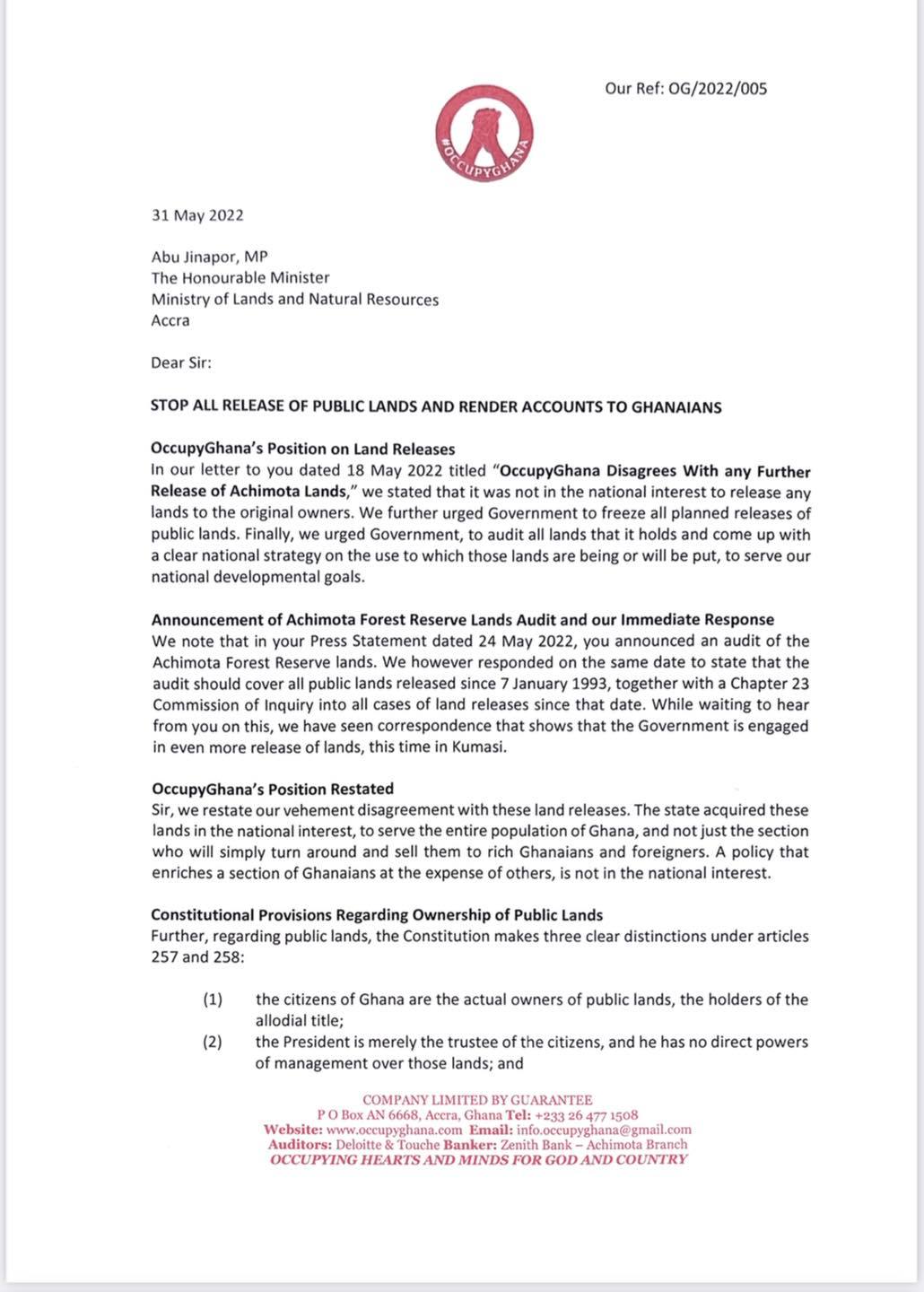
In our letter to you dated 18 May 2022 on the above-entitled matter, we conveyed our vehement disagreement with the alleged plans to return substantial portions of the Achimota Forest Reserve to its former owners. Regarding the general matter of returning government lands to former owners, we stated as follows:
“There is also evidence of how some of these lands have been quietly sold to government and party officials.”
Since sending that letter to you, we have had further cause to believe that this state of affairs is worse and much wider than is apparent. We are also concerned that there might have been serious instances of conflict of interest and conflict of duty involving government officials and other government actors, concerning those lands.
We therefore write to demand that you revoke or suspend the operation of the Forests (Cessation of Forest Reserve) Instrument, 2022 (EI 144) and the Forests (Achimota Firewood Plantation Forest Reserve) (Amendment) Instrument, 2022 (EI 154) forthwith. Instead, we demand a full public inquiry under Chapter 23 of the Constitution into the matter of the Achimota Forest Reserve.
While the Achimota Forest Reserve issue requires immediate attention, we further demand a similar inquiry into all alleged return of government lands to former owners that have occurred under the Fourth Republic. The purpose of the inquiries would be to reverse any illegal acts perpetrated, and improper gains made, by government officials under the guise of returning lands.
Yours in the Service of God and Country
OccupyGhana LBG
The Auditor-General
Office of the Auditor-General
Ministry Block ‘O’
P. O. Box M 96
Accra (GA-110-8787)
Dear Sir,
Re: DEMAND TO ISSUE DISALLOWANCES AND SURCHARGES
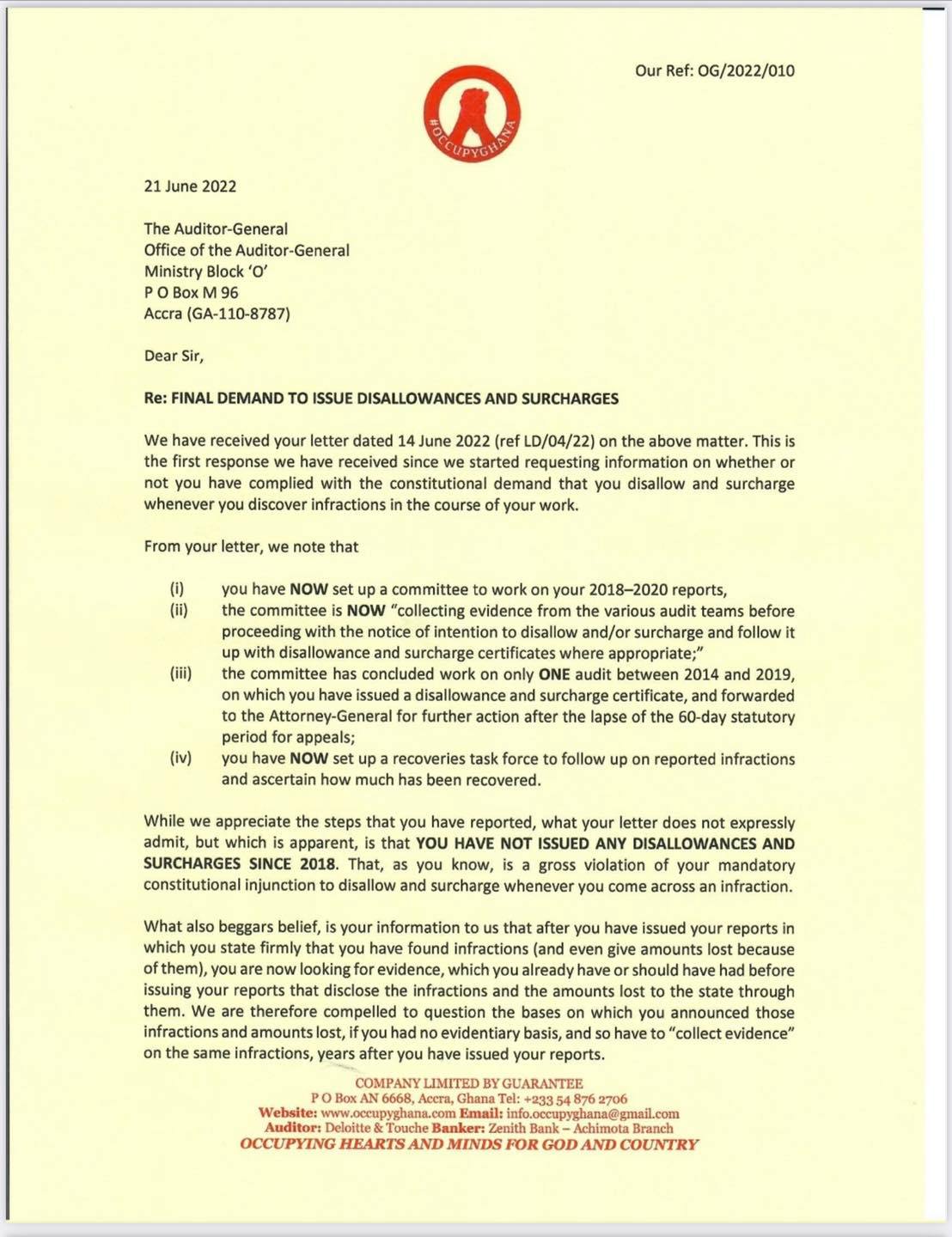
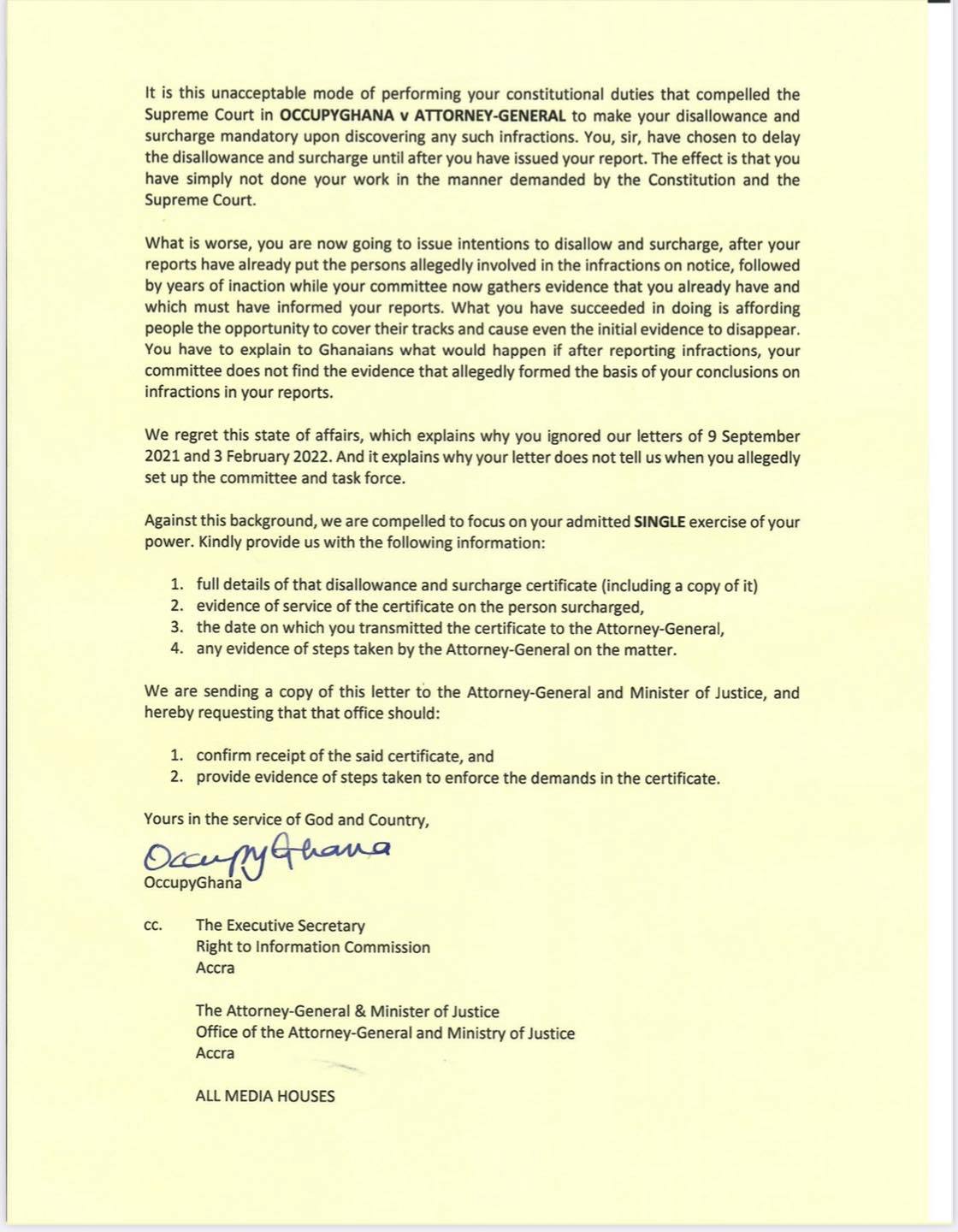
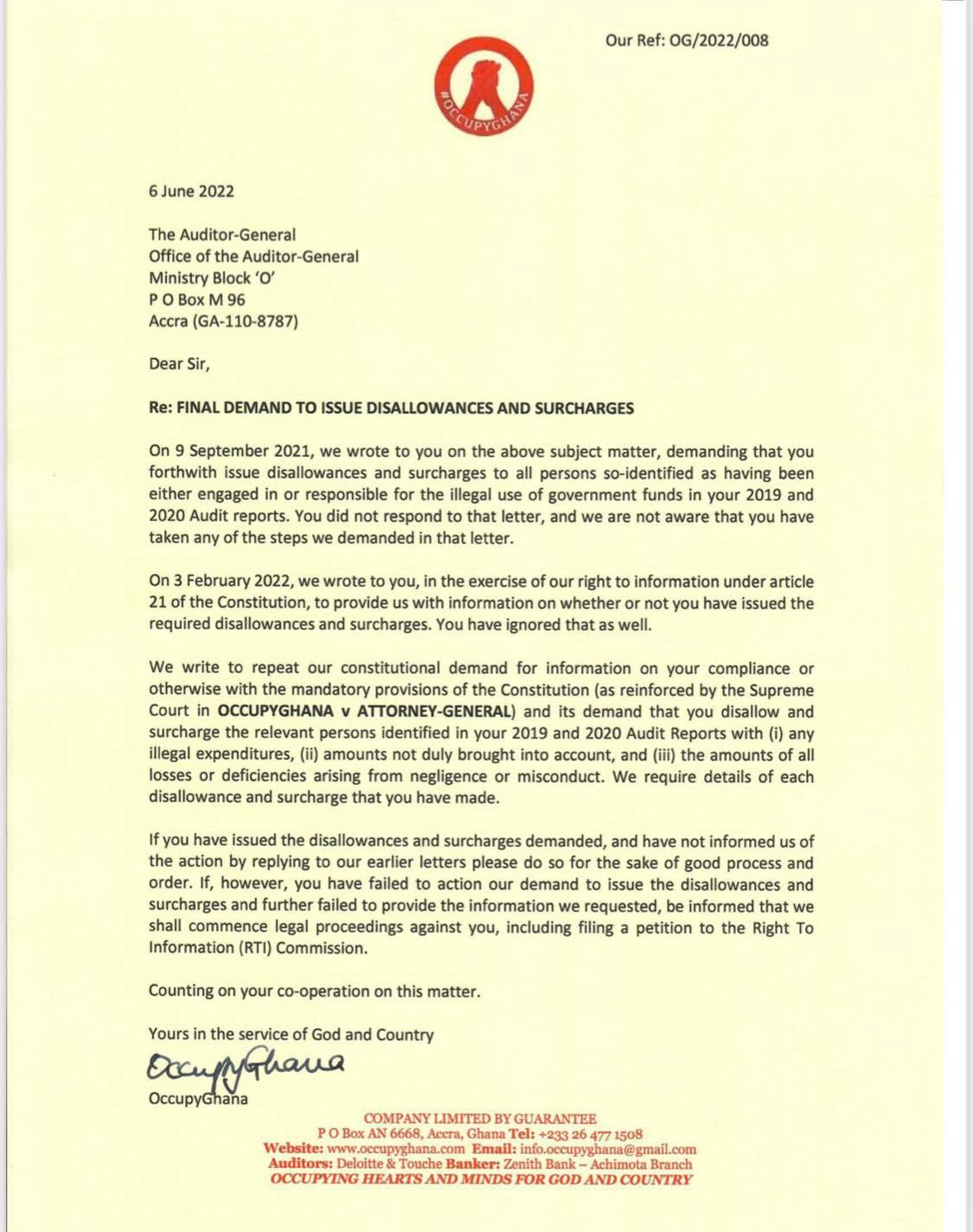
This is a letter to remind you of our earlier latter dated 9 September 2021 on the above subject matter, demanding that you forthwith issue disallowances and surcharges to all persons so identified as having been either engaged in or responsible for the illegal use of government funds in in your 2019 and 2020 Audit reports (copy of stamped receipt attached).
Unfortunately, we have not received any response from your office on this matter. If you have already taken action, please ignore this letter. But if you have not yet taken action, please do so immediately.
However, if we are not assured of any action being taken by your office on this action within the next seven (7) days, we will proceed with legal action including sending a petition to the Right To Information (RTI) Commission for you to provide information to us on your compliance or otherwise with the mandatory provisions of the Constitution and its demand that you disallow and surcharge the relevant persons with (i) any illegal expenditures, (ii) amounts not duly brought into account, and (iii) the amounts of all losses or deficiencies arising from negligence or misconduct.
Counting on your co-operation on this matter.
Yours in the service of God and Country
OccupyGhana®
CC.
The Executive Secretary
Right To Information Commission
Accra
All Media Houses
6th February 2019
The Honourable Minister for National Security
Accra
Mr. Albert Kan Dapaah
Dear Sir:
DEPLOYMENT OF AN ARMED FORCE BY THE NATIONAL SECURITY COUNCIL.
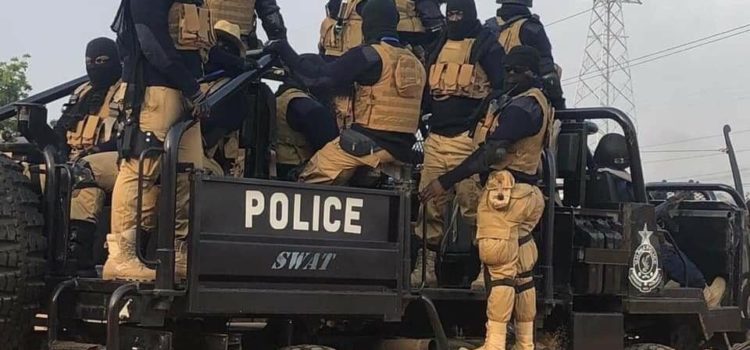
During the 31st January 2019 parliamentary by-election held at the Ayawaso West Wuogon Constituency in the Greater Accra Region, your office deployed an armed force (not established by law) to ostensibly perform policing duties.
We have seen video footage of these men, attired and bearing arms, engaging in acts of violence that we have condemned in our Public Statement of 1st February 2019.
We have also seen that some of these men were being driven in vehicles bearing the name and insignia of the Ghana Police Service and were, in some instances, chauffeured or accompanied by persons who appeared to be regular police personnel.
Concerned about the legality or otherwise of that force, we have checked the Constitution (particularly articles 83 to 85, 200 and 210) and all statutes relevant to National Security and have found no law that backs the force that your office deployed.
Sir, Ghanaians have exercised our “natural and inalienable right to establish a framework of government” for ourselves, which is required to secure for us and posterity the blessings of liberty among others. It is for this reason that our Constitution affirms that “all powers of Government spring from the Sovereign Will of the People,” in “whose name and for whose welfare the powers of government are to be exercised in the manner and within the limits laid down in [the] Constitution.” Thus any act(s) and/or omission(s) that threaten these aspirations and legitimate expectations of Ghanaians ought to arouse the concern of all responsible and well-meaning Ghanaians.
Therefore, we write to demand that you kindly indicate to us:
We demand answers to these questions because the powers of government, as required by law, must be exercised, first, in the welfare of the people who were inexcusably violated by this force, and second, “in the manner and within the limits laid down in [the] Constitution.”
This letter is a formal request for information under Article 21 of the Constitution. Further, it constitutes statutory notice of our intention to take appropriate action against the Government should you fail to respond to and address the issues we have raised.
Thus if we do not hear from you we shall go to Court to seek reliefs including (but not limited to): (a) providing the information requested above, (b) declaring the said force illegal, (c) ordering that the force be disbanded, (d) ordering you to account for all of sums of money expended on maintaining this force, (e) and further ordering that all such sums be refunded to the State, the expenditure on the said force being contrary to law.
We are counting on your co-operation
OccupyGhana®
cc.
His Excellency the President
His Excellency the Vice-President
Attorney-General and Minister for Justice
Minister for Foreign Affairs
Minister for Defence
Minister for the Interior
Minister for Finance
Chief of Defence Staff
Inspector General of Police
The Auditor-General
National Security Coordinator
29th January 2019
The Honourable Minister
Ministry of Finance
Accra
Dear Sir,
RE: CONCERNS AND QUESTIONS ABOUT GHANA’S FISCAL RESPONSIBILITY ACT
OccupyGhana® is delighted that Ghana has passed a fiscal responsibility act. It’s a step in the right direction.
But we at OccupyGhana® are still grappling with the basic question: “will the Act actually control excessive government expenditure now and in the future?”
For instance, according to the law, “… the overall fiscal balance on cash basis for a particular year shall not exceed a deficit of five percent of the Gross Domestic Product for that year; and an annual positive primary balance shall be maintained.”
We note that:
Overall budget balance = (Primary balance) + (Government Interest Payments).
From this, the following questions and concerns arise:
We note that India enacted a Fiscal Responsibility and Budget Management (FRBM) law in August 2003. However, the impact of the 2008 global financial crisis disrupted the fiscal consolidation process, leading to a progressive loosening of fiscal targets and eventually an amendment of the FRBM Act in 2012.
We ask these questions and raise these concerns because historically, although the Bank of Ghana (BoG) Act places a limit on advances from the BoG to government, this has been violated by nearly all governments. And, parliament has really never provided effective fiscal oversight of the executive.
Thus while this law is a step in the right direction, we must admit that no law is perfect and laws tend to have technical loopholes. It would appear to us that this law needs “a few good men and women” for it to work.
However, that is a quality that we cannot guarantee and that is why we wish to raise these questions and concerns, aimed at exploring ways in which the law could be further tightened to prevent future abuse.
Yours in the service of God and Country,
OccupyGhana®
14th November 2018
The Honourable Minister
Ministry of Finance
Accra
Dear Sir,
RE: ALLOWANCES FOR BOARDS AND COUNCILS IN THE PUBLIC SERVICE
OccupyGhana® has noted with delight and approval Government’s directive to the Public Service through you, on the above-entitled matter, and dated 2nd November 2018, to streamline the basis for paying sitting allowances to members of state Boards, Authorities, Council, etc., and to ban the payment of monthly salaries/allowances to such persons. This ties in very much with our Press Statement dated 20th May 2018 that expressed deep concerns about such matters, and in which we called for the specific ban of such payments, among others.
While we applaud this all-important step towards reining in unjustified payment of monies, we respectfully want to bring to your attention certain wrong practices engaged in by members of such Boards for several years and which, if not checked alongside your directive, would completely erode its essence and violate its spirit.
First, with the primary aim of accumulating sitting allowances, certain Boards and Board Committees are known to meet several times in a month, even when the meetings are repetitive and meaningless. We are aware of Board and Board Committee meetings that are called without agenda, ostensibly just to review minutes of a previous meeting. Heads of such institutions and Board chairs have to be held responsible for unnecessary meetings and surcharged with any sitting allowances so paid.
Second, some Board and Board Committee members have essentially become parallel structures to those existing in the entities, and insist on undertaking work that would ordinarily be undertaken by employees of the entities. Some insist on, for instance, touring facilities or educating the public around Ghana. Even worse are the scandalous and ridiculous travel budgets presented for approval. It leaves very little to the imagination the real reason behind such ventures.
Third, you would have to take the additional step of cutting out expenses associated with the unfounded belief on the part of Board Members and members of Board Committees that they are entitled to training and conferences, especially abroad, at the expense of the tax payer. We believe that it is a person’s already existing experience and knowledge that gets that person to serve on a Board or Board Committee. That knowledge and experience are not to be acquired after appointment and at the expense of the tax payer. Thus, paying for the cost of training, costs of airfares, hotel expenses and per diem should be a thing of the past. Boards and Board Committees do not need members who are there to line their pockets with undeserved allowances, enjoy paid travel and enhance their personal curriculum vitae.
We reiterate a point we made in our Press Statement dated 20th May 2018 that no board member is entitled to monthly remuneration, an office, official accommodation, official vehicle, etc. To the extent that any such facilities have been, or are being, provided, they are unlawful.
These are only some of the things that have to be checked as part of your directive, if it is not to be defeated on the ground.
Yours, for God and Country,
OccupyGhana®
CC.
The Chief of Staff
Office of the President
Accra
The Chief Executive
State Enterprises Commission
Accra


Recent Comment