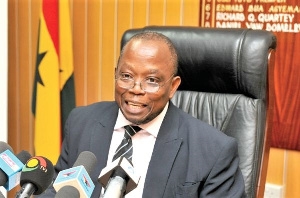
OCCUPYGHANA® CALLS FOR THE IMMEDIATE RECALL OF THE AUDITOR-GENERAL FROM LEAVE

OCCUPYGHANA® CALLS FOR THE IMMEDIATE RECALL OF THE AUDITOR-GENERAL FROM LEAVE

10TH JULY 2020
OCCUPYGHANA® PRESS STATEMENT
OCCUPYGHANA® CALLS FOR THE IMMEDIATE RECALL OF THE AUDITOR-GENERAL FROM LEAVE

1. OccupyGhana® has observed with great disquiet the circumstances leading to and following the President’s directive to the Auditor-General to proceed on an ‘accumulated leave.’ We find it difficult reconciling that directive with the constitutional injunction under which in the performance of his functions, which necessarily includes the mundane matter of whether, when and how he takes his leave, the Auditor-General is insulated from the ‘direction and control of any person or authority.’

2. While it may be best industrial, governance and management practice for every worker, including the Auditor-General, to take an annual leave, we think the constitutional insulation of that office is clear and leaves no room for any penumbra within which the presidential directive may operate. Even if there was, which we dispute, the circumstances of this matter should have given the Executive a great opportunity for exercising restraint of power and the development of the constitutional check and balances inherent in the creation and protection of independent constitutional bodies. Ours is still a nascent democracy that requires all of us to assist in upholding the independence of constitutionally protected bodies such as the Auditor-General, the Electoral Commission, CHRAJ and the Judiciary. Ghana would be the ultimate loser if presidential power is deployed to micromanage any of these independent constitutional bodies, contrary to the express terms of the Constitution.

3. We also believe that this matter ought to be resolved by the Council of State in a manner that upholds restraint of power and errs on the side of the development of the constitutional check and balances inherent in the creation and protection of the independent constitutional bodies.

Leave Is a Constitutional Right

4. First, leave is a constitutional right, and not a statutory obligation. With respect to the Auditor-General, article 187(12) of the Constitution specifically mentions, recognises and protects ‘his rights in respect of leave of absence.’ These words are repeated verbatim in section 10(7) of the Audit Service Act.

5. The leave entitlement of the Auditor-General is part of the terms and conditions of his office, expected to be provided under article 71 of the Constitution. Under that article, the ‘facilities and privileges’ of the Auditor-General (which definitely includes ‘his rights in respect of leave of absence’) is first recommended by the relevant Article 71 Committee and then determined by the President, acting in accordance with the Council of State’s advice.

6. From our checks, the relevant and applicable Article 71 Committee Report is the Edu-Boandoh Report of August 2016, which was to apply for 2013 to 2017 but has continued in operation because there is no other, current Report. Our review of that document shows that it contains no provision on the Auditor-Generals’ leave entitlement.

7. To compound matters, the whopping 40-day leave provided under the Conditions Of Service For Management Staff of the Audit Service dated 30 July 2008 (extended by the reported practice that adds 4 days of ‘travel time’ to annual leave periods for some public officers) does not apply to the Auditor-General. That document, prepared by the Board of the Audit Service under article 189(3) of the Constitution states expressly as follows:

‘These Conditions of Service…shall apply to the Management Staff of the Audit Service (Deputy Auditors-General, Assistant Auditors-General and Directors) other than the Auditor-General.’

8. In this situation, all that an Auditor-General is assured of, is the minimum 15 days entitlement provided for under section 20 of the Labour Act.

9. Further, and with respect to leave being a right and not an obligation, article 24(2) of the Constitution assures all workers of ‘rest, leisure and reasonable limitation of working hours and periods of holidays with pay, as well as remuneration for public holidays.’ These are assurances, not obligations. Thus, if a worker may voluntarily opt to work beyond the normal ‘limitation of working hours,’ then that worker does nothing wrong in deciding to take less or even no ‘periods of holidays with pay,’ however personally unhealthy that might be.

10. That is why section 31 of the Labour Act cannot be interpreted or applied to convert the constitutional right into its exact opposite, a statutory obligation. Such an interpretation or application is not only unconstitutional, but does violence to the internal harmony of the Labour Act itself, section 20 of which aligns with the position of the superior provisions of the Constitution, that leave is a right.

11. While we may debate the propriety or otherwise of not taking one’s leave entitlement, and also debate the meaning of the outlawing of an ‘agreement’ to relinquish or forgo leave under section 31 of the Labour Act, whichever meaning is applied cannot turn or flip the constitutional right on its head into a statutory obligation.

12. Thus, we respectfully think that the singling out of the Auditor-General and applying leave to him as an obligation is a grave error and a regrettable unconstitutional act.

13. Our worries got even exacerbated when the presidency purported to direct the Auditor-General to also proceed on his 2020, largely unearned leave when 2020 is only about halfway through. While that directive is also unconstitutional by itself, in our view, it also breaches section 20 of the same Labour Act that the presidency relies upon, which speaks of the right to leave being ‘in any calendar year of continuous service.’

14. 2020 is not over and every worker, subject to arrangements with the employer, technically has until the last 15 days of the year (the minimum statutory period of leave) to exercise that right. The presidency’s direction to the Auditor-General to take his 2020 leave literally in the middle of the year, could become a bad precedent that can only harm our constitutional development.

15. We are further alarmed at the purported reliance on some previous direction to another Auditor-General to proceed on accumulated leave. We are convinced that that alleged administrative precedent was illegal and unconstitutional, and that the quiet compliance with, and failure, refusal or neglect of the affected person then to challenge it (reminiscent of the period where successive Auditors-General were too scared to even exercise their constitutional disallowance and surcharge powers), does not convert that illegality and unconstitutionality into a much-desired precedent, worthy of being followed.

16. We are certainly not convinced by the purported reliance on the decision of the Court of Appeal in Adrah v ECG. That decision was simply that an employer could not provide for commuting leave into cash in its Staff Manual and then assert in court that that was illegal. Dzamefe JA characteristically did not mince his words. He said ‘ECG cannot play hot and cold at the same time… It is contradictory. The company’s negligence and mistakes cannot be visited on the innocent employee.’

17. In his detailed concurring opinion, Ofoe JA spent considerable time to analyse and interpret section 31 of the Labour Act and held that what that section did was to deny the worker the right to sell his leave and prevent the employer from buying that leave. However, based on the specific facts of the matter, he held that in equity, it would be unconscionable, grossly unfair, manifestly unjust and fraudulent to allow ECG to rely on this section of the Act. He would not allow ECG to use the law as an engine of fraud and therefore held that it is not every agreement to forgo leave that is void and for which accumulated leave yields no benefits for the worker.

18. Thus, throughout this unanimous decision, the Court was careful to uphold the fact that leave is an entitlement to the worker. For section 31 to apply, it held, there must be an agreement to sell the leave. That is what was outlawed. This case did not provide any general support to compelling any worker to go on so-called accumulated leave.

19. What the case rather establishes is that section 31, on which the entire presidential direction appears to be based, outlaws agreements to sell or purchase leave. Thus, where the worker fails or neglects to take or commence leave in the calendar year the worker loses the leave days and cannot be paid for it, unless the court finds grounds to the contrary.

20. We must also comment on the eye-popping leave entitlement of some public officials. 44 working days of leave, in addition to the 13 days of public holidays, means that for three months in each year, these public official enjoy leisure and rest, while being paid by the tax payer. It is time to begin a national debate on whether it is right at out stage of development when hard work is what is required, for public officials to work for just three-quarters of a year, and to enjoy paid rest for one-quarter of the year.

21. The reality, we know, is that several public officials never took the full leave entitlement. The simply sold it back to us and we paid for it. This is what section 31 seeks to prevent, according to the Court of Appeal in Adrah v ECG.

22. Thus, neither the purported administrative precedent nor purported judicial precedent is applicable or of any relevance to this matter.

23. We should also look beyond the immediate and be concerned about why at least two Auditors-General have been reluctant to take their full leave entitlements, and the role that the Board of the Audit Service plays in all of these matters.

Independence of the Auditor-General

24. The Constitution vests in the Ghanaian presidency, some of the most immense powers in any democracy on earth. The President is the repository and embodiment of executive power and authority, and gets to appoint almost every actor in the public service.

25. But having vested such immense powers in the President, the Constitution puts in place certain checks and balances that, hopefully, would restrain the exercise of those powers and not leave Ghana with the oxymoron or contradiction of a democratic, constitutional dictatorship to replace the dictatorship that we quietly rejected and overthrew when we voted to enact this Constitution at a national referendum held throughout Ghana on the 28 April 1992.

26. One way in which the Constitution checks presidential power is the creation of independent constitutional bodies or offices. Although the President appoints persons to those bodies or offices, the President has and exercises absolutely no power over them after they are appointed. As hard as that may be to accept, the President has no political, executive, administrative, financial or even disciplinary power over those offices.

27. Those bodies or offices are the Electoral Commission, CHRAJ, NCCE, National Media Commission, Public Services Commission, Lands Commission, and of course the Auditor-General. By the use of the radical and mandatory words ‘shall not be subject to the direction or control of any person or authority,’ the Constitution insulates these from being subjected to any other entity, including the Executive and Parliament. The only other body with similar insulation is the Judiciary.

28. Yet the Constitution did not seek to constitute those offices into demi-gods. It therefore subjects them and their operations to the Constitution and the law, by providing specific, limited instances for calling them to order, such as articles 23, 33, 295(8) and 296 of the Constitution.

29. That is why in the 25 June 2020 ruling of the Supreme Court in NDC v AG & EC (Consolidated), the Court felt constrained to refer to and reiterate its 2016 decision in Abu Ramadan & Gary Nimako v EC (No 2), that an independent body such as the EC in the exercise of its functions, ‘cannot be compelled to act in a particular manner unless there is clear evidence that they have acted unconstitutionally,’ and that it was ‘necessary to keep the Court itself within its proper limits in order to give effect to the supremacy of the law.’ We commend this exemplary exercise of restraint of power, to the Executive and Legislature in their dealings with these bodies.

30. This constitutional architecture that restrains even the highest court of the land from giving directions to or exercising control over these bodies, in the absence of any evidence of unconstitutionality, is deliberate. These bodies are expected to counter-balance and check the power of, and stand up to, all other persons or authorities, if need be. Thus our Constitution does recognises not just the traditional three branches of power, but carves out and ring fences another branch, composed by the independent constitutional bodies, essential watchdog bodies, and insulates them from any control. By this, the Constitution anticipates and expects ‘healthy tension’ between these bodies and other persons and authorities, and therefore protects the former from the whims and caprices of the latter, in the expectation that out of that ‘equilibrium of tension,’ (to borrow from Nixon v Sirica) Ghanaians would be protected from oppression.

31. Separation of powers is ‘not to promote efficiency but to preclude the exercise of arbitrary power. The purpose was not to avoid friction, but by means of the inevitable friction incident to the distribution of the governmental powers… to save the people from autocracy’ (Myers v United States.)

32. This is the state of the unique separation within even executive power, meant to hold the otherwise super-powerful executive presidency in check. Thus, although the occupants of the independent office are public officers appointed by the President, the latter shall not direct and control them in any manner whatsoever.

33. Therefore, the argument from the presidency, that article 297(a) subjects these bodies to the President’s disciplinary control simply on account of his having appointed them is implausible, is untenable and drives a fleet of Ayalolo buses through the carefully constructed constitutional architecture meant to prevent just that.

34. The fact that a past President breached that constitutional architecture and got away with it, sets a bad precedent. Bad precedents are not followed. Bad precedents are not justified. If this is not checked and rolled back immediately, we will be setting further bad precedents that will eventually erode the precious little constitutional checks on executive power that exist.

Concluding Comments

35. OccupyGhana® has from its formation been interested in the work of the Auditor-General and a great deal of our time, resources, advocacy and efforts have been directed toward making that office work to protect the national purse. When the occupant of that office and the powers-that-be at the time would not listen to us, we went to the Supreme Court. The victory that we won and the seminal decision in OccupyGhana v AG, marked a turning point in the work of that office in the history of this nation. Not only that, we drafted and submitted the bill, which together with changes made by the Rules of Court Committee, was enacted as High Court (Civil Procedure) (Amendment) (No 2) Rules, 2016 (CI 102), to regulate appeals from the Auditor-General’s disallowances and surcharges.

36. However, we can never discount the yeoman’s role that this Auditor-General has personally played in seizing the opportunity offered by judgment by the scruff of the neck and running with it.

37. In the State of the Nation Address delivered on 8 February 2018, the President endorsed the work of OccupyGhana® with the Auditor-General as follows:

‘The role of OccupyGhana in increasing awareness of the importance of the work of the Auditor-General should be recognised.’

38. The President made this statement after recounting the huge savings Ghana had made from a blatant attempt by some public officers to swindle the nation, but for the work of the Auditor-General. The President said:

‘a staggering amount of GH¢5.4 billion has been identified as constituting fictitious claims.’

39. It remains a source of surprise to us that no person involved in making those fictitious claims, which Auditor-General’s work exposed, has faced prosecution or even compelled to take a leave.

40. In a speech delivered by the Vice President at a town hall meeting held on 3 April 2019, he referred to this saving and said of the work of the Auditor-General:

‘In addition to this, 112 Certificates have been issued and a total amount of GH¢511,211,239.04 was levied against individuals, companies and institutions who committed financial infractions against the State. Also, GH¢67million had been recovered from disallowances and surcharges. This is protecting the public purse.’

41. We bring these up because we do not think that Auditor-General should be subjected to this treatment on account of him losing his leave. Although he has not taken the full complement of his leave, his office has been audited each year by the independent auditing firm appointed by Parliament for that purpose under article 187(15) of the Constitution.

42. The combination of the decision in OccupyGhana v AG and the Auditor-General’s sterling work has raised the stature and profile of Ghana in the world of auditors to the extent that some African countries, namely South Africa, Liberia and Sierra Leone (and Zambia, earlier in time), have adopted Ghana’s disallowance and surcharge provisions, so that their Auditors-General can do what has been done in Ghana.

43. When the history of the office of the Auditor-General is written, the appointment (and even the timing and circumstances of it), the work of the current Auditor-General and the phenomenal financial and other support that this government gave to his office, should be what are highlighted. That story should not end with a final paragraph that says in the twilight of his public service, the Auditor-General was subjected to an unconstitutional removal from office dressed up as an enforced accumulated leave.

44. The constitutional history of the Fourth Republic is replete with stories of the ‘little people’ who, with their lawyers, stood up to and stared down at authority, and helped shape our constitutional rule. Key examples are found in the ex parte Ampong and ex parte Adim Odoom cases where ‘ordinary’ civil servants and their lawyers refused to be cowed by the might of the presidency. They stood up to the then President, and with the support of the courts, established that the President had no disciplinary powers over civil servants and could not place them on interdiction. The principle that supported their efforts then, should be alive, respected and upheld today.

45. We call on the President to revoke the directive and allow the administrative system in the Auditor-General’s office to appropriately evolve, like every other institution, and perfect some of the very basic matters such as leave in order to safeguard the constitutional principles which justified guaranteeing the independence of office. We should do all in our power as a nation not to sour and soil one of the few highlights in the generally and historically stuttering fight against corruption in Ghana.

46. Considering the seriousness of this matter, we also call on the Council of State to intervene, in the exercise of its advisory mandate under article 91(3) of the Constitution to ‘upon request or on its own initiative, consider and make recommendations on any matter being considered or dealt with by the President.’

47. We identify with and endorse the unified position of fellow Civil Society Organisations to demand a reversal of this directive.

48. We also commend to all the wisdom and foresight in the enduring and near-prophetic words of Dotse JSC in his powerful and insightful dissent in Appiah-Ofori v AG:

‘It should be noted that in view of the very important watchdog role that the Auditor-General plays or is supposed to superintend in the transparent use and accountability of the public purse, any attempt to prejudice and/or compromise his position by linking it to the pleasure of a sitting President, is untenable. This is because the President is the head of the Executive Branch of Government whose use of monies entrusted to them, the Auditor-General is mandated to audit… Once appointed to that office, the Auditor-General must have his continued stay in office subject only to this Constitution, and no more.’

49. The presidency does not deserve this. The Auditor-General does not deserve this. More importantly, Ghana does not deserve this.

Yours in the service of God and Country
OccupyGhana®
OCCUPYGHANA® DEMANDS THE DISMISSAL, PROSECUTION AND WITHDRAWAL OF CANDIDATURE OF CARLOS AHENKORAH

3RD JULY 2020

OCCUPYGHANA® PRESS STATEMENT

OCCUPYGHANA® DEMANDS THE DISMISSAL, PROSECUTION AND WITHDRAWAL OF CANDIDATURE OF CARLOS AHENKORAH

OccupyGhana® joins countless Ghanaians in registering our chagrin and disappointment with the behaviour and actions of Deputy Trade and Industry Minister, Mr Carlos Ahenkorah, MP. He has admitted that after testing positive for COVID-19, and before obtaining a subsequent negative test, he recklessly and callously put himself in the public space, visiting registration centres in the Tema West Constituency. By this, he put his fellow citizens at such high risk of contracting the coronavirus disease. As a minister of state of a government that is battling hard against this pandemic, he has shown a remarkable lack of good sense on the social and physical distancing that is required by law, on the pain of criminal prosecution.

His actions show gross disrespect to the pronouncements of the President concerning keeping the populace safe, and his behaviour makes a mockery of any enactments government has made in the fight against the coronavirus.

This is especially worrying in the wake of the political primaries, which in the main, also ignored the law and common sense of social and physical distancing, and the obvious struggle of the Electoral Commission to enforce these rules in the ongoing voter registration. We fear that the combination of these events, and the irresponsible conduct of government officials such as Mr Ahenkorah will lead to an increase in infections and possibly, deaths.

These are the reasons why we find the deputy Minister’s conduct despicable, outrageous and selfish. This conduct and his defensive nonchalance are not befitting of a person occupying the high offices of a Deputy Minister.

If no steps are taken against Mr Ahenkorah, it will cast the government as not just being hypocritical, but as being incapable of keeping the citizenry safe and incompetent to enforce laws it has made. Many have been taken to task for doing way less than Mr. Ahenkora has done, including not wearing a mask while driving alone.

We therefore respectfully call upon the President to remove him from office forthwith. We also call on the police to investigate his actions, and if found to have breached the law, to prosecute him. We also call on the New Patriotic Party to withdraw him as their candidate for the upcoming parliamentary elections.

We conclude by urging the government and the Electoral Commission to ensure that participants in the ongoing voters’ registration fully comply with the COVID19 security, health, safety, and personal hygiene protocols.

For God and Country

OccupyGhana®

COVID-19 – ARE WE READY?

1st March 2020

OCCUPYGHANA® PRESS STATEMENT

COVID-19 – ARE WE READY?

Since the very first patient reported to a hospital in Wuhan China on 1 December 2019, the COVID-19 virus has led to 87,586 confirmed infections and 2989 reported deaths worldwide as at 1 March 2020.

Wuhan in the Hubei Province in China is the epicentre of this outbreak that is reaching pandemic status and even though cases have been reported from 57 countries so far, China remains the country with the most cases and deaths.

In the last week or two, Iran, Italy and South Korea have reported an increasing number of cases too.

Until last week, no cases had been reported from countries in sub-Saharan Africa. However, that changed when an Italian travelled to Nigeria from Milan, Italy (the epicentre of the outbreak there) and was found to be positive for a COVID-19 infection. This shows that it is only a matter of time until cases are seen in Ghana too. With the amount of travel between countries in the sub-region and also between the region and Europe, we in Ghana are bound, sooner or later, to see cases.

That is why the country needs to be prepared if an outbreak should occur.

The Ghana Health Service (GHS) recently released a paper detailing its degree of preparedness. The efforts to prepare for and deal with a possible outbreak of COVID-19 are being spearheaded by the Emergency Operations Centre (EOC) with help from units like a Rapid Response Team (RRT). We commend all involved in those efforts. However, we cannot escape the fact that the nation’s health sector is weak and not well-resourced. This means that our preparedness for epidemics and/or pandemics may not be the most optimal. The 2019 Global Health Security Index, published by Johns Hopkins and the Nuclear Threat Initiative ranked Ghana 105th out of 195 on preparedness for epidemics and pandemics.

Notwithstanding these odds, Ghana has been able to deal with outbreaks like H1N1 influenza and cholera; so the ability is there.

Thus, where a possible COVID-19 outbreak is concerned, thought must be given to what to do when our resources are stretched to the maximum. There must be a Plan B. With this Press Release OccupyGhana® seeks to explore that.

In planning for a possible COVID-19 outbreak, OccupyGhana® suggests that Ghana considers the following variables:

1 – Surveillance;

2 – Containment;

3 – Prevention;

4 – Testing;

5 – Treatment;

6 – Coordination; and

7 – Finance.


  1. SURVEILLANCE

Since COVID-19 started and is spreading outside Ghana, keeping an eye on travellers to Ghana from the countries with outbreaks of the virus is of utmost importance. The Ghana Health Service (GHS) in collaboration with the respective stakeholders is already monitoring travellers at our ports-of-entry. Since patients infected with the virus may not show symptoms in the first 14 days, the combination of temperature monitoring and the use of the health declaration form is a good idea. To ensure that surveillance at these ports-of-entry are done properly, the calibre of medical staff manning these health post must meet international standards.

In our places of work and worship, in our schools and universities, we should all be on the lookout for those who may appear ill and ask them to seek treatment or to self-quarantine.

Surveillance testing is another important yet expensive part of dealing with an outbreak. The Chinese surmised that COVID-19 could be circulating more broadly and undetected in the community, especially in patients with fever, flu-like or SARS-like symptoms. Thus, they tested broadly and widely, including all who showed these symptoms and those who presented to their fever clinics. In Guangdong Province, by 24 February 2020, 320,000 suspected cases had been tested. 420 patients tested positive, giving a yield of about 0.14%. Given our economic means, surveillance testing may not be feasible.

  1. CONTAINMENT

Quarantining those who are suspected of having the virus either because they travelled to a high-risk area and/or have had contact with a person with the virus is one of the best ways of preventing the spread of the disease. The only known quarantine centre we have is a 100-bed new hospital. Thought must be given to finding alternatives. Could finished but unused public housing be commandeered for this purpose? Other unused hospitals? What about tents or converted containers?

Another option is for patients to self-quarantine at home. This calls for a high level of discipline on the part of patients. Maybe law-enforcement could be used to ensure isolation is adhered to. The police and even the army may be necessary in those instances where whole communities or even towns may need to be isolated.

  1. PREVENTION

That can go a long way to reduce the contraction and spread of the virus. Enough cannot be said about personal hygiene including the washing of hands for at least 20 seconds and keeping a safe distance of at least 1 meter from persons with symptoms. The use of face masks by infected patients may reduce the spread of droplets when they cough or sneeze.

People who fall sick with symptoms that may be due to COVID-19 should consider not going to work, school or even church. They should avoid large gatherings.

In this, public education assumes a very important role. Constant education of the public through TV, radio and social media would be very helpful.

Events that call for large gatherings – funerals, church services, campaign rallies, sporting events – may need to be curtailed.

Ghana’s experience from the H1N1 epidemic in 2009 when the 1st confirmed case reported at a private clinic in Accra should teach us that the frontline primary care facilities could well be where the first case would be picked up. Private facilities are the first option for foreigners and this could be the route for community entry and transmission of COVID-19. Even preliminary checks by OccupyGhana®’s Medical Team suggest that preparedness at the front-line facilities is poor. Being prepared means making sure front-line clinics and polyclinics have the logistics and supplies needed to screen, catch and hold suspected cases until help is received from the Rapid Response Team. Currently, even though some training has been done, no additional support like Personal Protective Equipment has been made available at this level.

Several numbers have been made available for a hotline. Maybe there should be just one number made up of 3 easy-to-remember digits. Also, these numbers cannot be the personal phone numbers of medical personnel.

  1. TESTING

Testing is now being done at just two places – Noguchi Memorial Institute and the Kumasi Centre for Collaborative Research. The Emergency Operations Centre (EOC) should ensure that all frontline clinics know what to do when a patient shows up with symptoms suspicious of COVID-19 infection.

These clinics should have holding rooms for such cases. The personnel should also have protective gear that allows them take samples from the patient that the Rapid Response Team can then pick up. Having an easy-to-remember hotline number helps.

  1. TREATMENT

Tema General and Ridge hospitals have been designated as the two hospitals for isolating and treating these patients. Four other facilities (Ga East, Police, LEKMA and Korle-Bu Teaching Hospitals) have been identified as additional facilities to support case management.

However, are these isolation and treatment centres ready and able to accept and manage confirmed cases? Do they have adequate stocks of oxygen, ventilators and other vital equipment? We were surprised to learn that until a few days ago, Tema General Hospital had no running water. We were also shocked to learn about how Korle Bu Hospital, a designated support centre for COVID-19 buckled under when its lack of readiness was exposed by 2 suspected cases. How can we trust that these designated centres are up to the task?

COVID-19 can lead to severe pneumonia and even Acute Respiratory Distress Syndrome (ARDS). These complications call for intubation and ventilation in the intensive care setting. Ghana has very few ventilators nationally. The health system could get very overwhelmed quickly if there is an outbreak of COVID-19. Without an acute expansion of our intensive care capabilities in the next few days, we need to realise that not everyone who will need life support is going to get one. So, for the future we urge the government to expand our intensive care capabilities and also set up at least 1, preferably 2 specialised hospitals for Infectious Diseases management and research. These emergent viral diseases are here to stay.

Lastly, so as not to overload our already crowded medical facilities, those with mild symptoms should be advised to stay home. That will all depend on the level of education that is done.

  1. COORDINATION

The Emergency Operations Centre (EOC) which was set up during the Ebola epidemic was dismantled after that outbreak died out. That should never have happened. Ghana is constantly buffeted by infectious disease outbreaks and the ability to deal with them on a large scale should be maintained at all times. However, per the statement from the GHS recently, another EOC has been set up in the wake of COVID-19. Moreover, the Incident Commander of the EOC or a surrogate should maintain open lines of communication with the general public. It helps inform, diffuse anxiety and counter mis-information. There’s also the need to prepare a COVID-19 vaccine deployment plan now and explore access mechanisms as WHO has already deemed Ghana to be among the high-risk African countries.

  1. FINANCES

Government initially declared an emergency provision of GHS2.5m for COVID-19 preparation. Subsequently, the MOH/GHS EOC estimated a budget of about GHS35m. It is understood that an initial GHS2.5m is in the pipeline. The slow pace of MOH/GHS mobilisation is very worrying as COVID-19 is a global emergency.

In conclusion, although Ghana may not be as prepared as a lot of developed nations, OccupyGhana® believes that if we consider the above, use our resources well, think outside the box and figure out alternatives, we might just avert a disaster should there be a COVID-19 outbreak.

In the Service of God and Country

OccupyGhana®
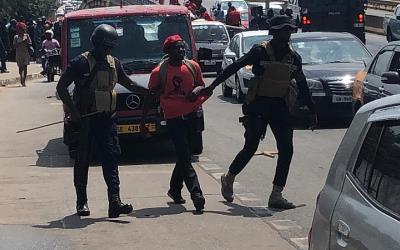
The Case of the Missing Galamsey Excavators

29 JANUARY 2020

FOR IMMEDIATE RELEASE

JOINT PRESS STATEMENT BY THE MEDIA COALITION AGAINST GALAMSEY AND OCCUPYGHANA

THE CASE OF THE MISSING GALAMSEY EXCAVATORS

Accra, January 29, 2019 – The Media Coalition Against Galamsey, OccupyGhana, and we believe, most Ghanaians, are disappointed and saddened by the revelation by the Minister for Environment, Science, Technology and Innovation, Professor Frimpong Boateng that hundreds of seized Galamsey excavators have disappeared from District Assemblies around the country.

Our deep concern at this revelation stems from the fact that the authorities have simply once again failed to follow and enforce the law. The inability of the government to enforce the law, from the facts as we know them, is only matched by the brazenness of the illegal miners.

We have a number of questions for the government that require answers; and we respectfully demand those answers.

First, under the 2006 Minerals and Mining Act, it is illegal for anyone to “erect equipment… for the purpose of mining” without being the holder of either a mining lease or a small-scale mining licence. Everyone who does this commits an offence. The government has to explain to Ghanaians whether the persons from whom the equipment was allegedly seized were also arrested. If that did not happen, the government should explain why it did not happen. Or, were the illegal miners also allowed to disappear just like the equipment?

Second, the law then provides that upon the arrest of illegal miners, the equipment they were using “shall, regardless of the ownership…, be seized and kept in the custody of the police.” It is for very good reason that the law demands that the equipment should be kept by the police, and no other institution. The government therefore has to explain to Ghanaians why the equipment allegedly seized was kept with District Assemblies and not the police. Was this deliberate? Was this to make it very easy for the equipment to simply ‘disappear’? Did anyone take an inventory of the seized equipment and if so where is that inventory? Which public officers were responsible for flouting the law?

Third, the Act demands that the arrested persons should be tried in court and then upon conviction, the court is empowered to “order the forfeiture of any equipment… seized.” The government has to explain to Ghanaians whether the persons from whom the equipment was seized were duly prosecuted, and if not, why not? Without prosecution, the seized equipment cannot be forfeited in the manner the law demands. Are any prosecutions still taking place? If so, have there been any convictions? And if so, did the courts order forfeiture? Is the government able to publish a report on these matters?

Fourth, the Act provides that within 60 days of the confiscation, the Minister for Mines shall “allocate the equipment… to the appropriate state institution and publish in the Gazette the name of the state institution to which the equipment… is allocated.” We do not need to ask this question because it is pretty obvious to all of us that this has not happened.

Fifth, the Roadmap For Lifting of Ban on Artisanal & Small Scale Mining & the Way Forward policy document says in section 3.2.1 bullet 3 that there shall be a “Directive by the Government/IMCIM to move all earth moving mining equipment for artisanal and small-scale mining to designated areas for subsequent registration and installation of tracking devices. This will be done under the direct supervision of the Regional Ministers prior to the vetting of artisanal and small-scale mining companies”. Obviously from the statement of the Minister this directive has not been implemented.

Also, section 3.2.5 states that “The Minerals Commission in collaboration with the Driver and Vehicle Licensing Agency (DVLA) have been tasked to register and install tracking devices on earth moving equipment to ensure that the use of equipment at inappropriate locations are monitored and reported. A committee was formed to deal with the registration and installation of tracking device on the earth moving mining equipment.” Has this provision been implemented? If it had, these excavators would have been registered and could be tracked making it impossible for them to be stolen. Can the government explain to Ghanaians why this has not happened?

And, sixth, we also need to know from the government whether all existing mining leases and small-scale licences have now been submitted to Parliament for ratification as is required under both the Constitution and the Minerals and Mining Act.

Considering the above and the revelation by the Minister, the government should be as unhappy as we are, and more so. If the government with all the power and force at its disposal is unwilling to or incapable of implementing and enforcing its own laws, then it gives a signal to potential wrongdoers that we have no respect for the rule of law; it is just something we mention to others to make us feel good. That is why the nation is still under brazen attack from illegal miners. They know that we make noise and even deploy our military, but we have no teeth to bite. Nowhere is this more evident than the blatant illegal mining at the place called “Dollar Power,” and the apparent inability or unpreparedness of the government to enforce the law there. This and the impunity it connotes should be a scar on our conscience.

We are therefore not surprised that the War Against Galamsey is generally accepted to be failing. Operation Vanguard has all but petered out. That is unacceptable. We call on the government to shake itself out of its stupor and enforce the mining law without fear or favour. We also call on the media and civil society organizations to reawaken, hold leadership to account and reinvigorate the #StopGalamsey war.

Losing this war is not an option. Irresponsible and unsustainable mining is an existential threat and should not be countenanced.

Issued by:

Media Coalition Against Galamsey
OccupyGhana

OccupyGhana® Demands Return Of Government Vehicles Illegally Sold To Political Appointees

OccupyGhana® Demands Return Of Government Vehicles Illegally Sold To Political Appointees

27TH JANUARY 2020

OCCUPYGHANA® PRESS STATEMENT

OCCUPYGHANA® DEMANDS RETURN OF GOVERNMENT VEHICLES ILLEGALLY SOLD TO POLITICAL APPOINTEES

OccupyGhana® has read reports of a statement by President John Mahama on 17 January 2020 that if he is elected back to office, he would “to put an immediate and permanent end to the purchase of duty post vehicles by political appointees,” and that “Government vehicles will remain government vehicles.” On this matter there appears to be unusual unanimity among the two leading contestants, as President Akufo-Addo is also reported to have told ministers on 11 April 2017 that “No official is any longer going to have the opportunity to buy any official car, so that we put an end to [the constant buzz], ‘Where are the cars? Where are the cars?’ Nobody is going to have that capacity anymore.”

While we at OccupyGhana® wholeheartedly agree with these pronouncements, we have grave reservations that must be addressed. Simply, we are not satisfied with bare promises and assurances of executive action. We believe that this is a matter where government is simply required to respect and comply with the law as laid down in the 2003 Public Procurement Act, as amended in 2016.

Therefore, we demand proof that the government followed that law in the sale of a massive 361 government vehicles to “political appointees” between 29 December 2016 and 6 January 2017, or a return of all of those vehicles to the government for due process to be complied with and proper value realised for them. The law that applied in 2016 is that which applies now. If the law was breached then with no consequences and sanctions, there is no guarantee that it would not be breached again. That is why these the “never again” assurances provide cold comfort and ring hollow to us.

When the Public Procurement Act was passed in 2003, it introduced under its Part Eight (sections 83 and 84) a mandatory procedure for disposing of government “stores, plant and equipment.” That procedure involved establishing a Board of Survey, obtaining a Technical Report and Recommendations, and ultimately, the sale of only “obsolete or surplus items” by public tender to the highest tenderer or public auction subject to a reserve price.

While several citizens were in no doubt that this law applied to the sale of government vehicles, successive governments still disposed of such vehicles especially to their appointees after every election, without recourse to the law. The ridiculous and risible excuse from those governments was that the words “stores, plant and equipment” in the law did not specifically apply to vehicles.

However, with pressure from civil society and several others, in June 2016, Parliament finally amended section 83 of, and introduced a new section 83A to, the 2003 Public Procurement Act, so that the mandatory procedure for disposing of government assets would specifically apply to government vehicles.

Thereafter, one would have expected that the government would comply with this new law. However, in a period of just nine days starting from 29 December 2016 and ending on the night before the handover of power on 7 January 2017, and while Ghanaians were focused on the political transition, there was this massive sale of government vehicles to departing political appointees in apparent disregard and breach of the law, at an average of 40 cars per day!

On 28 March 2017, we wrote to both the Chief of Staff and the Administrator-General under our right to information under Article 21(1)(f) of the Constitution, inquiring whether the government followed the law in those disposals. It was within weeks of this letter and while we were awaiting responses that President Akufo-Addo announced the ban.

When after several months of more waiting we did not receive a response from either office, we sent reminders on 30 January 2018. This time we received a response from the Administrator-General on 7 February 2018 providing us with a schedule and details of 361 “vehicles disposed of as end-of-service benefits to political appointees,” the names of the beneficiaries, and how much they were sold for.

If the breach of the law was surprising, then the prices at which the vehicles were sold told shocking story. For instance a Toyota Camry registered in 2014 was sold to a political appointee in 2016 for GHS12,500. A Toyota Corolla commissioned in 2013 and registered in 2015 was sold to another political appointee for GHS6,000. Another Toyota Corolla, commissioned and registered in 2016 was sold for GHS6,100 to an appointee. A one-year old Nissan Sunny went to an appointee for GHS7,500. In another instance, a Toyota Avensis was sold for just GHS1,200 to another appointee. BMWs were sold to the more prominent appointees at between GHS25,000 and GHS45,000.

In the absence of the Technical Report that the law demands, it is impossible to ascertain if these vehicles were even or duly classified as “obsolete and surplus.” What has become apparent is that there was no Board of Survey or Technical Report. There certainly were no public tenders or public auctions. The vehicles were simply handed over to political appointees at ‘yor kɛ gari’ prices, all in flagrant breach of the law.

That is why in the Administrator-General’s 7 February 2018 letter, he tellingly stated that he could not provide information on whether the disposals complied with the mandatory procedure imposed by law, and then directed us to seek answers to this from the Office of the Chief of Staff. That office has never responded to us. When on 14 February 2018 we wrote back to the Administrator-General demanding data on disposal of assets since 2003, he responded on 15 February 2018 to say that his office did not have that data since it only came into existence in 2013.

Our further letter to the President dated 17 July 2018 demanding a full-scale inquiry into the matter has received neither a response nor any action. The lack of response is particularly worrying when viewed against the fact that section 92 of the Act criminalises breaches of its provisions and makes offenders (i.e. officials and beneficiaries) liable to be jailed for up to five years.

It is in the light of the above that we remain unconvinced by the assurances made by the immediate past president and the current president to end this practice. We note that they still fail to acknowledge the sheer illegality of it. That is why we believe that the best way to assure Ghanaians that this practice is or will be a thing of the past, would be to satisfy Ghanaians that the December 2016 sale of 361 government vehicles was in accordance with the law. If not, we expect the government to rescind those sales forthwith and then compel compliance with the law.

We call on all well-meaning Ghanaians to support our demands especially in the light of our shared constitutional duty under Article 41(f) “to protect and preserve public property and expose and combat misuse and waste of public funds and property.”

We believe that in the coming elections, Ghanaians will judge the parties, especially those that are in power or have been in power before, not just by the sweetness of their promises and assurances, but by their deeds concerning the same matters about which they seek to make promises and give assurances.

Still in the service of God and Country.

OccupyGhana®

CONSTITUTION DAY: IT IS TIME TO TAKE THE ASSETS AND LIABILITIES DECLARATION REGIME SERIOUSLY

7th January 2020

OCCUPYGHANA® PRESS STATEMENT

CONSTITUTION DAY: IT IS TIME TO TAKE THE ASSETS AND LIABILITIES DECLARATION REGIME SERIOUSLY

OccupyGhana® salutes Ghanaians on the 26th anniversary of the coming into force of the Fourth Republican Constitution. Marking 7th January as ‘Constitution Day’ is intended to acknowledge Ghana’s collective efforts at ensuring that the tenets of democracy, rule of law and principles of constitutionalism are upheld. This has been the longest spell of constitutional democracy since independence, and it is no mean achievement.

On this auspicious day we would want to highlight, once again, an aspect of our Constitution that has been largely ignored by successive governments, but which is currently being forced to the front burner of our national discourse by the Auditor-General: the declaration of assets and liabilities by public office holders.

Our position is summarised as follows:

(i) affected officers must file the declarations at the specific times prescribed by the Constitution (for which reason the six-month extension granted by statute is unconstitutional and must be repealed),

(ii) the over 40,000 public officers in default must be compelled to comply forthwith, and

(iii) the Auditor-General must end the unconstitutional system of secret, unverified declarations.

TIME FOR FILING

The Constitution expressly and mandatorily requires that prescribed office holders must declare their assets and liabilities to the Auditor-General (i) before taking office, (ii) on every fourth anniversary thereafter, and (iii) at the end of a person’s term of office. We demand strict compliance with these mandatory timelines.

That is why we remain convinced that the provision in section 1(4) of Public Office Holders (Declaration of Assets and Disqualification) Act, 1998 (Act 550), which gives a 6-month extension for making declarations, is unconstitutional and void.

We therefore repeat our invitation to the government to take immediate steps to repeal this offending provision, without us having to proceed to the Supreme Court to have it struck down as unconstitutional.

PRESCRIBED OFFICERS

The Constitution prescribed specific public office holders who were to declare, and allowed Parliament to extend the coverage to other public office holders. This is what Parliament did when it passed Act 550, Schedule 1 of which contains the extended list.

Unfortunately, the vast majority of public office holders have simply failed, refused or neglected to make the declarations. From our conservative estimates, more than 40,000 public officers are currently in breach of the law.

While we were contemplating legal action against every public office holder in breach, we became aware of the Auditor-General’s 31st December 2019 Circular that announced that henceforth the declarations would be considered part of audits and that offending officers shall be reported to the Commission on Human Rights and Administrative Justice for action as required by article 287 of the Constitution.

Since then we have become aware of some frantic and even desperate efforts by some heads of affected institutions to ensure compliance within those institutions. We commend this to every institution mentioned in the law. As the saying goes, “better late than never.”

We also welcome this bold move by the Auditor-General and we give it our full and unalloyed commendation and support.

END OF SECRET DECLARATIONS

The fact is that even in the relatively few circumstances where declarations have been made, they have been made in sealed envelopes to the Auditor-General and remain unopened, unaudited and unverified.

However an automatic audit or verification would ascertain whether (i) the assets and liabilities were declared in accordance with the law, (ii) the assets declared actually exist, so as to prevent ‘assumptive’ declarations (where the person declares non-existing assets now, based on the assumption that through corruption those assets may be acquired later), (iii) the declarations were submitted within the time provided by the Constitution, and (iv) any new assets were acquired or liabilities discharged while in office, so that an inquiry may be conducted into whether those assets or the means to settle the declared liabilities were genuinely acquired.

Sadly, successive Auditors-General have not considered it part of their obligations under the Constitution to open the sealed envelopes, let alone verify or audit their contents.

We reiterate our position that there is nothing in article 286 that supports the current “secret declaration,” which is a contradiction in terms. The concept of a “secret declaration” that remains uninspected in the hands of the Auditor-General is not just alien to the Constitution but an anathema, and is therefore unconstitutional.

Verification by the Auditor-General is the only way to give life to article 286(3) as follows:

“Any property or assets acquired by a public officer after the initial declaration required by clause (1) of this article and which is not reasonably attributable to income, gift, loan, inheritance or any other reasonable source shall be deemed to have been acquired in contravention of this Constitution.”

The current stance therefore flies in the face of the probity, accountability and transparency provisions in the Preamble to the Constitution, negates the mandatory obligation placed on the state under article 35(8) “to eradicate corrupt practices,” and claws back the duty placed on citizens by article 41 “to protect and preserve public property and expose and combat misuse and waste of public funds and property.”

CONCLUSION

This is the fifth time that OccupyGhana® is raising the issue of assets and liabilities declaration. We believe that the government must take the lead in this matter and simply ensure that affected officers comply with the law. Further, we do not think that the government wants to wait for years of litigation before simply repealing the six-month extension for the declarations.

While saluting and congratulating Ghanaians on the 26th anniversary of the Fourth Republican Constitution, we wish to remind ourselves that there is a lot more to do to safeguard the Constitution and make its provisions relevant.

We once again invite all Ghanaians to occupy our spaces because if each of us does a little, together we will do a lot.

Still in the service of God and Country

OccupyGhana®

OCCUPYGHANA® HAILS CONSTITUTIONAL INDEPENDENCE OF AUDITOR-GENERAL

12TH DECEMBER 2019

OCCUPYGHANA® PRESS STATEMENT

OCCUPYGHANA® HAILS CONSTITUTIONAL INDEPENDENCE OF AUDITOR-GENERAL

OccupyGhana® has closely followed the story about the Auditor-General disallowing a one million dollar payment and surcharging the Senior Minister with that amount.

We have also seen a statement dated 11th December 2019, issued by the Senior Minister in which he states his disagreement with the Disallowance and Surchage and communicates his intention to challenge them in court.

We do not think that these momentous developments in our history ought to pass without comment.

This is probably the first time in this Fourth Republic (and possibly in Ghana’s political history) that an Auditor-General has dared to issue a Disallowance and then Surcharge a minister; and no less a minister than the Senior Minister.

And under the constitutional dispensation that we are blessed with, the Auditor-General who issued the Disallowance and Surcharge cannot mysteriously disappear. He cannot be shut up. He cannot be arrested or lose his job for doing his work. Rather, people he surcharges (whoever they are) have no option but to work under the principles of constitutionalism and the rule of law, and to challenge the Auditor-General in court.

When in November 2014, OccupyGhana began the fight to compel the Auditor-General to exercise the constitutionally-mandated powers of Disallowance and Surcharge, our biggest obstacle was the several naysayers who were convinced that we had no case and would lose. But we were confident because our cause was just and our course was right. We were fortified in our simple argument: that where the Constitution donates a power and prescribes the circumstances under which the power is to be exercised, it is a breach of the Constitution if that power is never exercised. We were convinced that especially where the Auditor-General himself issued annual reports showing the routine illegal dissipation of Ghana’s resources, the non-use of the power to check that wrong was in and of itself an abuse of the power.  We therefore urged the Supreme Court to interpret the empowering word “may” in the Constitution as the imperative “shall,” so that whenever the Auditor-General discovers what he considers to be a wrongful use of Ghana’s money, he would be mandatorily required to disallow and surcharge.

When on 21st June 2016 the Supreme Court came out with a judgment that granted each of the five reliefs we had sought, we knew that the history of public sector accountability in Ghana had changed forever. But the Supreme Court was not done. It gave one further relief that we had not even asked for, as follows: “Finally, the Attorney-General is hereby ordered to take all necessary steps to enforce the decisions or steps taken by the Auditor-General…to ensure compliance including in some cases criminal prosecutions.”


Going to court cost us a lot in terms of energy, time and resources. But Ghana was and remains the winner from our convictions and resolve.

We do not know as yet the legal route that the Senior Minister plans to take in his promised challenge. However, if it is an appeal under the new Order 54A of the High Court (Civil Procedure) Rules, 2004 (CI 47), then we are even more gratified because we were proud to work on and submit the original draft that gestated into the Bill, which was adopted by the Rules of Court Committee and passed by Parliament as the High Court (Civil Procedure) (Amendment) (No. 2) Rules, 2016 (CI 102), and which we have happily named “the OccupyGhana Rules.”

We believe that in the final analysis, if the Auditor-General erred in the Disallowance and Surcharge against the Senior Minister, the court will say so. However, if he was right, the court will also say so and hold the Senior Minister liable to pay the money paid under the transaction to the state.

That is democracy. That is constitutionalism. That is the rule of law. Ultimately, when the story of Ghana is told, it ought to end with three words: “…and Ghana won.”.

Yours in the service of God and Country,

OccupyGhana®

OCCUPYGHANA® DEMANDS ASSETS AND LIABILITIES DECLARATION BY OVER 40,000 AFFECTED PUBLIC OFFICERS

16th OCTOBER, 2019

OCCUPYGHANA® PRESS STATEMENT

OCCUPYGHANA® DEMANDS ASSETS AND LIABILITIES DECLARATION BY OVER 40,000 AFFECTED PUBLIC OFFICERS

NON-COMPLIANCE
Article 286 of the Constitution demands the declaration of assets and liabilities by the occupants of certain public offices under three circumstances: (1) upon appointment, (2) every four years, and (3) at the end of the appointment. This provision has become notorious for the breach of it rather than compliance with it.

Often, the discourse has focused on the political offices that article 286(5) specifically mentions. Scant attention has been paid to the chairpersons, MDs and CEOs, General Managers and Departmental Heads in public corporations and companies “in which the State has a controlling interest,” who are also covered. Possibly no attention is paid to the category the Constitution specified as “such officers in the public service and any other public institution as Parliament may prescribe.”

In the Public Office Holders (Declaration of Assets and Disqualification) Act, 1998 (Act 550), Parliament prescribed several additional, covered officers including officers “in any other public office or public institution other than the Armed Forces, the salary attached to which is equivalent to or above the salary of a Director in the Civil Service.”

From preliminary and raw data to which we are privy, the number of public officers who fall within this ‘salary-based requirement’ but who do not comply with the mandatory declaration of assets and liabilities exceeds 40,000.

In the Ministry of Education alone, over 5,000 officers are covered. Others include the Ministries of Finance and Health, each of which has over 3,000 officers covered. Each of the Ministry of Interior, Ghana Health Service and Controller and Accountant General’s Department has over 1000 officers covered. The Audit Service has well over 600 officers affected.

When we apply the ‘salary-based requirement’ to officers of the various other Ministries, Departments, Agencies, Authorities, Commissions, Councils, Boards, Services, Institutes, Organisations, Secretariats, Colleges, Programs, Diplomatic Missions, and the Metropolitan, Municipal and District Assemblies, then our 40,000 estimate appears extremely conservative. The actual figure could exceed 10% of all public servants.

The effect is that all of these public officers are in breach of article 286 of the Constitution and should be facing sanctions under article 287.

ONLINE DECLARATIONS
The sheer volume of declarations required brings into sharp focus the capacity of the Auditor-General to receive the declarations and then verify them to ensure that the correct declarations are made. The statutory requirement for obtaining, completing and submitting hard copy forms is clearly obsolete and impractical, and a fetter to both compliance and the Auditor-General’s audit and verification responsibilities.

We therefore call upon the Government to, as a matter of extreme urgency, procure necessary, appropriate and robust software that will make it easy both for affected officers to comply by simply filling the forms online and for the Auditor-General to audit and verify the declarations made. We also call for the immediate amendment of Act 550 to provide statutory support for the online declaration regime, if deemed necessary.

CONCLUDING COMMENTS
In our press release on Assets and Liabilities Declaration issued on January 28, 2018, we stated that the Auditor-General’s post-declaration audit and verification function, which to the best of our knowledge have never happened, are critical to ascertain whether the assets and liabilities are declared in accordance with the law, upon the assumption the public officer assuming office. The audit and verification would investigate whether the assets declared actually exist, so as to prevent ‘assumptive’ declarations, where the person declares non-existing assets now, based on the assumption that through corruption those assets may be acquired later. The audit and verification would also determine whether the declarations were submitted within the time provided by the Constitution, and whether any new assets were acquired or liabilities discharged while in office, so that an inquiry may be conducted into whether those assets or the means to settle the declared liabilities were acquired genuinely.

We repeat that the only way to give voice and flesh to article 286 is to equip the Auditor-General to verify and audit declarations that are submitted, or at least a sample of them.

We once again call on the Auditor-General to outline a verification and audit procedure that reflects the true and proper interpretation of the Constitution, particularly article 286, in line with the above, and implement it forthwith.

Yours in the service of God and Country

OccupyGhana®

OCCUPYGHANA® CONDEMNS POLICE BRUTALITIES AGAINST DEMONSTRATING LAW STUDENTS AND DEMANDS REFORMS TO PROFESSIONAL LEGAL EDUCATION

OCCUPYGHANA® CONDEMNS POLICE BRUTALITIES AGAINST DEMONSTRATING LAW STUDENTS AND DEMANDS REFORMS TO PROFESSIONAL LEGAL EDUCATION

9th OCTOBER, 2019

OCCUPYGHANA® PRESS STATEMENT

OCCUPYGHANA® CONDEMNS POLICE BRUTALITIES AGAINST DEMONSTRATING LAW STUDENTS AND DEMANDS REFORMS TO PROFESSIONAL LEGAL EDUCATION

POLICE BRUTALITIES

OccupyGhana® is appalled by the brutal assault that the Police meted out to unarmed and peacefully demonstrating law students and their sympathisers on Monday, October 7, 2019. We have seen footages and photographs that show several infractions against the rule of law and of humaneness on the part of the Police. This Police high-handedness and brutality against students exercising nothing more than their constitutional right to demonstrate and air out their grievances makes a mockery of the democracy we claim to respect, and we wish to unequivocally announce our disgust with that turn of events and to condemn same in no uncertain terms.

We have closely studied the Police Statement on the matter which, to all intents and purposes, is a poor attempt to throw dust in the faces of Ghanaians concerning a true and accurate account of the day. For instance, how does the Police Service explain how the protestors somehow procured arsenals of stones to hurl at Police officers on the Independence Road stretch between the Canadian Consulate to the Golden Jubilee House? How is it possible, in 2019, for the police to call an exercise of the constitutional right to assembly “illegal” when police permits are not required to stage a demonstration, and the notice requirement in the Public Order Act can never morph into an unconstitutional demand for some kind of police permission?

We could ask a dozen questions about the Police Statement, which we find as offensive as we find their unwarranted abuse of power and their impunity in a civilised society governed by respect for human rights, human dignity, the rule of law and justice. And we wonder how Government can bear the news that many of these harmless student protestors reportedly found shelter at a foreign consulate from the atrocities of their country’s own Police Service.

We repeat and remind the Police that the right to demonstrate is an inalienable right that requires absolutely no police approval or censure beyond notification. And no edifice, building or “zone” should exist which, having the benefit of public access roads, public traffic and public thoroughfare in whole or in part, cannot accept the presentation of petitions by unarmed and inoffensive demonstrators. No ground in this country is so sacred that it cannot tolerate the lawful exercise of unarmed students’ rights to demonstrate.

We demand, at the very least an apology from the recently-confirmed Inspector General of Police who bears ultimate responsibility for this egregious display of brutishness. We also demand that all Commanding Officers who directly supervised, sanctioned and called for these barbaric attacks on innocent protestors be punished in accordance with the law.

PROFESSIONAL LEGAL EDUCATION

We must also emphatically state that the time is ripe to address the root cause of this matter: the inability of the state to provide sufficient facilities to enable law students from the various law faculties and law schools gain access to professional legal education. We cannot, as a people, grant accreditation for several law faculties and law schools to be opened and run, and then maintain the current size of the School of Law for the professional law course, a completely unjustified bottleneck and another evidence of our lack of planning.

It is a fact that the introduction of the entrance examinations and the erstwhile interviews remain a formalised knee-jerk reaction to a problem that has an obvious solution that we refuse to provide. Ghana is not an island. Several other countries have resolved this problem in a manner that allows prospective lawyers to be trained and given the opportunity to write the final bar exam, however often they may write it. There is nothing wrong with learning from others and adapting what we learn to suit our purposes.

The Government cannot absolve itself of blame in this regard. It is statute that created the General Legal Council. That statute gives the Council the power to regulate professional legal education, sometimes with the approval of the Attorney-General. We insist that the same legislative process should be used to fix this problem once and for all.

A country of almost 30 million people cannot be proud that its official roll of lawyers has just about 3,000 lawyers. A ratio of one lawyer to 10,000 citizens is highly anaemic, and any existing or new policy that unduly restricts access to any form of education, especially in a developing economy, is not forward-looking and should be jettisoned. The time for action on this matter is now, and this buck stops at the desk of the Government.

CONCLUSION

In conclusion, we demand of the Police Service, the General Legal Council and the Government of Ghana to be guided by the principles outlined in the Ghanaian constitution that all power emanates from the people and not the other way round.

Yours in the service of God and Country

OccupyGhana®

OCCUPYGHANA® DEMANDS CLARITY AND DIRECTION ON THE COMPREHENSIVE SEXUALITY EDUCATION (CSE) DISCUSSION

3rd OCTOBER, 2019

OCCUPYGHANA® PRESS STATEMENT

OCCUPYGHANA® DEMANDS CLARITY AND DIRECTION ON THE COMPREHENSIVE SEXUALITY EDUCATION (CSE) DISCUSSION

OccupyGhana® has keenly followed the active discussions and strong views on the alleged or proposed introduction of CSE into the curriculum of public basic schools.

The lack of clarity and apparent contradictions in statements and actions by government officials on whether such a curriculum is to be implemented at all, and if so what the content would be, is at the heart of the confusion that is festering.

We note that the Minister for Education has been careful to emphasise that CSE is not a part of the “approved” curriculum and curriculum framework for use by the Ghana Education Service for all public schools, that no teacher has been trained on CSE, and that CSE was not included in teacher resource packs and manuals.

However we have seen video footage dated February 2019 in which the minister referred to some guidelines and was emphatic that sexuality education should be part of the curricula to be launched in September 2019 “all they way from Kindergarten to Senior High School.”

This, we believe, was at a program held in Accra where Ghana and UNESCO announced the launch of a CSE program called “Our right, Our lives, Our future (O3),” the implementation of which was reported to have already started in 2018.

Further in paragraph 369 of the 2019 Budget Statement, the Finance Minster announced that the National Population Council and “other stakeholders” had collaborated to develop CSE guidelines “for incorporation into the national education curriculum,” and making reference to the National Condom Strategy.

Much earlier in June 2017, the Ministry of Education participated in the launch of the comprehensive sexuality education manual for young people titled “KnowItOwnItLiveIt,” a product of the Planned Parents Association of Ghana (PPAG) and Marie Stopes International Ghana (MSIG). We note that the GES also participated in the launch and were reported to be developing content for the project. Although there is no evidence that this document would be considered or treated as part of any proposed curriculum, it is difficult to divorce the circumstances surrounding its launch from the current discussions.

Further, we have seen what purports to be a Ghana Government and GES document (the foreword of which bears the following name and title “KWASI OPOKU-AMANKWA (PROF), DIRECTOR-GENERAL, GHANA EDUCATION SERVICE”) containing guidelines for CSE in Ghana, and which has modules for teaching CSE from Pre-school to SHS. Page 8 of this document discloses that “the choice of topics is informed by the six features of CSE in the Bogota Declaration of 2010,” the first of which is captured as “Respect for human rights and diversity with sexuality education affirmed as a right.” The Report issued in Bogota, Colombia in December 2010 and, titled “Comprehensive Sexuality Education: Advancing Human Rights, Gender Equality and Improved Sexual and Reproductive Health,” contains and endorses aspects of sexuality that some Ghanaians might object to.

We have also seen the Teacher Resource Pack of the National Council for Curriculum and Assessment (NaCCA), titled “RESOURCE GUIDE FOR THE ORIENTATION OF PRIMARY SCHOOL TEACHERS TOWARDS THE IMPLEMENTATION OF THE REVISED CURRICULUM FOR PRIMARY SCHOOLS,” and it states at page 11 that CSE was one of the “contemporary issues addressed through the National Pre-Tertiary Curriculum Framework (NPCF).”

It is these and more that make it difficult to accept the Minister’s claim that CSE is not part of the approved curriculum. Even if it has not been formally approved, it is definitely under consideration. Our view is that the time is ripe for full and frank disclosure and a full-throttled debate on the matter and path going forward.

Ghanaians deserve and demand clarity on this once and for all. Specifically, we demand the following:

1. A definite position of the Government on the introduction of a CSE curriculum in our schools;

2. Before any approval or implementation, key stakeholders, including parents, traditional leaders and faith-based organisations must be actively engaged and involved in discussions surrounding it, so that the final product fully reflects our Ghanaian cultural and religious values;

3. If CSE is to be approved for implementation, then the Ministry of Education and Ghana Education Service must publish the detailed contents of the materials via traditional media channels, websites or/and social media; and

4. Parents must be given an “opt out” option for their wards. Parents whose wards remain in the programme must be supplied the same teaching material that the teachers would use and then constantly engaged by the teachers, so that the parents would emphasise their peculiar cultural, religious and other values to their wards as they are exposed to the topics being taught in school.

It should be clear to the Government that Ghanaians will not accept any CSE or other initiative that is suspected or believed to be the work of any foreign bodies, and which does not reflect our cultural and religious values, and public concerns. We believe that the education of Ghana’s future leaders in relevant subject areas is necessary to build a holistic character in them.

Yours in the service of God and Country

OccupyGhana®