OccupyGhana® Calls On Government To Immediately Address The Filth Engulfing The Country

OccupyGhana® Calls On Government To Immediately Address The Filth Engulfing The Country

1st MARCH 2018

OCCUPYGHANA® PRESS STATEMENT

OCCUPYGHANA® CALLS ON GOVERNMENT TO IMMEDIATELY ADDRESS THE FILTH ENGULFING THE COUNTRY 

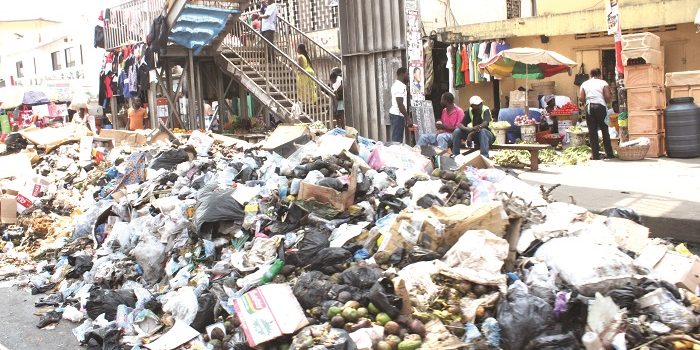
OccupyGhana® has noted with concern the huge swathes of plastic and other solid and human waste engulfing our country, especially our capital. It is rapidly reaching an alarming state and photographs taken after the recent downpour in parts of Accra in the morning of Wednesday 14th February 2018 have thrown this looming and potentially disastrous health and security problem into sharp focus.

We have also been monitoring how the matter of sanitation is being addressed by Government and we are concerned about Government’s commitment to resolve it

It appears that in spite of the establishment of the new Ministry of Sanitation & Water Resources, little has been done to confront and remove the filth engulfing our country. The reality is that by the Local Governance Act, 2016 (Act 936) and its predecessor statute, issues of sanitation are to be handled by the Metropolitan, Municipal and District Authorities (MMDAs). There are also the provisions of the Community Water and Sanitation Agency Act, 1998 (Act 564), and the functions assigned to that Agency. This legislative dilemma is compounded by the Environmental Sanitation provisions under Part Five of the Public Health Act, 2012 (Act 851), falling within the remit of the Ministry of Health. We therefore have doubts as to what the Ministry will do and achieve when it technically has no legislative mandate to handle sanitation anywhere in the country, unless its role is to coordinate the activities of all the legislatively-mandated bodies on issues of sanitation.

We have taken note of the National Sanitation Campaign launched by the President in November 2017, which does not appear to have made any real impact in resolving the problem yet. Under this campaign, there were to be:

  1. Introduction of automated street sweepers.
  2. The formation of a National Sanitation Brigade.
  3. Appointment of Sanitation Marshalls and Deputies in Municipal and District Assemblies; these appointments were to have been made within one week of the announcement by the President.

None of these initiatives appear to have started, with no clear cut time frame on when and how the Ministry of Sanitation & Water Resources intends to roll out the program.

The President also indicated that he and the Minister for Monitoring & Evaluation would evaluate the performance of all Metropolitan, Municipal and District Chief Executives (MMDCEs) and publish the results of their performance. We think that it would be very apt if the agreed Key Performance Indices used to evaluate them are published so that as Citizens we can monitor and score our MMDCEs on sanitation issues.

We also call upon our MMDAs and Ghana Police to rigidly enforce our laws regarding littering the environment, refuse disposal and open defecation, and charge and prosecute offenders. There are the specific provisions under sections 13(3) and 14 of the Local Governance Act, which empower them to enforce the provisions of section 296 (1) of the Criminal Offences Act, 1960 (Act 29) and section 56 the Public Health Act. These laws contain the penalties for breaches. We see no reason why the laws should not be strictly enforced and offenders punished. We urge the MMDAs and Ghana Police to enforce them without delay.

We urge the Government, acting through the MMDAs, to confront this menace before the impending rainy season, which comes with diseases such as cholera, a direct consequence of poor sanitation. OccupyGhana® is convinced that as a people we should ingrain the practice of keeping our surroundings clean on a continuous basis and not restrict it to periodic nationwide clean up exercises. To achieve this, the bodies tasked with sanitation responsibilities by law, must strictly apply our sanitation laws, carry out intensive and sustained public education and build a new positive attitude in our citizens toward caring for and protecting the environment. This must be done without any further delay.

We also urge Ghanaians to desist from littering the environment, refrain from disposing refuse improperly and stop the practice of open defecation. We must all strive as a people to live up to our dying national maxim: “Cleanliness is next to Godliness”.

The fight for a clean environment cannot be delayed further.

Let us Keep Ghana Clean!

OccupyGhana®

OccupyGhana® Calls For Support For The Auditor-General To Verify All Assets & Liabilities Declared By Public Officials

28TH  JANUARY 2018

OCCUPYGHANA® PRESS STATEMENT

OCCUPYGHANA® CALLS FOR SUPPORT FOR THE AUDITOR-GENERAL TO VERIFY ALL ASSETS & LIABILITIES DECLARED BY PUBLIC OFFICIALS

INTRODUCTION 

OccupyGhana® believes that it is within the constitutional remit of the Auditor-General to conduct an audit or verification of all forms submitted to that office by affected public officers, purporting to declare their assets and liabilities. Such audit or verification would be to ascertain whether:

(1) the assets and liabilities were declared in accordance with the law, upon the assumption by the public officer of his office,

(2) the assets declared actually exist, so as to prevent ‘assumptive’ declarations, where the person declares non-existing assets now, based on the assumption that through corruption those assets may be acquired later,

(3) the declarations were submitted within the time provided by the Constitution, and

(4) any new assets were acquired or liabilities discharged while in office, so that an inquiry may be conducted into whether those assets or the means to settle the declared liabilities were acquired genuinely.

Such a verification or audit could cover all assets declared since the coming into force of the Constitution.

We also believe that if the audit/verification reveals contravention or non-compliance or that there are assets that are not properly attributable to the income of the office holder, then the Auditor-General may refer the matter to the Commission for Human Rights and Administrative Justice (CHRAJ) for investigation.

OccupyGhana® has also received and studied the 2017 Conduct of Public Officers Bill. While recognising that the Bill contains some forward-looking provisions on assets declaration, we notice that the Bill stops short of expressly recognising the inherent power of the Auditor-General to verify the declarations that are submitted to her/him, although that recognition is inferred in that Bill.

We nevertheless do not think that the Bill must be passed into law, or that any constitutional or legislative amendments are required, for the Auditor-General and CHRAJ to perform these functions.

We believe that it is time for the said offices to rise up to the constitutional obligations placed on them, and perform these functions that will bring life and meaning to the relevant constitutional provisions in the fight against corruption.

We now turn to a discussion of the relevant constitutional provisions.


‘SECRET’ DECLARATIONS ARE UNCONSTITUTIONAL

Article 286(1) demands that holders of specified public offices “shall submit to the Auditor-General a written declaration of all property or assets owned by, or liabilities owed by him whether directly or indirectly.” The article speaks of a “declaration,” which we understand to mean a formal or explicit statement or announcement.

Currently the declaration is in the nature of a form that is found in Schedule 2 to the Public Office Holders (Declaration of Assets and Disqualification) Act, 1998 (Act 550). Our understanding of the current practice is that the Declaration Form is allegedly completed and submitted to the Auditor-General in a sealed envelope. We also understand that the envelopes remain sealed, and that the successive Auditors-General have not considered it as part of their obligations under the Constitution to open the sealed envelopes, let alone verify or conduct an audit of their contents.

We find nothing in article 286 that supports the current “secret declaration,” which is a contradiction in terms. The concept of a “secret declaration” that remain uninspected in the hands of the Auditor-General is not just alien to the Constitution but an anathema, and is therefore unconstitutional.

We also note that the power of the Auditor-General to verify the declarations submitted is implicit or implied in the language of the Conduct of Public Officers Bill. For instance, clauses 7 and 11 make it an offence to submit a false declaration or clarification, or to fail to submit a declaration or clarification. Clause 8 provides for the Auditor-General seeking clarification on matters such as the ownership of assets declared and explanation or correction of discrepancies or inconsistencies in the declarations. Clearly, these are not possible until the Auditor-General has exercised his power to verify or audit the declarations submitted to her/him.


TIME FOR MAKING DECLARATIONS

Further, article 286 demands that the declarations should be submitted to the Auditor-General by office holders (i) before taking office, (ii) at the end of every four years, and (iii) at the end of a person’s term of office. The Constitution expresses these in mandatory terms and does not permit the making of the declaration and submission on any date after the stated times.

Therefore, it is also unconstitutional to submit any declaration to the Auditor-General after the deadline stated in the article. Any office holder who submits the declaration after the stated deadline has breached the Constitution and the oath of office to “defend the Constitution of the Republic of Ghana as by law established.”

Accordingly, we believe that the provision in section 1(4) of Public Office Holders (Declaration of Assets and Disqualification) Act, 1998 (Act 550), which gives a 6-month extension for the submission of the declaration, is unconstitutional and void. The repeat of this in clause 4(3) of the Conduct of Office Holders Bill would also be unconstitutional if the Bill is passed into law.


NO CONSTITUTIONAL BAR TO VERIFICATION

Article 286(3) then provides that the declaration “shall on demand be produced in evidence” before a court, a commission of inquiry under article 278 and before an investigator appointed by CHRAJ.

Since the inception of the Constitution, this provision has been applied to mean that these are the only circumstances under which the declaration may be made public. We disagree. This provision only states instances where the declaration may be tendered in evidence. It does not say that apart from these circumstances, the declaration is and remains a confidential document that even the Auditor-General can neither audit nor verify. The article surely does not bar the Auditor-General from opening the envelopes submitted to verify if indeed what has been submitted is an assets and liabilities declaration form in the first place, and then to audit the contents, cross-checking with other assets and liabilities declared previously by the same persons.

That is why any application of article 286(3) to make the declaration submitted to the Auditor-General a secret even from the Auditor-General himself/herself also flies in the face of article 286(4), which is couched in general terms and not subject to article 286(3) as follows:

“Any property or assets acquired by a public officer after the initial declaration required by clause (1) of this article and which is not reasonably attributable to income, gift, loan, inheritance or any other reasonable source shall be deemed to have been acquired in contravention of this Constitution.”

Any position that purports to bar the Auditor-General from auditing and verifying the declaration would read article 286(4) as being subject to article 286(3), so that the only circumstances under which it may be discovered that an office holder had acquired assets or settled liabilities in breach of the Constitution, is when the declaration is “produced in evidence” in the course of court proceedings, commission of inquiry proceedings or CHRAJ investigations.

Our respectful view is that it is the Auditor-General’s audit or verification that would reveal whether any new assets have been acquired or liabilities settled. It is that audit that would inform the commencement of any of the article 286(3) proceedings at which the actual declaration submitted to the Auditor-General would be “produced in evidence.”

The current stance therefore flies in the face of the probity, accountability and transparency provisions in the preamble to the Constitution, negates the mandatory obligation placed on the state under article 35(8) “to eradicate corrupt practice,” and claws back the duty placed on citizens to “to protect and preserve public property and expose and combat misuse and waste of public funds and property.”


CONCLUSION

We reiterate that it is not for nothing that the Constitution provides that the assets and liabilities declarations be submitted to the Auditor-General, and no other person. In line with the residual auditing function of that office under the Constitution, we find it hard to believe that the declarations submitted remain unopened and are simply filed away. Without the Auditor-General conducting such audits and verification, the spirit and true intent of article 286 will never be achieved and the current “concealment and archiving” process will be used to defeat the article.

It is on these bases that we have concluded that the only way to give voice and flesh to article 286 is for the Auditor-General to verify and audit declarations that are submitted, or at least a sample of them. That audit will reveal to the office (i) whether a person has truly declared all assets and liabilities upon assumption of office, and (ii) when a person had completed service to the nation, whether that person has acquired any new assets or settled any liabilities so that an inquiry may be had into whether those assets were acquired genuinely.

We call on the Auditor-General to outline a verification procedure which reflects the true and proper interpretation of the Constitution, particularly article 286, in line with the above, and implement it forthwith. Yours in the service of God and Country,

OccupyGhana
Notice of Court Action to Births and Deaths Registry

Notice of Court Action to Births and Deaths Registry

January 26, 2018


The Attorney-General & Minister for Justice

Ministry of Justice and Attorney-General’s Department

Accra


Dear Madam,

REFUSAL TO REGISTER NAMES AT THE BIRTHS AND DEATHS REGISTRY – NOTICE OF ACTION

Our attention has been drawn to the implementation of an alleged policy by the Registrars of the Birth and Death Registry that refuses to register the birth of children whose names include names such as “Maame,” “Pappa,” “Nana,” “Naa,” “Junior,” “Nene,” “Nii” and “Ohemaa” as well as determine the order in which names must be written, giving prominence to foreign names over indigeneous Ghanaian names. The Registrars claim that they are empowered to do this on the basis of the Registration of Birth and Death Act, 1965 (Act 301).

We have however checked that Act and all relevant laws including the Regulations passed under the Act. We have not seen any provision that either supports this policy or gives the Registrars of Births and Deaths any power to refuse to register any name. We believe that this stance is a gross violation of the rights of Ghanaians to choose names (particularly Ghanaian names) as they deem fit for their children, subject to the right to change one’s name at any time later in life.

We therefore write to put you on notice, in accordance with section 10 of the State Proceedings Act, 1998 (Act 555), that we intend to commence civil action against the Republic within thirty (30) days of the date of this letter if this illegality is not addressed forthwith.

We however believe that this cause of action will not be necessary if all Registrars of the Births and Deaths Registry will be directed to desist from these acts and stop refusing to register such names as they have no basis in law.

Yours faithfully,

OccupyGhana®

cc

The Honourable Minister

Ministry of Local Government

Accra.


The Registrar

Birth and Deaths Registry

Accra

OccupyGhana® Calls For The Existing Television Licence Regime To Be Repealed And Replaced

OccupyGhana® Calls For The Existing Television Licence Regime To Be Repealed And Replaced

4th JANUARY 2018

OCCUPYGHANA® PRESS STATEMENT

OCCUPYGHANA® CALLS FOR THE EXISTING TELEVISION LICENCE REGIME TO BE REPEALED AND REPLACED

OccupyGhana® has followed the recent discussions regarding TV Licence Fees, particularly the announcement that specific courts have been established to try defaulters. We disagree with these moves for two reasons:

  1. There is no constitutional or statutory basis for the Ghana Broadcasting Corporation (GBC), simply as the designated “licensing authority,” retaining the revenue from what is essentially a tax, and then determining how to use it, outside laws passed and appropriations made by Parliament, and
  2. The entire TV Licence regime that was established in 1966 (with just a few amendments) has become obsolete. What is required is not a forcible re-implementation of it, but a root-and-stem review that repeals the existing law and regime, and, if necessary, introduces a new statute and regime that takes the current realities in broadcasting into account.

We will address these matters in turn:

UNCONSTITUTIONALITY AND ILLEGALITY

The Television Licensing Act, 1966 (NLCD 89) and the various Television Licensing Regulations passed under it, provide for the payment of TV Licence Fees for the licensing of the installation and use of “television receiving sets.” These are to exist and operate under the auspices of a “licensing authority” that would be either “the Ghana Broadcasting Corporation or any other statutory corporation appointed by the Minister by legislative instrument.” Every contravention of the Act (including the non-payment of the fee) is an offence punishable by up to a fine of 250 penalty units (GHS3,000) and/or up to one year’s imprisonment.

The TV Licence Fee is simply a tax for owning or dealing in the affected apparatus. GBC is merely the currently designated body to administer the licences and collect those taxes, as an agent of the government. We are not aware of any statute that gives GBC the power to retain the revenue derived from the tax and then use it for its operations, developing content, sharing with other broadcasters or for any other purpose.

That tax revenue is also not listed as one of the sources of funds of the GBC under section 10 of the Ghana Broadcasting Corporation Act, 1968 (NLCD 226). Although that section provides that GBC’s funds include “moneys accruing to the Corporation in the course of the performance of its functions,” tax revenue does not accrue to the GBC and does not fall under this rubric. Similarly, if the Minister were to designate another statutory corporation as the “licensing authority” under the Act, that entity would not have the right to use the revenue.

Further, that revenue does not constitute GBC’s “internally generated funds” (IGF). Article 176 of the Constitution demands that “all revenues or other monies raised or received for the purposes of, or on behalf of, the Government;” and “any other monies raised or received in trust for, or on behalf of, the Government,” must be mandatorily paid into the Consolidated Fund. Exceptions, particularly retentions, are only permitted under an Act of Parliament.

That is why statutes such as the Ministries, Departments and Agencies (Retention of Funds) Act, 2007 (Act 735) and the Public Financial Management Act, 2016 (Act 921) contain strict rules on the use of IGFs, and our statute books are replete with specific statutes (too many to be listed here) in which Parliament expressly allows entities to keep all or part of IGFs. We are not aware of any such statute with respect to the GBC.

It is on these bases that we believe that the automatic retention of the TV Licence Fees by the GBC for its purposes is unconstitutional and illegal and we therefore call for that practice to cease forthwith. Absent a specific enabling legislation, all TV Licence Fees collected should be immediately deposited in the Consolidated Fund.

OBSOLENCE

We further contend that both the regime and the law on TV licensing are obsolete for three main reasons:

(i) The Act defines “television receiving set” as “an apparatus CONSTRUCTED SOLELY for the reception of pictures, with or without sound transmitted by radio” [Emphasis added.] This means that if the apparatus in use, by its manufacture and technology, is not restricted to only receiving pictures (with or without radio-transmitted sound), but is capable of receiving other signals, that apparatus is not the subject of licensing and consequently the payment of the fee. We think that contrary to your expressed view, the law expressly rules out the vast majority of apparatuses (Smart TVs, phones, pads, tablets, etc.) that are currently in use, and which are manufactured to receive and process more than just pictures. Indeed what may even be called “TVs” today are not mere linear broadcast receivers and translators of pictures. They are also used to play games, watch movies, project presentations, display location adverts and browse the Internet. The reality is that a strict application of a law that is based on 1966 technology, to 2017 apparatuses would leave the licensing authority with precious little or almost nothing to enforce the licence against.

(ii) With over authorized 505 radio stations (392 operational) and 75 television stations, Ghanaians have a lot of media sources to consume both local/public and international content. This ensures competition that should result in producing quality content. Also, Ghana has recorded a tremendous growth in the number and diversity of media channels, with Ghanaians having countless media sources such as radio, newspaper, magazines, websites and other online platforms. Further, online platforms such as YouTube, Hulu, Netflix, Apple TV, Amazon Prime Video and Google ChromeCast are redefining content broadcasting online and pointing to the future of TV broadcasting. All these are available and consumed in Ghana, driving the growth of data usage. There are also cable-TV services in Ghana who broadcast local channels through set-top boxes. Some of these have become the first choice channels for media content consumption, thereby reducing the audience share for traditional TV transmission. Evidently, GBC is not the only TV media source where public information is consumed for it to warrant an automatic right to TV Licence Fees and to be able to produce and broadcast public information. Further, not all Ghanaians or TV owners in Ghana will consume GTV’s content.

(iii) GBC (managers of GTV) is a commercial broadcaster. For years, it enjoyed an absolute monopoly in television broadcasting and the income from adverts and sponsored contents. Now it has competition and is faltering. Compelling Ghanaians to pay TV Licence Fees to GBC is grossly unfair and anti-competitive. Announcing the setting up of a court for these purposes sends the wrong signal to Ghanaians, that draconian steps are being taken to use the judiciary a tool of enforcement of a grossly unpopular tax. If GBC is unable to be profitable, in spite of years of government subvention and TV Licence Fees, then it may be time to consider selling it.

CONCLUSION

In conclusion, the world of television has moved from being analogue to the digital sphere. The rules have changed. In a world of digitisation, Ghana should be thinking of laws and policies that look into the future, and seek to create the enabling smart digital environment for prosperity and opportunities for all. You cannot, in 2017, be seeking to implement laws based on obsolete and currently inapplicable 1966 technology and then seek to punish Ghanaian for not complying with it. That is why we are advocating the repeal of the 1966 law and regime, and if necessary, the enactment of new laws that take the new realities into account.

Yours in the Service of God and Country.

OccupyGhana®

STATEMENT TO THE HEALTH MINISTER ON THE OUTBREAK OF INFECTIOUS DISEASES IN SENIOR HIGH SCHOOLS

17TH DECEMBER 2017

OCCUPYGHANA® PRESS STATEMENT

STATEMENT TO THE HEALTH MINISTER ON THE OUTBREAK OF INFECTIOUS DISEASES IN SENIOR HIGH SCHOOLS

Infectious diseases play a significant role in the health of Ghanaians. These diseases, some of which are highly contagious, are fortunately preventable and treatable. Their control however demands sustained and well-financed public health measures. A lack of such measures, their inadequate finance or incomplete implementation can lead to deaths.

It must be noted that some of these diseases are endemic to certain areas of the country while others occur everywhere. Some like meningitis tend to be seasonal while others like malaria may occur year round. What is common to all these diseases is that they are often found in places where people live in close proximity with each other. Our boarding schools and universities are such institutions that come to mind.

OccupyGhana® notes with concern the outbreak of infectious diseases in senior high schools in various parts of the country with at least 8 fatalities this year. In particular, we refer to the outbreak of H1N1 Flu in Kumasi Academy where 4 students have died and many others taken ill and hospitalised, and Meningitis in Koforidua Sec. Tech., Damango Snr. High School, and most recently Bawku Sec. Tech. School.

The questions that arise from these events are whether Ghana has adequate and well-financed public health measures to deal with these outbreaks and if these measures, if available, are implemented properly.

In a nutshell, these measures should include:
• a vaccination or prophylaxis program to protect against contracting these diseases,
• practices that help in protecting one from contracting them,
• a centre manned by trained professionals that monitors the incidence and outbreaks,
• a good reporting system that allows outbreaks to be reported,
• a team that responds to these reports of outbreaks,
• an incident manager to supervise the management of each outbreak,
• an effective way of quarantining affected individuals or communities,
• an effective way of tracking down individuals who may be carriers,
• a clear way of reassuring the public about the measures taken, and their safety and those of their families
• a program to treat the sick and
• measures to get the outbreak under control.

From all the reports of what happened in Kumasi Academy a few weeks ago, several issues become apparent:
• there is a reporting system that allows outbreaks to be reported to the Ministry of Health/ Ghana Health Service (GHS),
• the response from the GHS was adequate,
• it is unclear if autopsies were done on all 4 deceased students,
• diagnosis of the cause was rapid,
• quarantining of the affected students and areas was not good. The President visited the school in that period,
• there seems to be no vaccines available for the H1N1,
• there was a breakdown in adequate communication to the public about the outbreak and the measures being taken.

Considering these listed observations, what has happened at several schools so far, and the fact that we have entered the annual season for meningitis and outbreaks are expected in the meningitis belt, we respectfully ask the Minister of Health to provide answers to the following questions:
• Are our public health measures against infectious diseases well-funded?
• What steps has the ministry taken to protect the public and SHS students from meningitis?
• Have teachers and school staff been educated about meningitis?
• Have students been immunised against meningitis and other preventable infectious diseases?
•Do the schools have isolation guidelines and established links with health care facilities?
• Is there an effective communication strategy with the public and the media and who are the frontline communicators?
• Are the response teams allowed to quarantine affected individuals or even communities? Do we need the help of the military for that?
• Is there always an Incident Manager designated to manage the control of these outbreaks?
• What steps have been taken to enhance sanitation and hygiene and reduce congestion in schools?
• Could the GHS publish protocols to deal with outbreaks for schools?

Infectious diseases, though devastating in their effects, are also controllable and preventable. Let’s all work together to get a handle on them for a healthier Ghana for God and Country.

OccupyGhana®

OccupyGhana® Demands Outline For Passage Of The Right To Information Bill

11TH  NOVEMBER 2017

OCCUPYGHANA® PRESS STATEMENT

OCCUPYGHANA® DEMANDS OUTLINE FOR PASSAGE OF THE RIGHT TO INFORMATION BILL

OccupyGhana® is deeply concerned that there do not appear to be any clear or discernible plans to pass the Right to Information Bill into law. Despite numerous Government assurances that the Bill will be passed “this year,” “very soon” or in the “next session” of Parliament, no clear timetable has emerged.

The inexcusably long delay by successive governments under the Fourth Republican Constitution to pass this law suggests to us that governments are simply afraid to pass a law that will help actualise a right that the Constitution has already given to Ghanaians. Unless and until the law is passed, Ghanaians are entitled to conclude that governments will seek any and every excuse to defer the passage of this law for as long as possible.

OccupyGhana® is gratified that the courts have held that the right to information does not require an Act of Parliament to be exercised. Yet there remain substantive and procedural impediments to the exercise of this right. The current ‘default’ position of government departments is to either refuse or simply not answer any request for information. This forces citizens to go to court every time they seek to exercise that right. This is unacceptable and has to be addressed to ensure a straightforward and low cost system for the public to be able to enforce requests for information.

OccupyGhana® therefore demands from the government and Parliament, a clear timetable for the passage of this law. This timetable should take cognisance of the commendable public engagement process for the Office of Special Prosecutor Bill, and set firm dates by which:

  1. the government will publish and gazette the Bill;
  2. the Bill shall be tabled for debate in Parliament and
  3. the Parliamentary Select Committee on Constitutional, Legal and Parliamentary affairs shall conclude its deliberations on the Bill.

OccupyGhana® expects that the Bill, when passed into law, will set out the clear parameters and instances where the government will exercise public interest privilege (this is the privilege that allows government to refuse the disclosure of a document or information which is against the public interest.) The current wide-bound interpretation of the government on this privilege is, in our view, the greatest substantive and procedural hurdle to the full realisation of the right to information. Any law that does not deal with this matter in a manner that eases the right to information would be worthless and not have been worth the wait.

OccupyGhana® proposes that the mechanism of a truly Independent Commissioner with the power to determine disputes over public interest privilege would be the single most straightforward means of resolving any current impasse over this issue. An Information Commissioner using a highly simplified and swift process with limited scope for hearings and procedural delays would address concerns about the conflict between public disclosure and privilege. Any disputes over the Commissioner’s determination may be resolved by the Court, on narrow grounds akin to judicial review.

In conclusion, the continued delay in passing this Bill, which is now 18 years old, cannot and should not be accepted one jot further by the Ghanaian people.

Yours, for God & Country,

OccupyGhana®

OCCUPYGHANA® STATEMENT ON THE REPORTED DEFILEMENT OF A MINOR AT ASSIN ADADIENTEM AND MATTERS ARISING

7th NOVEMBER 2017

OCCUPYGHANA® PRESS STATEMENT

OCCUPYGHANA® STATEMENT ON THE REPORTED DEFILEMENT OF A MINOR AT ASSIN ADADIENTEM AND MATTERS ARISING

BACKGROUND.

Two weeks ago, we woke up to media reports, alleging that a 4-year old girl had been sexually abused in Assin Adadientem in the Central Region. This allegedly took place on 13th October 2017. The age of the suspect, named only as “Kwabena.” varies between 17 and 18 years, depending on which source you are getting the information from. The mother of the victim is alleged to have reported the matter to the chief, who is said to have pronounced the suspect innocent on the instructions of the gods. The chief has denied this. The victim’s father is also said to have reported the case to the police. There is very little to that part of the story.

According to one article on ‘myjoyonline’, she bled profusely for days before her mother sought help. According to one report, the victim’s mother had travelled to a funeral and had left her in the care of her 8-year old sister, a report that ought to be seriously investigated. That narrative, and given the fact that the mother detected the bleeding on the 14th of October, suggests that the mother was away for at least one night. Even though the article did not specify the bleeding site, we will assume that it was from the area of the vagina, considering the circumstances.

According to another Joy FM report, Dr. Bernard Brew at the St. Francis Xavier Hospital in Assin Fosu, issued a medical report showing an intact hymen with no evidence of laceration; the vulva however was moist and appeared inflamed.  These events are not unusual when it comes to matters involving child sexual abuse. The stories are hardly ever straightforward and it takes a lot of time, patience, training and commitment to sieve through the available evidence.

We condemn without reservation sex abuse in general and Child Sex Abuse in particular. However, we also believe in being innocent until proven guilty by a competent law court. For there to be a conviction, there must be good evidence gathered by the authorities to hold up in court, and like with all evidence, the earlier collected, the better. A delay usually leads to contamination and unreliability of the evidence, if any.

The court of general opinion has already found 17 or 18-year old ‘Kwabena’ guilty. We do not have the luxury to support that position until, it has been so proved by the prosecution in a competent law court. If ‘Kwabena’ is under the age of 18 years, he would be treated as a juvenile. That would mean that this matter would fall squarely within the remit of the 2003 Juvenile Justice Act, which has very different considerations as regards offences committed by juveniles. Our hearts still go out to the little girl because she is unwell and has been admitted to hospital. This will attempt to dissect the media reports, in an attempt to make any sense of it all, but ultimately, the evidence produced in court is the most crucial.

Globally, Child Sexual Abuse (CSA) is defined as intra or extra familial contact abuse of a minor (below 18 years of age), and the victim may be female or male. What then is defilement? In Ghana, section 101 of the 1960 Criminal and Other Offences Act defines defilement as the natural or unnatural carnal knowledge of a child under sixteen years of age. In defilement, consent from the child is immaterial. What this means is that, a suspect who defiles a child under sixteen cannot say that he obtained consent from the victim therefore he is justified. Apart from having natural or unnatural carnal knowledge of a child, some children are also indecently assaulted; there is a spectrum, running from non-invasive to frank rape, and this poses a challenge.

There are varied but marked consequences on the victims, from mental, through emotional and even to their physical health. CSA is a complex, deeply rooted and very traumatizing phenomenon; the victims suffer profound disturbances in their sexual development. It leads to profound feelings of guilt, shame, low self-esteem and familial and social isolation. Globally, about 20% of girls are sexually abused as minors. Curiously, it has very little correlation with socio-economic status of the victim and the perpetrator – all are at risk. Indeed, it is commoner than childhood cancers.

Could it be related to culture? At this moment, there is no evidence to support that, because the incidence is about the same globally, with the difference being in the number of reported and prosecuted cases. Perhaps, the effect of our culture may lie in the elders, chiefs and deities deciding to adjudicate the matter, rather than allowing the law to take its course. The perpetrators are related or known to the victims in 70% of cases. We also know that this is grossly under reported because of collective and individual shame. When there is strong collective shame, there is a low tendency to disclose. It is even worse when the victim and perpetrator are related. With the combined efforts of the police Domestic Violence and Victim Support Unit (DOVVSU), social pressure groups, better education and financial independence of our women, the number of reported cases has increased. For instance, reported rape cases rose by about 10% from 2016 to 2017, whereas defilement cases reduced by about 15% over the same period.

There are a ton of publications on CSA, and most papers often address it as primarily legal as well as feminist issue. This moved the discussion away from the psychological and emotional dimensions and focused more on the direction and development of the law, and in such cases, the law tends to be identified as a significant site of contest.

This particular case, presents more questions than answers:

  1. Apart from the 8-year old sister, was there an adult child keeper?
  2. If there was such a keeper, what did she do about it before the victim’s mother returned from the funeral?
  3. From the media, the victim’s mother reported after several days of bleeding, why was that so? Was it that the child refused to talk? Was she afraid? Was the mother also afraid?
  4. Did the mother confide in another person prior to reporting the case? If she did, what did the person advise?
  5. The victim’s mother is said to have reported to the chief of the village, can this be corroborated?
  6. If she did report to the chief, what exactly did the chief advise?
  7. Did the chief say he had consulted the oracles who declared the suspect innocent?
  8. Was there another person present when the victim’s mother met the chief? We know that per our customs, there is usually a linguist at least, when the chief holds court.
  9. Has the chief been invited by the police for questioning? If he did not advise the lady to report the case, nor did not report same to the police, can we say he obstructed justice?
  10. Has the suspect been questioned by the police?
  11. Has the suspect been examined by the doctor?
  12. How authentic is the medical report doing the media rounds?
  13. Is it possible for a rape victim not to have physical clinical evidence of rape?

EVIDENCE GATHERING.

The successful prosecution in a normal legal system requires that there are laws that have been infringed upon and good quality evidence presented. Sadly, 90% of CSA will not have any physical clinical findings. Sometimes, the only evidence is the victim’s word, and that has many challenges; even for adults, it is not easy, so you may well imagine it for a 4-year old witness whose evidence might even require corroboration to stand up in court. The recent abuse stories involving Harvey Weinstein, the American movie producer, show that even the adults were afraid to come forward for many years.

‘The absence of the hymen does not mean CSA’.

Anatomy is not sacrosanct; there are variations of normal, and these are not abnormal. In simple language, there are tall and short people, with many shades between. Likewise, there are normal variations of the genitals. The appearance of genitalia and the hymen in particular varies with age, constitution, hormonal and the different phases of life. Tampons, riding, splits and stretches may vary the shape and size of hymen.

The perineum (the area around the vagina/penis and anus) has a rich blood supply, and this hastens tissue healing. It is important therefore, to report immediately. A few days later, and the evidence is gone. Early presentation may also allow for DNA evidence from semen, skin and hair to be collected at the hospital. It also allows for medical examination of the suspect for scratch marks, bruising of genitalia and the victim’s DNA samples on his body. It is important to examine the whole body, and not just the genital area. Most doctors may not be sufficiently trained in child and adolescent gynaecology and forensics, and are therefore, likely to miss important pieces of the jigsaw puzzle. A well-trained gynaecologist will be familiar with the challenges and the current trends in determining CSA. Unfortunately, there is a shortage of those.

RECOMMENDATIONS.

DOVVSU should join hands with the gynaecologists to organize training sessions for the doctors in the front line. This will equip them with the skills to enable them pick up evidence and quickly from the history, physical examination and appropriate investigations. Again, we should look at the legal framework that will enable limited and responsible use of photography to improve evidence collection, interpretation and preservation.

Having lost so much time already, this case needs a medical board with gynaecologists, police interrogators and investigators, psychologists and forensic scientists to give it the best shot.

There is a lot of work to be done to reduce the incidence of CSA in Ghana and the rest of the world. We need the police to be professional, we need the doctors to be well equipped to gather the evidence, we must encourage people to come forward, and early and we must find a way of stopping adjudication by people who are not mandated by law so to do. Even though the state encourages out of court settlement in certain cases, that only applies to misdemeanours and not offences like CSA. It might even be prudent to consider legislation that punishes people who block such cases from coming to the authorities.

Children are not responsible enough to look after other children. That is why the 1998 Children’s Act demands that parents must “ensure that in the temporary absence of a parent, the child is cared for by a competent person.” Parents should therefore show responsibility and not leave children in the care of other children and adults in whom trust is questionable. Ghanaians must be educated on the fact that the breach of the parental care and duty provisions of the Children’s Act is an offence that could end up in the parent being fined and/or going to jail.

Further, parents should love and encourage their children to communicate with them without fear, so that the children are able to report any form of abuse. Finally, the community should not shield offenders.

What we should all realize is that, prevention is better than cure!

Yours in the service of God and Country

OccupyGhana®

OCCUPYGHANA® DEMANDS AN UNQUALIFIED APOLOGY FROM MR. GEORGE AYISI BOATENG OR IN THE ALTERNATIVE HIS REMOVAL FROM OFFICE

OCCUPYGHANA® DEMANDS AN UNQUALIFIED APOLOGY FROM MR. GEORGE AYISI BOATENG OR IN THE ALTERNATIVE HIS REMOVAL FROM OFFICE

1st  NOVEMBER 2017
OCCUPYGHANA® PRESS STATEMENT
OCCUPYGHANA® DEMANDS AN UNQUALIFIED APOLOGY FROM MR. GEORGE AYISI BOATENG OR IN THE ALTERNATIVE HIS REMOVAL FROM OFFICE
OccupyGhana® is disgusted and appalled by High Commissioner George Ayisi Boateng’s discriminatory comments that pitched partisan  interests above those of other Ghanaians. We are even more shocked by his unrepentant expression of lack of remorse in the face of the massive expressions of disappointment at his divisive comments.
We do not have to remind the High Commissioner that as a public officer of his standing, he is required to speak both with honour and from a patriotic disposition. He has failed in this regard.
We do not have to remind the High Commissioner that he must operate above party cronyism and the prioritization of partisan interests above the supreme interests of the Ghanaian people. He has failed in this regard.
We do not have to remind the High Commissioner that his comments run counter to the theme of his own party’s Manifesto: “An Agenda for Change. Creating Prosperity & Equal Opportunities for All.” He has failed in this regard too.
We can not condone such statements, and we condemn them in no uncertain terms as unbefitting of an envoy and holder of a high privileged diplomatic office.
We also condemn the statement made by the Acting NPP Chairman, Mr. Freddie Blay that suggested support for Mr. Ayisi Boateng’s position.
We demand from Mr. Ayisi Boateng an unqualified apology to the people of Ghana for both his appalling initial comments and his subsequent statement expressing lack of remorse. We call on the NPP and the government to denounce the statement and demand a full retraction and apology.
If he should fail or refuse to do that, then we would respectfully and humbly call on the President to remove Mr Ayisi Boateng from office as High Commissioner.
Yours, for God & Country,
OccupyGhana®
OccupyGhana® Condemns The Mishandling Of The Delta Force Case And The Farcical Sentences Imposed.

OccupyGhana® Condemns The Mishandling Of The Delta Force Case And The Farcical Sentences Imposed.

25th OCTOBER 2017

OCCUPYGHANA® PRESS STATEMENT

OCCUPYGHANA® CONDEMNS THE MISHANDLING OF THE DELTA FORCE CASE AND THE FARCICAL SENTENCES IMPOSED.

OccupyGhana ® has noted with grave concern, the ridiculously insignificant fines imposed on the NPP activists who either escaped from lawful custody or engaged in criminal acts under the banner of the Delta Forces.

On March 28th 2017 we issued a press statement condemning the acts of lawlessness, vandalism, violence, thuggery and assault by certain groups said to be associated with the ruling New Patriotic Party (NPP) since it took over the reins of power on January 7th 2017.

We pointed to the Flagstaff House assault on January 9th 2017 by persons alleged to be members of the NPP’s Invincible Forces, forcible takeovers of tollbooths by persons claiming NPP membership, and the March 24 attack in the Ashanti Region by persons alleged to belong to the NPP affiliate, Delta Force.

OccupyGhana® minced no words in expressing our alarm that these unlawful and criminal acts were being brazenly carried out seemingly without condemnation by the government, and in the full glare of and a seeming lack of strong, swift, forceful and decisive intervention by the state security apparatus to stop it. We unreservedly condemned the acts as illegal and unlawful and called on the government, the NPP and the state security apparatus to act to curb them.

We are not aware that anyone was punished for the Flagstaff House attack and tollbooth takeovers. That was bad. But ultimately, what has happened with respect to the acts of the so-called Delta Force leaves a bitter taste in the mouth, makes a mockery of our law enforcement institutions and ridicules our judiciary. From the botched bail hearing which was disrupted by alleged Delta Force members, through the failure of the police to provide evidence to support a prosecution leading to the filing of a nolle prosequi, and ending with the farcical fines slapped on those who escaped lawful custody and the even more farcical fines imposed for “rioting”, the notion that one can get away with impunity and even criminality if one was an activist of a ruling government has been reinforced and fortified.

That is wrong. We are shocked at how these matters have been handled and are even more appalled about the risible fines imposed on the persons found to have engaged in these criminal acts.

One would have thought that all would have learnt lessons from the Montie 3 incidents when it comes to dealing with the court. The physical attack on the circuit court in Kumasi was in our view worse than what the Montie 3 did on radio. One would have expected that the judiciary, like it did with the Montie 3, would send a strong message to all that similar conduct would not be tolerated. Unfortunately the meek fines imposed can at best be described as a stab in the back of the judiciary by the judiciary itself.

It is of little wonder that a self-proclaimed leader of the Delta Force is reported to have stated that they have no regrets for their acts. That is a sad testimony produced by the toxic mix of official complicity and judicial blessings in the imposition of those farcical fines.

It is hardly surprising that on Monday 16th October, in blatant disregard for the rule of law, the Burma Camp Youth Wing, a pro NPP youth group, attacked and chased out  the Regional Coordinator & staff of the Ghana School Feeding Programme in Tamale over perceived unfair allocation of schools in the region to caterers. The group’s chairman has since boldly defended their actions which included locking the Regional GSFP offices saying they would do whatever it takes to make the party succeed.

OccupyGhana® registers its absolute disgust at and utter condemnation of these matters.

It is not too much to demand from political parties, especially those in power, that they call their supporters and support groups to order and educate them on these matters. It is not too much for the state security apparatus, especially the Ghana Police Service to thoroughly investigate acts of thuggery (irrespective of who engages in them), and arrest the perpetrators and bring them to book. It is not too much to demand that the state deal with this fast calcifying canker firmly, immediately and decisively without delay, without favour and resist interference from every quarter. It is not too much to ask of the judiciary that as the last bastion of the rule of law and constitutional harmony, it should do more than merely slap persons who engage in such acts on the wrist.

Our regret is that what has happened will give these or like-minded people and groups increased licence to perpetrate unlawful acts, embolden others to form new groups along similar lines, increase the likelihood of reprisal attacks from rival groups and spur violence between political opponents and on citizens. If the court can be attacked in this way, who can tell how far such people will be prepared to go?

We consider these as grave threats to our national security and cohesion. Ghana cannot afford this. We call on the Attorney-General to appeal against these sentences and to give a higher court an opportunity to review the sentences imposed. That is what will send a clear message that impunity is not tolerated in Ghana. Anything short of this is wrong and unacceptable.

Yours in the service of God and Country,

OccupyGhana®

OCCUPYGHANA® Calls For New Rules On Lpg Dispensing Stations And Trucks

OCCUPYGHANA® Calls For New Rules On Lpg Dispensing Stations And Trucks

9th OCTOBER 2017

OCCUPYGHANA® PRESS STATEMENT

OCCUPYGHANA® CALLS FOR NEW RULES ON LPG DISPENSING STATIONS AND TRUCKS

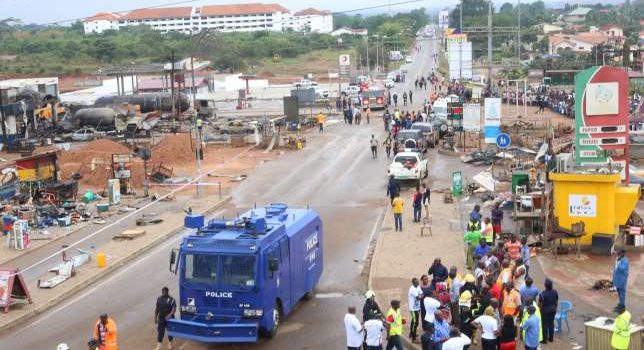
The explosion and fire that occurred at the Liquefied Petroleum Gas (LPG) dispensing station at the Atomic Junction on the night of October 7th, 2017, is another reminder that the Government and the regulators it appoints need to produce a permanent solution to this issue. There have been eight reported gas explosions within the last 3 years. These are eight occurrences too many.

The fact that several of these LPG dispensing stations are sited in close proximity to markets, chop-bars, shops, lorry stations, and residential areas causing residents to complain, means we have a major problem with adherence to our zoning laws. It also means that we should have the strictest of safety standards, and regulate the siting or existence of these dispensing stations, and most importantly, the discharge of gas from tankers into the site storage tanks. It is critical that the industry players adhere to strict safety rules, comply with standard operating procedures, and have both a perfect maintenance culture and adequately trained staff. There must be periodic, routine and unannounced stress testing and drills including evacuation procedures. Clearly, this training must go beyond the staff to others living or operating in close proximity to these dispensing stations.

We must have and enforce rules that treat the tankers that carry the gas for dispensing almost as ‘weaponised trucks’ that must obtain and maintain special permits and pressure gauges that will indicate if there are any leakages at any time during the transport and discharge.

Until these measures are tried, tested, and put in place, OccupyGhana® would recommend the banning of all on-site dispensing of gas. We side with the decision of the National Petroleum Authority to regulate the downstream gas distribution by phasing out refilling of LPG gas at LPG dispensing stations. Thus, instead of having LPG dispensing outlets, all gas cylinders will be filled by cylinder bottling plants for onward distribution to retail outlets.

We know that LPG distributors have met this decision with fierce resistance. However, in the interest of the health and safety of service providers, consumers and the general public, we urge the regulators to put these measures in place and enforce the zonal laws for the siting of fuel and LPG gas stations.

In the meantime, we urge all the regulators- the NPA, EPA, Ghana Atomic Energy Commission, the GNFS, the Ghana Standards Authority- to ensure that strict safety rules are enforced at filling stations especially during discharge.

Yours in the service of God and Country,

OccupyGhana®